
Introduction to AI Conversational Commerce
In 2026, AI Conversational Commerce has become a pivotal force in transforming the way businesses interact with customers. Unlike traditional e-commerce, where the shopping experience is often one-way and static, conversational commerce allows dynamic, real-time communication powered by artificial intelligence. This shift is redefining customer expectations, making interactions more personalized, efficient, and context-aware.
Businesses are increasingly leveraging advanced AI to enhance engagement, reduce friction in transactions, and provide tailored solutions that resonate with individual customers. From answering questions instantly to recommending products intelligently, AI Conversational Commerce is no longer a futuristic concept it is a present-day necessity for brands that aim to stay competitive.
The Role of AI in Modern Commerce
Artificial intelligence plays a central role in powering conversational commerce platforms. Machine learning algorithms analyze user behavior, predict preferences, and even anticipate needs before a customer articulates them. This not only improves the overall user experience but also drives higher conversion rates.
Moreover, technologies like Deep Learning Chatbots allow systems to understand complex queries and respond in a human-like manner. These chatbots can handle multiple queries simultaneously, freeing up human agents for more strategic tasks.
Key Benefits of Conversational Commerce
The advantages of adopting AI Conversational Commerce are multifaceted:
- Enhanced Customer Engagement: AI chatbots interact in real-time, ensuring that customers never wait for a response.
- 24/7 Availability: Unlike traditional support systems, chatbots operate round the clock.
- Personalization: By analyzing previous interactions, AI can provide tailored recommendations.
- Operational Efficiency: Automating repetitive tasks allows businesses to allocate resources more effectively.
Additionally, AI-powered systems can integrate seamlessly with payment gateways, inventory management, and analytics tools, creating a holistic ecosystem for commerce.
Emerging Trends in Conversational Commerce
As AI continues to evolve, new trends are shaping the future of conversational commerce. Multilingual Chatbots are enabling brands to reach global audiences by understanding and responding in multiple languages without losing context. This is crucial for companies aiming to expand internationally.
Another emerging area is the use of AI Chatbots for Accessibility, ensuring that users with disabilities can navigate e-commerce platforms easily. Voice recognition, text-to-speech, and other assistive technologies are increasingly integrated into conversational commerce solutions.
AI Chatbots for Niche Applications
Beyond general e-commerce, AI chatbots are finding use in specialized domains. For instance, AI Chatbots for Stock Analysis can provide investors with real-time insights, monitor market trends, and answer queries regarding financial data. This integration of conversational AI with industry-specific knowledge showcases the versatility and potential of AI Conversational Commerce beyond traditional retail.
Similarly, the combination of AR Quantum Computing and conversational interfaces is beginning to influence tech-driven commerce platforms. Augmented reality allows users to visualize complex products or data, while AI chatbots guide them through interactions in an intuitive way.
Implementing AI Conversational Commerce

Successfully leveraging AI Conversational Commerce requires a strategic approach that balances technology, user experience, and business objectives. Simply deploying a chatbot is not enough; businesses need to design interactions that feel intuitive, helpful, and personalized.
Designing Conversational Experiences
When designing AI-driven chat experiences, the first step is understanding the customer journey. Mapping out key touchpoints helps identify where conversational interfaces can add value. For example, early-stage engagement might involve answering FAQs or guiding users through product catalogs, while later stages could focus on upselling or assisting with checkout.
Integrating Deep Learning Chatbots into these workflows allows the system to learn from user behavior continuously. Over time, the AI can predict user intent more accurately, reducing friction and enhancing satisfaction.
AI Chatbots for Personalized Guidance
One of the most compelling aspects of AI Conversational Commerce is the ability to provide personalized guidance. AI Chatbots for Stock Analysis, for instance, can recommend investment strategies tailored to a user’s portfolio, risk profile, and market trends. Similarly, in retail or e-commerce, chatbots can suggest products based on past purchases, browsing history, or seasonal trends.
Global Reach Through Multilingual Chatbots
Expanding into international markets is simplified with Multilingual Chatbots. By understanding and responding in multiple languages, these chatbots remove communication barriers, making conversational commerce accessible to a broader audience. This capability is crucial for brands targeting diverse demographics and aiming to create a seamless experience across regions.
Accessibility and Inclusivity
Modern conversational commerce is not just about speed or convenience it’s also about inclusivity. Implementing AI Chatbots for Accessibility ensures that users with disabilities can interact effortlessly with platforms. Features such as voice commands, screen-reader compatibility, and adaptive interfaces create an environment where all customers can benefit from AI-driven commerce.
Advanced Technologies in Conversational Commerce
The integration of emerging technologies further enhances AI Conversational Commerce. For instance, AR Autonomous Agents combine augmented reality with AI-driven guidance, allowing users to explore products virtually while receiving real-time suggestions from a conversational interface.
Similarly, AR Quantum Computing is beginning to reshape how data-heavy applications interact with users. By leveraging quantum-enhanced algorithms, platforms can process complex datasets instantly, providing actionable insights and interactive visualizations in a conversational format. This opens doors for industries like finance, tech, and education to integrate AI chatbots in innovative ways.
Measuring Success in Conversational Commerce
To ensure ROI, businesses need to track performance metrics such as engagement rate, conversion rate, average response time, and customer satisfaction. Using analytics dashboards integrated with AI chat systems provides actionable insights, enabling continuous improvement.
By monitoring these metrics, companies can refine chatbot scripts, optimize AI algorithms, and enhance the overall experience. Over time, AI Conversational Commerce transforms from a simple tool into a revenue-driving engine, aligning customer satisfaction with business growth.
Practical Use Cases of AI Conversational Commerce

The real strength of AI Conversational Commerce lies in its practical applications across various industries. Businesses that adopt conversational AI strategically can streamline operations, boost engagement, and drive revenue.
Retail and E-Commerce
In retail, conversational AI is revolutionizing the customer journey. AI chatbots guide shoppers through product discovery, provide personalized recommendations, and assist with purchases. For example, a fashion retailer might implement chatbots that suggest outfits based on user preferences or seasonal trends. Over time, these systems learn from purchase history and browsing patterns, enhancing personalization and increasing conversion rates.
Integration with Deep Learning Chatbots enables a more nuanced understanding of customer intent. These chatbots can handle multi-turn conversations, answer complex queries, and adapt responses in real-time, making the shopping experience feel genuinely interactive and human-like.
Finance and Investment
Financial institutions are increasingly adopting AI Chatbots for Stock Analysis. These chatbots provide real-time market insights, track portfolio performance, and answer user queries on investment strategies. By leveraging conversational AI, firms can offer personalized guidance to clients at scale, increasing trust and engagement while reducing the workload of human advisors.
The ability to analyze large datasets quickly, combined with predictive algorithms, allows chatbots to deliver actionable advice within seconds—an essential feature in fast-paced financial markets.
Global Expansion with Multilingual Chatbots
Businesses looking to expand internationally benefit significantly from Multilingual Chatbots. By supporting multiple languages, brands can communicate effectively with customers across regions without additional human staffing.
These chatbots are particularly useful in hospitality, travel, and e-commerce industries, where language barriers can limit user experience. AI-driven translation and context understanding ensure that customers receive accurate information and a seamless conversational experience.
Enhancing Accessibility
Accessibility remains a critical component of modern commerce. AI Chatbots for Accessibility allow users with disabilities to navigate platforms effortlessly. Features such as voice commands, text-to-speech, and screen-reader compatibility make shopping inclusive for all users, aligning with global standards and regulatory requirements.
By integrating accessibility-focused chatbots, companies not only broaden their customer base but also strengthen their reputation as socially responsible brands.
Advanced AR and Quantum Integrations
Emerging technologies are amplifying the potential of AI Conversational Commerce. For instance, AR Autonomous Agents enable users to interact with products or virtual environments in real time, guided by intelligent conversational systems. This approach is increasingly popular in sectors like real estate, automotive, and high-tech retail, where visualizing products in a real-world context is crucial.
Meanwhile, AR Quantum Computing opens new frontiers in data-intensive applications. By leveraging quantum-enhanced algorithms, businesses can provide interactive, real-time solutions in fields such as finance, logistics, and healthcare. Combining AR visualizations with conversational AI creates immersive and informative experiences for users, establishing a competitive edge in the market.
Enhancing Customer Loyalty
AI-powered conversational systems play a key role in fostering long-term customer relationships. By providing instant assistance, tailored recommendations, and proactive engagement, AI Conversational Commerce encourages repeat purchases and builds trust.
For example, loyalty programs can be seamlessly integrated into chatbots, allowing users to track points, redeem rewards, and receive personalized offers—all within a single conversational interface. Over time, this level of convenience and personalization strengthens brand loyalty and drives higher lifetime value.
Future-Proofing Businesses
Adopting AI Conversational Commerce positions businesses for the future. With continuous improvements in machine learning, natural language processing, and integration with emerging technologies, conversational AI is evolving rapidly. Early adopters can gain a significant competitive advantage by delivering exceptional user experiences and innovative services before competitors catch up.
Step-by-Step Implementation of AI Conversational Commerce
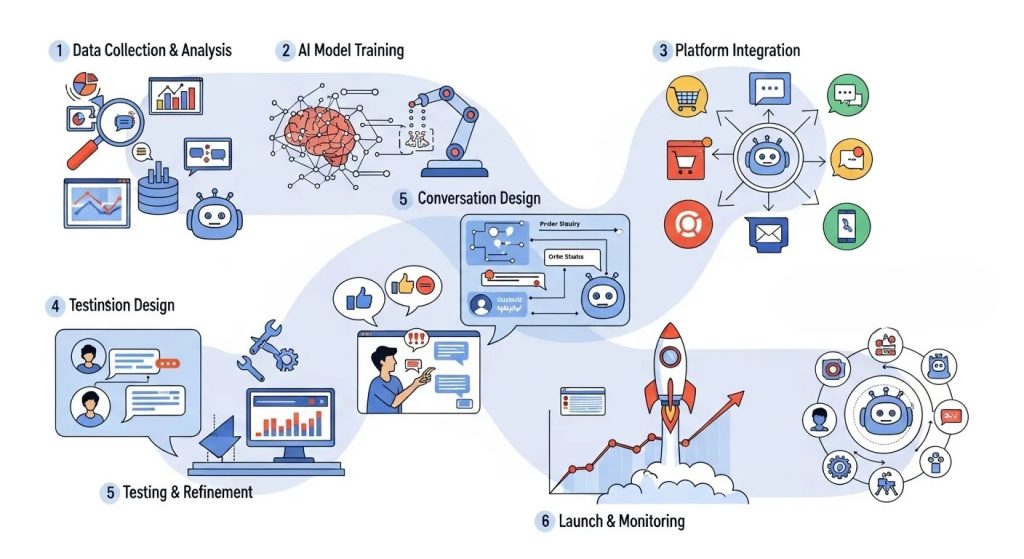
Implementing AI Conversational Commerce effectively requires a structured approach. Businesses that follow a well-defined roadmap can maximize ROI, enhance customer experience, and minimize operational friction.
Step 1: Define Objectives
Before deploying chatbots, businesses must clarify their goals. Are you aiming to increase sales, improve customer support, or gather insights about user behavior? Clearly defined objectives guide the AI strategy and determine which tools and platforms to use.
Step 2: Map Customer Journeys
Understanding customer touchpoints is critical for designing effective conversational experiences. Map the entire journey from initial discovery to post-purchase support—and identify where chatbots can add value. For example, a chatbot could assist during product selection, provide information about shipping, or recommend complementary products.
Integrating Deep Learning Chatbots ensures the system can handle complex interactions across multiple stages of the journey, providing responses that feel natural and intelligent.
Step 3: Choose the Right Platform
Selecting the appropriate AI platform is essential. Platforms that offer natural language processing, machine learning integration, and analytics capabilities enable more personalized and scalable experiences.
Step 4: Design Conversational Flows
Effective conversational flows are intuitive, adaptive, and user-friendly. Use branching logic to handle multiple scenarios, including FAQs, product inquiries, and issue resolution. Incorporating AI Chatbots for Stock Analysis in financial applications or Multilingual Chatbots for global audiences can enhance functionality without overwhelming users.
Step 5: Test and Optimize
Continuous testing is crucial for conversational commerce success. Monitor interactions, track metrics such as response accuracy, engagement rate, and conversion rate, and adjust scripts and AI models accordingly. Regular updates ensure that chatbots remain effective, accurate, and aligned with evolving customer needs.
Step 6: Monitor Analytics and Feedback
Data-driven optimization is the backbone of successful AI Conversational Commerce. Integrate analytics dashboards to monitor performance, track user satisfaction, and gather actionable insights. Feedback loops allow businesses to refine AI models, improve conversation quality, and enhance personalization.
Best Practices for Chatbot Design

Designing chatbots that resonate with users requires a balance of technology and psychology. Here are key best practices:
Personalization
Tailor interactions based on user behavior, preferences, and history. Personalized suggestions improve engagement and drive conversions, reinforcing the value of AI Conversational Commerce.
Accessibility
Ensure chatbots are inclusive. Implement features such as voice commands, text-to-speech, and compatibility with screen readers. Leveraging AI Chatbots for Accessibility ensures all users can interact seamlessly.
Multilingual Capabilities
Global brands should support multiple languages. Multilingual Chatbots can handle diverse customer queries without miscommunication, expanding the reach of conversational commerce.
Integration with Emerging Tech
Combining chatbots with AR or quantum computing technologies can create immersive experiences. AR Autonomous Agents provide real-time guidance in virtual environments, while AR Quantum Computing allows instant processing of complex datasets, making interactions smarter and more interactive.
User-Centric Design
Keep interactions simple, intuitive, and human-like. Avoid overly technical language, ensure quick responses, and use conversational tones to make the AI approachable.
Future Trends in AI Conversational Commerce
The landscape of AI Conversational Commerce is constantly evolving. Businesses that stay ahead of trends can maintain a competitive edge.
- Voice Commerce: Conversational AI is expanding into voice-enabled devices, allowing customers to shop hands-free.
- Predictive Analytics: AI will increasingly anticipate user needs, providing suggestions before customers even ask.
- Emotional AI: Future chatbots may detect user sentiment and adapt responses accordingly, enhancing engagement.
- Cross-Platform Integration: AI chatbots will seamlessly operate across websites, apps, messaging platforms, and social media, providing a consistent user experience.
By adopting these emerging trends, brands can future-proof their conversational commerce strategies while delivering innovative, customer-centric experiences.
Advanced Analytics in AI Conversational Commerce

One of the most significant advantages of AI Conversational Commerce is its ability to generate actionable insights through advanced analytics. By tracking user interactions, businesses can understand customer preferences, identify pain points, and optimize the overall shopping experience.
AI systems collect data on response times, query types, engagement rates, and conversions. These insights enable businesses to refine conversational flows, personalize recommendations, and enhance operational efficiency. For example, if a pattern emerges where users frequently abandon the checkout process, AI-driven analysis can identify the cause and suggest targeted solutions.
Predictive Analytics and AI Chatbots
Predictive analytics enhances AI Conversational Commerce by anticipating user needs. Using machine learning algorithms, platforms can predict likely purchases, suggest complementary products, or provide timely notifications.
In financial services, AI Chatbots for Stock Analysis utilize predictive models to forecast market movements and guide investors. By analyzing historical trends and current market data, these chatbots can offer personalized advice in real-time, increasing user engagement and trust.
Measuring ROI and Conversion Impact
To justify investments in AI Conversational Commerce, businesses must monitor ROI closely. Key metrics include:
- Conversion rates from chatbot interactions
- Average order value
- Customer retention and repeat purchase rates
- Response time and resolution effectiveness
Using these metrics, businesses can quantify the impact of conversational AI on revenue and efficiency. Over time, improvements in personalization, predictive recommendations, and engagement strategies further enhance ROI.
Industry-Specific Applications
AI Conversational Commerce is not limited to retail. Its applications span multiple industries:
- Healthcare: AI chatbots can provide appointment scheduling, medication reminders, and patient guidance.
- Finance: Chatbots analyze stock trends, assist with portfolio management, and answer investor queries using AI Chatbots for Stock Analysis.
- Education: Conversational AI can serve as virtual tutors, providing real-time feedback and support.
- Global Brands: Implementing Multilingual Chatbots ensures customers in different regions can interact naturally, expanding the market reach.
Enhancing Customer Loyalty and Retention
Loyalty programs integrated with AI Conversational Commerce can dramatically improve customer retention. Chatbots can notify users about rewards, track points, and suggest personalized promotions. By keeping interactions seamless and personalized, businesses build long-term relationships with their customers.
The Role of Emerging Technologies
Integrating emerging technologies makes AI Conversational Commerce even more powerful:
- AR Autonomous Agents allow interactive guidance in real-world or virtual spaces, providing immersive product demos or navigational help.
- AR Quantum Computing enables instant processing of massive datasets, giving users real-time insights and recommendations.
- Deep Learning Chatbots continue to refine understanding of complex queries, making conversations more natural and human-like.
Case Study Example
Consider a global e-commerce company that integrated AI Conversational Commerce with AR tools and predictive analytics. The company implemented Multilingual Chatbots to engage international users, while AI Chatbots for Accessibility ensured inclusive interactions. Over six months, conversion rates increased by 25%, average order value rose by 18%, and overall engagement doubled.
This example highlights the potential of AI Conversational Commerce when strategically deployed, integrating advanced analytics, accessibility, and cutting-edge technology for measurable results.
Conclusion
AI Conversational Commerce is no longer a futuristic concept it has become a core strategy for businesses seeking to enhance customer engagement, streamline operations, and drive revenue in 2026. By leveraging advanced technologies such as Deep Learning Chatbots, AR Autonomous Agents, and AR Quantum Computing, companies can create intelligent, personalized, and immersive shopping experiences.
Integrating AI Chatbots for Stock Analysis, Multilingual Chatbots, and AI Chatbots for Accessibility ensures that these experiences are not only effective but also inclusive, global, and adaptable to various industries. From retail and finance to healthcare and education, AI Conversational Commerce provides measurable benefits in customer satisfaction, conversion rates, and operational efficiency.
Frequently Asked Questions (FAQ)
What is AI Conversational Commerce?
AI Conversational Commerce refers to the use of artificial intelligence, such as chatbots and virtual assistants, to facilitate real-time, personalized interactions with customers, enhancing shopping experiences and driving sales.
How do AI Chatbots improve customer engagement?
AI chatbots can answer queries instantly, provide personalized product recommendations, guide users through transactions, and operate 24/7. Tools like Deep Learning Chatbots make conversations natural and adaptive.
Can AI Conversational Commerce work globally?
Yes. Multilingual Chatbots allow businesses to interact with customers across regions in multiple languages, breaking language barriers and expanding market reach.
How does AI Conversational Commerce enhance accessibility?
AI Chatbots for Accessibility ensure that users with disabilities can navigate platforms easily. Features like voice commands, text-to-speech, and screen-reader compatibility make interactions inclusive.
What industries benefit most from AI Conversational Commerce?
Industries such as retail, finance, healthcare, education, and technology leverage AI Conversational Commerce for improved customer service, personalized guidance, and predictive analytics like AI Chatbots for Stock Analysis.
How do AR and emerging technologies integrate with AI Conversational Commerce?
Technologies like AR Autonomous Agents provide interactive guidance, while AR Quantum Computing enables fast processing of complex data. Combined with AI chatbots, these innovations create immersive, intelligent experiences.
Is AI Conversational Commerce worth the investment?
Yes. Businesses implementing AI-driven conversational systems can increase conversions, improve customer loyalty, and optimize operations, making it a valuable investment for long-term growth.