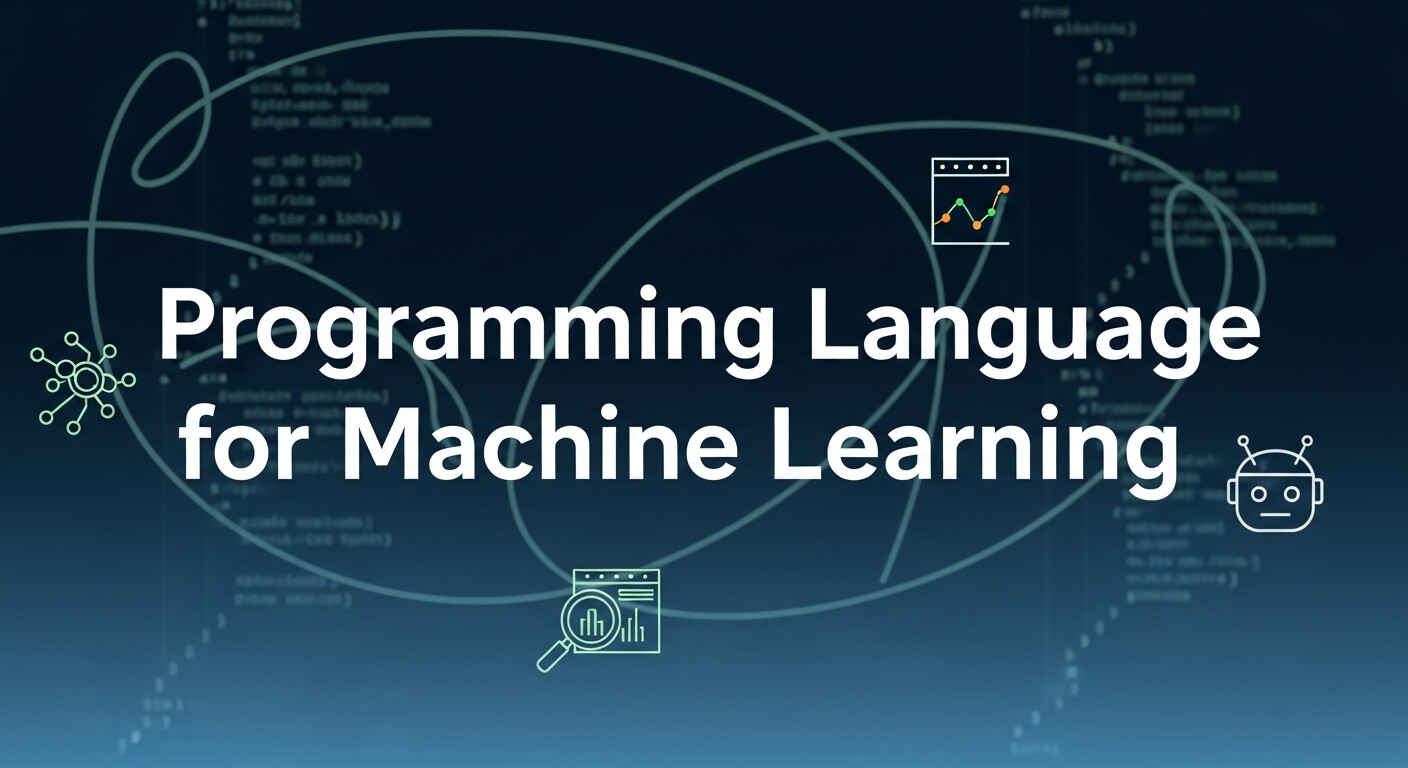
Machine Learning (ML) has become a motivating force in many industries. From predicting customers’ behavior to revolution in the health care system, ML provides strength to a new wave of innovation. But with so many programming languages to choose, how do you determine the best for machine learning projects? This post will guide you through top competitors, their strengths and how to choose the right language for your needs.
Why Choosing the Right Language Matters for Machine Learning

Your choice of programming language can make or break the efficiency and scalability of your machine learning project. The right language simplifies the development process, offers robust libraries and frameworks, and ensures better integration with diverse tools. Before making a decision, it’s essential to consider factors such as project requirements, team expertise, and application goals.
Top Programming Languages for Machine Learning
Let’s break down the top programming languages for machine learning, exploring their features, strengths, and most common use cases.
Python The Dominant Leader in Machine Learning
Python is the undisputed favorite when it comes to machine learning. Its simplicity and readability make it accessible to beginners and experts alike. More importantly, Python offers an extensive ecosystem of libraries and frameworks explicitly tailored for data science and machine learning.
Popular Libraries:
- TensorFlow and PyTorch for creating deep learning models.
- scikit-learn for traditional machine learning algorithms.
- Pandas for data manipulation.
- NumPy for numerical computation.
Key Advantages:
- Vast Community Support: Numerous tutorials, forums, and communities make problem-solving easier.
- Interoperability: Python integrates seamlessly with other programming languages and tools.
- AI-specific Libraries: Libraries like Keras and OpenCV make AI application development more accessible.
Ideal For:
- Deep learning and neural networks.
- Prototyping and experimentation.
- Large-scale ML projects require thorough library support.
R The Statistician’s Machine Learning Toolkit
While Python is famous for its flexibility, R shines in statistics and data visualization. Designed with statisticians in mind, R is especially effective for data cleansing, graphical representation, and analysis.
Popular Libraries:
- caret for building various ML models quickly.
- ggplot2 for elegant visualizations.
- randomForest for ensemble learning.
Key Advantages:
- Tailored for advanced analytics and statistical operations.
- Excels in producing compelling visualizations.
- Ideal for projects that emphasize exploratory data analysis (EDA).
Ideal For:
- Statistical modeling and hypothesis testing.
- Projects requiring great visuals and reports.
- Smaller-scale machine learning tasks.
Java Versatility and Scalability
Java is a widely used programming language with a strong foothold in enterprise applications. Its “write once, run anywhere” philosophy ensures it’s platform-independent and highly versatile. While not as specialized for ML as Python or R, its robust performance and scalability make it a strong choice for large-scale implementations.
Popular Frameworks:
- Weka for traditional machine learning.
- MLlib for distributed machine learning on Apache Spark.
- Deeplearning4j for deep learning and predictive models.
Key Advantages:
- Strong performance in distributed and large-scale systems.
- Compatible with enterprise applications.
- Well-suited for building real-time systems.
Ideal For:
- Enterprise-grade ML applications.
- High-performance, production-level systems.
- Combining ML functionality with legacy systems.
Julia Optimized for Speed and Performance
Julia is often viewed as the underdog capable of rivaling the giants like Python and R. Built explicitly for numerical computing, Julia is inherently faster due to its just-in-time (JIT) compiler. This makes it ideal for ML applications requiring heavy mathematical computations.
Popular Libraries:
- MLJ.jl for machine learning functions.
- Flux.jl for deep learning.
- DataFrames.jl for data manipulation.
Key Advantages:
- Offers Python-like simplicity with C-level performance.
- Well-suited for working with large datasets.
- Seamless integration with existing Python or R workflows.
Ideal For:
- High-performance numeric calculations.
- Computational-heavy tasks, like simulations.
- Innovations that push the boundaries of ML.
JavaScript Machine Learning for the Web
JavaScript, primarily known for web development, is also making waves in the ML world, especially for browser-based projects. Thanks to libraries like TensorFlow.js, developers can run ML models directly in a web browser, opening the door for dynamic, client-side applications.
Popular Libraries:
- TensorFlow.js for deep learning in the browser.
- Brain.js for creating neural networks.
- Synaptic.js for simple neural network architectures.
Key Advantages:
- Native support for web development projects.
- Minimal overhead as everything operates on the client-side.
- Easy integration for real-time user-facing ML experiences.
Ideal For:
- Web-based ML applications.
- Developers aiming to integrate ML into websites.
- Lightweight, interactive use cases.
C++ Maximum Performance and Control
Although not as beginner-friendly as other languages, C++ offers unmatched control over system resources. It’s often the go-to choice for performance-critical applications like real-time image processing and game AI.
Popular Frameworks:
- MLpack for simple C++ machine learning.
- SHARK Library for fast computation.
- Dlib for machine learning and image processing.
Key Advantages:
- High-speed performance due to its compiled nature.
- Grants fine-tuned control over CPU and memory usage.
- Suitable for embedded systems and low-level computing.
Ideal For:
- Applications requiring real-time performance.
- Embedded systems or edge computing projects.
- Projects demanding maximum system control.
Machine Learning in Conversational Interfaces

Machine learning plays a crucial role in modern conversational systems by enabling applications to understand intent, context, and user preferences. These systems improve over time by learning from interactions and adjusting responses accordingly. Businesses use ML-powered conversational tools to automate customer support, assist with onboarding, and provide real-time assistance. Advanced models can analyze user behavior patterns to deliver more relevant replies and recommendations. Through effective chatbot personalization strategies, conversations feel more natural and human-like, increasing user satisfaction. As datasets grow, these systems become more accurate, reducing manual intervention while improving efficiency. Machine learning continues to refine how conversational interfaces respond, adapt, and scale across industries.
Machine Learning for Customer Engagement

Customer engagement has evolved significantly with the integration of machine learning technologies. ML models can analyze customer data such as browsing behavior, purchase history, and interaction patterns to predict user needs. This allows businesses to deliver targeted messages and offers at the right time. AI-driven chatbot marketing helps brands maintain consistent communication while reducing operational costs. These intelligent systems can guide users through sales funnels, answer product-related questions, and provide personalized recommendations. Over time, continuous learning enables better engagement strategies, increasing conversion rates and customer retention. Machine learning ensures that customer interactions remain relevant, timely, and scalable across multiple digital channels.
Automation and Efficiency Through ML
One of the biggest advantages of machine learning is its ability to automate repetitive and time-consuming tasks. From data classification to predictive analysis, ML systems can handle complex workflows with minimal human input. Automation powered by ML improves operational efficiency and reduces errors. In business environments, automated decision-making systems help optimize pricing, inventory management, and customer service processes. As models learn from historical data, they continuously improve accuracy and performance. This allows organizations to focus on strategic initiatives rather than routine tasks. Machine learning-driven automation is becoming essential for businesses aiming to scale operations while maintaining high levels of accuracy and consistency.
Machine Learning in Social Media Interactions

Social media platforms generate massive amounts of data daily, making them ideal environments for machine learning applications. ML algorithms analyze user behavior, content performance, and engagement metrics to optimize interactions. Social media chatbots are increasingly used to respond to inquiries, manage comments, and guide users through services directly within platforms. These bots learn from conversations, improving response quality over time. Machine learning also helps detect sentiment, identify trends, and recommend content tailored to user interests. By leveraging ML, businesses can maintain active social media presence, improve response times, and enhance user experiences across multiple platforms efficiently.
Data-Driven Decision Making with ML
Machine learning enables organizations to make smarter decisions by uncovering insights hidden in large datasets. Instead of relying on assumptions, ML models analyze patterns and trends to support evidence-based strategies. This approach is particularly useful in marketing, finance, healthcare, and logistics. Predictive models help forecast demand, assess risks, and optimize resources. As new data is introduced, machine learning systems adapt and refine their predictions. Data-driven decision-making powered by ML reduces uncertainty and improves outcomes. Organizations that effectively leverage machine learning gain a competitive edge by responding faster and more accurately to changing market conditions.
Scalability and Performance in ML Systems
Scalability is a critical consideration when deploying machine learning solutions. As data volumes and user bases grow, ML systems must handle increased workloads without performance degradation. Modern ML frameworks support distributed computing, allowing models to scale efficiently across cloud environments. Proper optimization ensures faster training times and real-time inference capabilities. Scalable ML systems are essential for applications like recommendation engines, fraud detection, and real-time analytics. By designing models with scalability in mind, organizations can future-proof their solutions. Performance optimization combined with scalable architecture ensures that machine learning applications remain reliable and efficient as demands increase.
Ethical Considerations in Machine Learning
As machine learning systems become more powerful and widely adopted, ethical considerations are increasingly important. ML models often rely on large datasets, which can contain biases related to gender, race, or socioeconomic background. If not addressed, these biases may lead to unfair or harmful outcomes. Transparency is another challenge, as complex models can act like “black boxes,” making decisions difficult to explain. Privacy is also a major concern, especially when handling sensitive user data. Developers and organizations must ensure responsible data collection, model fairness, and compliance with regulations. By prioritizing ethics alongside performance, machine learning can be developed in a way that is trustworthy, inclusive, and beneficial for society as a whole.
Factors to Consider When Choosing a Language
While the languages above excel in various ML scenarios, your choice ultimately depends on the nuances of your project. Here are key factors to consider:
- Technical Expertise: Are you or your team already familiar with any language?
- Project Requirements: Does your project focus on user-centric graphs (R), deploying deep learning frameworks (Python), or both?
- Application Scale: For small prototypes, Python may suffice. For large, production-level systems, consider Java or C++.
- Community and Resources: Larger ecosystems like Python offer more learning resources.
- Learning Curve: If you’re just starting, Python’s simplicity is unmatched.
Final Thoughts on Programming Languages for Machine Learning
The best programming language for machine learning varies depending on individual requirements. Python retains the title of the simplest and most flexible choice. However, languages such as R, Julia and even JavaScript provide compelling benefits for cases of special use.
Finally, the most important thing is to start. Machine learning requires an obligation for experimentation, relapse and continuous learning. Choose the language that match your current skills and project goals, and grow from there.
For people who are eager to detect ML without learning condition, see modern low-cod machine learning platforms. These devices unlock many opportunities for ML, and remove some complications.
Now the exciting world of machine learning is your turn to detect, create and innovate a coding line at a time.
Frequently Asked Questions (FAQ) – Programming Languages for Machine Learning
1. Which programming language is best for machine learning beginners?
Python is widely considered the best language for beginners in machine learning. Its simple syntax, extensive documentation, and vast ecosystem of ML libraries make it easy to learn and apply quickly.
2. Why is Python so popular for machine learning?
Python’s popularity comes from its powerful libraries like TensorFlow, PyTorch, and scikit-learn, along with strong community support. It allows fast prototyping, easy experimentation, and smooth integration with data science tools.
3. Is R better than Python for machine learning?
R is excellent for statistical analysis, data visualization, and exploratory data analysis. However, Python is generally more versatile and better suited for end-to-end machine learning applications and production systems.
4. Can Java be used for machine learning projects?
Yes. Java is commonly used in enterprise-level machine learning systems where scalability, performance, and integration with existing applications are important. Frameworks like Weka and Deeplearning4j support ML development in Java.
5. What makes Julia suitable for machine learning?
Julia is designed for high-performance numerical computing. It combines ease of use with speed, making it ideal for computation-heavy machine learning tasks and advanced mathematical modeling.
6. Is JavaScript a good choice for machine learning?
JavaScript is well-suited for web-based machine learning applications, especially when models need to run in the browser. Libraries like TensorFlow.js allow developers to create interactive ML experiences without server-side processing.
7. When should I choose C++ for machine learning?
C++ is best for performance-critical applications such as real-time systems, embedded devices, or game AI. It offers fine control over hardware resources but has a steeper learning curve.
8. Do I need to learn multiple languages for machine learning?
Not necessarily. Many developers start with Python and expand later if project requirements demand it. Learning additional languages can be helpful but isn’t mandatory for success.
9. How important are libraries and frameworks in choosing a language?
They are extremely important. Strong libraries reduce development time, simplify complex tasks, and provide tested implementations of algorithms, making your ML projects more reliable and scalable.
10. Are low-code or no-code ML platforms a good alternative?
Yes, especially for beginners or non-programmers. Low-code platforms allow users to build ML models without deep coding knowledge, though they may lack flexibility for advanced or custom use cases.