Voice Enabled Chatbots enhance customer experience, streamline interactions, and drive engagement. With AI, AR integration, and multilingual capabilities, businesses can deliver personalized, immersive, and efficient solutions, making them a vital tool for modern digital strategies.
Introduction The Rise of Voice Enabled Chatbots
In today’s digital-first world, businesses are looking for smarter ways to interact with customers, streamline operations, and improve engagement. Voice Enabled Chatbots have emerged as a revolutionary tool, bridging the gap between human-like conversation and automated efficiency. Unlike traditional text-based bots, these chatbots understand natural speech patterns, respond in real time, and create a seamless, hands-free experience for users.
The transformative potential of Voice Enabled Chatbots goes beyond simple Q&A interactions. They are designed to handle complex tasks such as booking services, answering queries, or even guiding customers through product selections. By integrating AI-driven features, businesses can ensure that each interaction feels personalized and responsive, enhancing overall customer satisfaction.
Moreover, Voice Enabled Chatbots are increasingly being equipped with capabilities that allow them to operate across multiple languages, adapting to diverse user bases without compromising communication quality. This makes them particularly valuable for global businesses seeking consistent customer experiences.
How Voice Enabled Chatbots Transform Customer Experience
Voice Enabled Chatbots are changing how companies interact with their audience. Traditional support channels often require long wait times and multiple touchpoints, but voice bots provide immediate responses, reducing friction and improving engagement.
One major advantage is their ability to interpret intent more accurately than conventional bots. By analyzing tone, phrasing, and context, these systems can deliver more nuanced answers. For example, AI Multilingual Bots allow international users to engage naturally in their preferred language, removing barriers that previously limited customer satisfaction.
Another area of impact is in sales. AI Sales Bots embedded in websites or apps can guide users through products, answer questions about features, and even complete transactions without human intervention. This not only increases conversion rates but also frees up human teams for more strategic tasks.
Key Features of Voice Enabled Chatbots
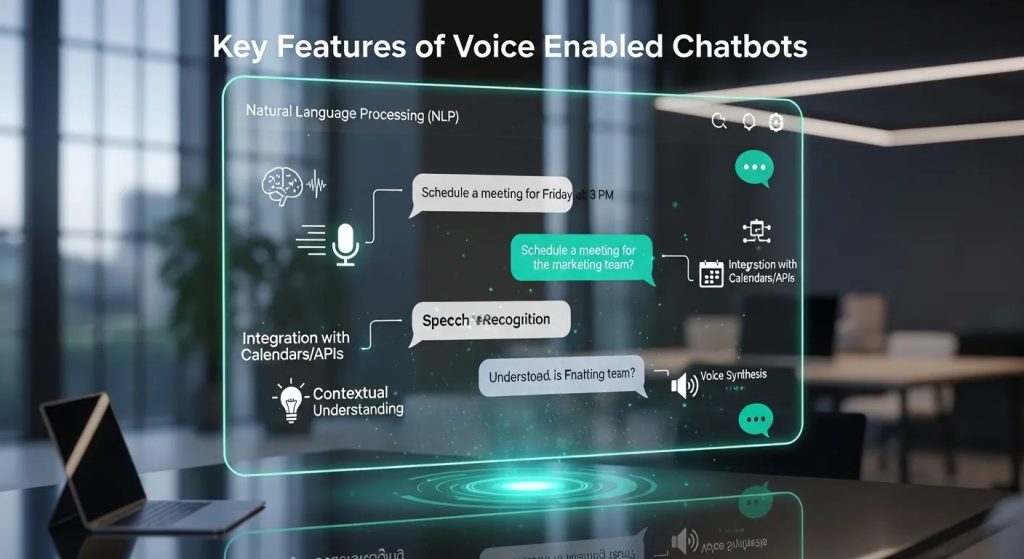
Voice Enabled Chatbots are not all created equal. Some of the standout features include:
Real-Time Speech Recognition
Advanced bots utilize AI-powered voice recognition technology to process natural speech instantly. This ensures that users don’t have to adjust their language or repeat themselves, creating a smoother interaction.
Interactive and Engaging Interfaces
By incorporating a Chatbot Interactive Touch, businesses can make conversations more dynamic and less robotic. Users can navigate through options, receive suggestions, or even play mini-interactive elements that enrich the experience.
AI Multilingual Capabilities
For businesses operating globally, AI Multilingual Bots allow seamless interaction in different languages. This is crucial in markets where customer support in the native language enhances trust and satisfaction.
Sales and Conversion Optimization
Voice bots embedded with AI Sales Bots capabilities provide proactive suggestions, upsell opportunities, and guided purchasing journeys. These intelligent prompts are subtle yet effective in increasing revenue.
Integration with AR Technologies
Some advanced voice chatbots are now pairing with AI Powered AR Vision and AR Facial Tracking to deliver immersive experiences. For instance, customers can try virtual products, receive visual demonstrations, or navigate AR interfaces—all guided by a voice bot.
Use Cases of Voice Enabled Chatbots
Voice Enabled Chatbots have found applications across industries. Below is a table summarizing key sectors and benefits:
| Industry | Use Case | Benefits |
|---|---|---|
| Retail | Guiding online shopping, upselling products | Increased sales, personalized shopping |
| Healthcare | Appointment booking, patient queries | Reduced waiting times, improved care |
| Finance | Account inquiries, fraud alerts | Enhanced security, real-time support |
| Hospitality | Reservation management, travel guidance | Better customer experience, reduced errors |
| Tech Support | Troubleshooting devices, software guidance | Faster resolutions, reduced human workload |
In all these cases, the presence of Voice Enabled Chatbots ensures a consistent, reliable, and engaging user experience while also allowing companies to maintain operational efficiency.
Addressing Security and Privacy in Voice Enabled Chatbots
While Voice Enabled Chatbots offer numerous benefits, ensuring user trust is critical. Companies must prioritize Bot Data Privacy by encrypting sensitive interactions, adhering to regulatory standards, and being transparent about data usage. Customers are more likely to adopt and trust voice-based systems if they feel their information is protected.
Privacy concerns often act as a barrier to adoption, especially in sectors like healthcare and finance. By implementing robust security protocols, businesses not only protect users but also enhance credibility and long-term engagement.
Advanced Technical Features of Voice Enabled Chatbots
Modern Voice Enabled Chatbots are far more than simple voice response systems. Their sophistication lies in combining AI, machine learning, and natural language processing to create highly intuitive user experiences. One notable feature is context retention, where the chatbot remembers past interactions and uses that information to deliver personalized guidance. This ensures conversations are coherent, relevant, and feel naturally human.
Another advancement is the integration of AI-Powered AR Vision into voice chatbot interfaces. By combining voice commands with augmented reality visuals, users can interact with digital objects in a real-world environment. For example, a customer shopping for furniture can ask the voice bot to show how a sofa fits in their living room using AR, creating an interactive, immersive experience.
The ability to handle complex queries across multiple languages is another critical innovation. AI Multilingual Bots allow companies to support a global customer base without language barriers. These bots detect the user’s language and adapt responses accordingly, making communication seamless and intuitive.
Additionally, intelligent voice bots now incorporate predictive analytics. By analyzing user behavior patterns, chatbots can anticipate needs, suggest relevant products, or provide reminders before the customer even asks. This level of proactivity enhances satisfaction and fosters trust.
Enhancing Engagement with Interactive Touch

A key factor in Voice Enabled Chatbots’ success is the incorporation of Chatbot Interactive Touch. Traditional chatbots often feel transactional and impersonal, but interactive elements change the game. Users can navigate menus, choose options, or trigger different conversational pathways, creating a dynamic, engaging environment.
For businesses, this interactivity translates into higher retention and more meaningful engagements. For example, an e-commerce platform using a voice bot can guide a user through a selection of products based on preferences expressed verbally, while subtly recommending complementary items, thereby increasing conversion rates.
In educational platforms, interactive touch allows students to ask questions and receive instant, contextually accurate explanations, making learning more accessible and efficient. Voice Enabled Chatbots equipped with such interactive capabilities are not just tools—they become digital assistants enhancing productivity, learning, and decision-making.
AI Sales Bots and Revenue Growth
Voice Enabled Chatbots integrated with AI Sales Bots provide businesses with a proactive sales tool that operates 24/7. These bots can engage potential buyers, answer detailed product queries, and guide them toward completing purchases without human intervention.
The strength of AI Sales Bots lies in personalization. By analyzing previous interactions, purchase history, and browsing behavior, the bot can offer suggestions tailored to individual preferences. This enhances the shopping experience, increases customer satisfaction, and boosts overall revenue.
Moreover, integrating AI Sales Bots with voice interfaces allows for hands-free interaction, a crucial advantage for mobile users. Customers can ask questions while cooking, driving, or multitasking, creating a convenient and seamless shopping experience that traditional web or text-based systems cannot match.
Voice Enabled Chatbots and AR Integration
The fusion of voice technology and augmented reality is opening new frontiers in customer engagement. Voice commands combined with AR Facial Tracking allow businesses to deliver experiences that are personalized and highly interactive. For instance, a cosmetic brand can let users virtually try makeup through AR, guided entirely by a voice chatbot that provides tips, product suggestions, and real-time feedback.
Similarly, retail environments can implement AI-Powered AR Vision to help users navigate stores, explore product options, and visualize complex items before purchase—all controlled by simple voice instructions. This integration not only enhances engagement but also reduces hesitation in buying decisions, leading to higher conversion rates.
By leveraging these advanced features, businesses position themselves at the forefront of innovation, offering customers experiences that are memorable, efficient, and enjoyable.
Voice Enabled Chatbots Across Industries
Voice Enabled Chatbots have practical applications in almost every sector. Their versatility makes them a vital tool for improving operational efficiency and enhancing customer satisfaction.
- Healthcare: Voice bots assist in scheduling appointments, providing reminders, and answering common medical queries. Their ability to interact naturally reduces administrative burdens and ensures patients receive timely support.
- Finance: Bots can handle account inquiries, transaction verifications, and fraud alerts, combining convenience with security. Emphasis on Bot Data Privacy ensures users feel safe sharing sensitive information.
- Retail and E-commerce: AI Sales Bots guide customers through products, while AR and voice integration allow virtual try-ons and interactive product demonstrations.
- Education: Students benefit from interactive, voice-guided learning sessions, especially with multilingual support through AI Multilingual Bots.
- Hospitality and Travel: Voice bots streamline bookings, answer questions about amenities, and guide users through interactive travel experiences enhanced with AR.
This cross-industry utility demonstrates that Voice Enabled Chatbots are not just a trend—they are becoming an essential part of digital transformation strategies.
Best Practices for Implementing Voice Enabled Chatbots
Implementing Voice Enabled Chatbots effectively requires a clear strategy that aligns with business objectives and customer expectations. One of the first steps is understanding user intent. By analyzing common questions, pain points, and interaction patterns, businesses can design conversational flows that feel natural and efficient.
Ensuring Bot Data Privacy is crucial from the outset. Users must trust that their voice interactions and personal information are secure. Encryption, secure data storage, and transparent privacy policies all contribute to building this trust, which directly impacts adoption and engagement rates.
It’s also important to incorporate Chatbot Interactive Touch elements where appropriate. Simple yes/no questions can be supplemented with menu options or guided choices, allowing users to navigate complex processes easily. This interactivity reduces friction and keeps the user engaged, making conversations more productive and satisfying.
Testing is another critical factor. Businesses should conduct rigorous trial runs, monitoring how the chatbot responds to different accents, speech speeds, and languages. Integrating AI Multilingual Bots ensures that global audiences can interact seamlessly without barriers, significantly improving satisfaction and adoption.
Finally, combining Voice Enabled Chatbots with backend systems such as CRM or e-commerce platforms allows real-time data utilization. This means that AI Sales Bots can access customer history, preferences, and purchase patterns, resulting in smarter recommendations and higher conversion rates.
Measuring Performance and ROI of Voice Enabled Chatbots
To ensure the success of Voice Enabled Chatbots, businesses must track and analyze performance metrics. Key performance indicators include response accuracy, resolution time, engagement rates, and user satisfaction scores. Monitoring these metrics helps identify gaps and improve conversational flows continuously.
Integration of AI-Powered AR Vision can also be tracked for engagement effectiveness. For example, in retail, measuring how many users utilize AR features guided by the voice bot provides insights into usability and customer interest. Similarly, AR Facial Tracking can inform businesses about how users interact with AR-enabled experiences, helping refine interfaces and increase adoption.
Revenue metrics are particularly important when using AI Sales Bots. Tracking conversion rates, upsells, and average order value attributed to voice interactions helps quantify the ROI of chatbots. Over time, data-driven adjustments to conversational scripts and recommendations can further optimize revenue generation.
Equally critical is monitoring user feedback. Collecting ratings, comments, and behavior patterns after each session can reveal subtle areas for improvement, ensuring that Voice Enabled Chatbots evolve in response to real user needs.
Common Challenges in Voice Enabled Chatbot Adoption
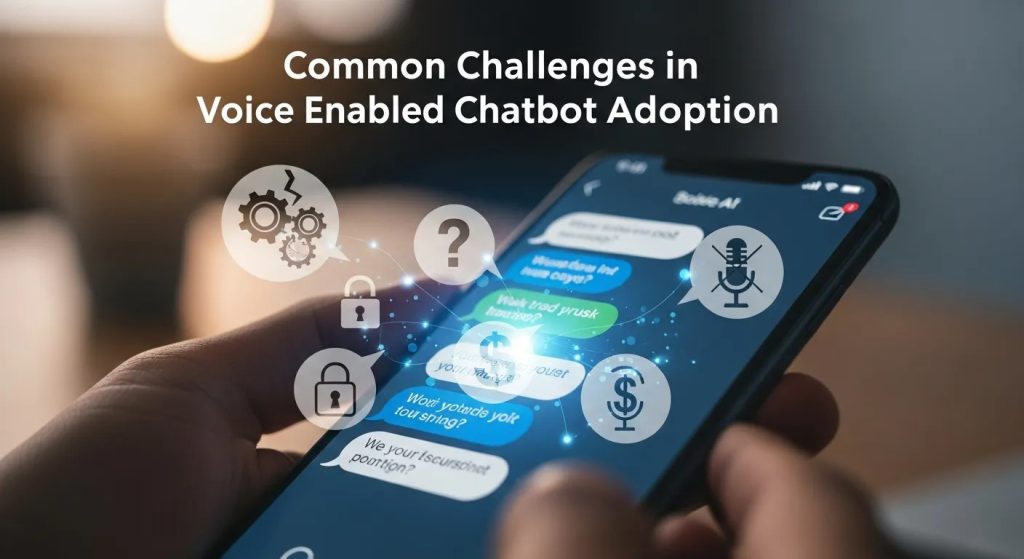
While Voice Enabled Chatbots offer immense benefits, businesses may encounter challenges during implementation.
1. Speech Recognition Accuracy: Not all accents, dialects, or speech patterns are recognized equally. Training the system with diverse datasets is essential to ensure broad accessibility.
2. Privacy Concerns: Some users are hesitant to interact with voice systems due to fear of data misuse. Transparent privacy policies and secure Bot Data Privacy measures can address these concerns.
3. Integration Complexity: Combining voice bots with existing CRMs, e-commerce platforms, or AR systems like AI-Powered AR Vision can be technically challenging. Planning and phased integration help reduce disruptions.
4. Maintaining Engagement: Without proper Chatbot Interactive Touch, conversations may feel linear and robotic. Interactive pathways, prompts, and optional features keep users engaged.
5. Multilingual Support: Expanding globally requires AI Multilingual Bots capable of understanding and responding accurately in multiple languages. This requires continual updates and testing to maintain quality.
By proactively addressing these challenges, businesses can maximize the effectiveness and adoption of Voice Enabled Chatbots.
Enhancing Customer Experiences with Advanced Features
Voice Enabled Chatbots are evolving into more than just support tools they are becoming full-fledged experience platforms.
One exciting trend is the integration of AI Sales Bots with predictive analytics. These bots can suggest products based on purchase history, browsing behavior, or even real-time interactions. By anticipating user needs, businesses create a more intuitive shopping experience, increasing satisfaction and revenue.
AR Facial Tracking is another innovation enhancing personalization. For example, cosmetic or fashion brands can offer virtual try-ons guided by a voice bot, analyzing facial features to recommend products accurately. Coupled with AI-Powered AR Vision, these interactions blend digital and physical experiences, making engagement immersive and memorable.
Additionally, the seamless inclusion of AI Multilingual Bots ensures that global audiences receive consistent experiences, regardless of language or location. This makes Voice Enabled Chatbots an essential tool for businesses looking to expand internationally while maintaining high service standards.
Improving Engagement with Voice Enabled Chatbots
Voice Enabled Chatbots are transforming how businesses connect with their customers by offering fast, hands-free interactions. These chatbots make conversations seamless, intuitive, and personalized, increasing overall engagement. Features like Chatbot Interactive Touch allow users to navigate menus or choose options effortlessly, making experiences more dynamic. By combining real-time responses with intelligent guidance, businesses can resolve queries quickly, enhance satisfaction, and encourage repeat interactions. Furthermore, integrating multilingual support and advanced analytics ensures that users worldwide receive consistent, efficient service. Properly implemented, Voice Enabled Chatbots become not just tools, but strategic assets in customer engagement.
Enhancing Sales with Voice Enabled Chatbots
Voice Enabled Chatbots are revolutionizing sales by providing personalized, real-time guidance to customers. Through AI-driven insights, these chatbots recommend products, answer questions, and streamline the purchasing journey without human intervention. Integrating AI Sales Bots ensures that upselling and cross-selling opportunities are seamlessly presented, boosting revenue. Customers enjoy hands-free convenience and intuitive interactions, while businesses gain valuable data on preferences and behaviors. The combination of intelligent voice responses and analytical insights allows companies to deliver smarter, more efficient sales experiences. Properly implemented, Voice Enabled Chatbots transform ordinary transactions into engaging, high-value customer interactions.
Conclusion
Voice Enabled Chatbots are reshaping customer interactions by combining AI intelligence, natural speech recognition, and advanced features like AI Sales Bots, AI Multilingual Bots, and Chatbot Interactive Touch. These systems enhance engagement, streamline processes, and deliver personalized experiences that adapt to user needs in real time. Integration with technologies like AI-Powered AR Vision and AR Facial Tracking further enriches digital interactions, offering immersive and interactive experiences. Businesses that adopt these tools not only improve operational efficiency but also gain a competitive edge in the market. Voice Enabled Chatbots are no longer optional they are essential for modern customer-centric strategies.
Frequently Asked Questions (FAQ)
What are Voice Enabled Chatbots?
Voice Enabled Chatbots are AI-driven systems that understand and respond to spoken language, providing hands-free, interactive user experiences.
How do Voice Enabled Chatbots improve customer engagement?
They deliver real-time, personalized interactions with features like AI Sales Bots and Chatbot Interactive Touch, making communication seamless and dynamic.
Are Voice Enabled Chatbots secure?
Yes, proper implementation ensures Bot Data Privacy, encrypting sensitive information and protecting user interactions.
Can Voice Enabled Chatbots support multiple languages?
Absolutely. AI Multilingual Bots allow global users to interact in their preferred language, enhancing accessibility and satisfaction.