
Chatbot drop-offs occur when users leave conversations before completing their intended tasks. This article explores common causes, including confusing responses, excessive questions, poor timing, limited support options, and privacy concerns. It also explains how businesses can measure chatbot drop-off rates, identify exit points, improve conversational flow, and connect engagement analysis with customer satisfaction and marketing outcomes.
Chatbots help businesses answer questions, guide visitors, recommend products, and support customers without requiring a human agent for every interaction. However, simply adding a chatbot to a website does not guarantee better engagement or more conversions. Many users open a conversation, exchange a few messages, and leave before completing their intended task. These interruptions are known as chatbot drop-offs, and they can reveal important weaknesses in the customer experience.
A visitor may leave because the chatbot asks too many questions, misunderstands a request, provides irrelevant information, or makes it difficult to reach a human representative. In other cases, the conversation may begin at the wrong moment or request personal information before the user understands its value. Each situation creates friction that can reduce trust and prevent the business from achieving its goals.
Understanding chatbot drop-offs requires more than counting abandoned conversations. Businesses need to examine what users were trying to accomplish, where interactions became difficult, and whether the chatbot delivered enough value to justify continuing. By studying these patterns, organizations can improve conversational experiences, strengthen engagement, and create smoother paths toward meaningful outcomes.
What Chatbot Drop-Offs Reveal About User Behavior
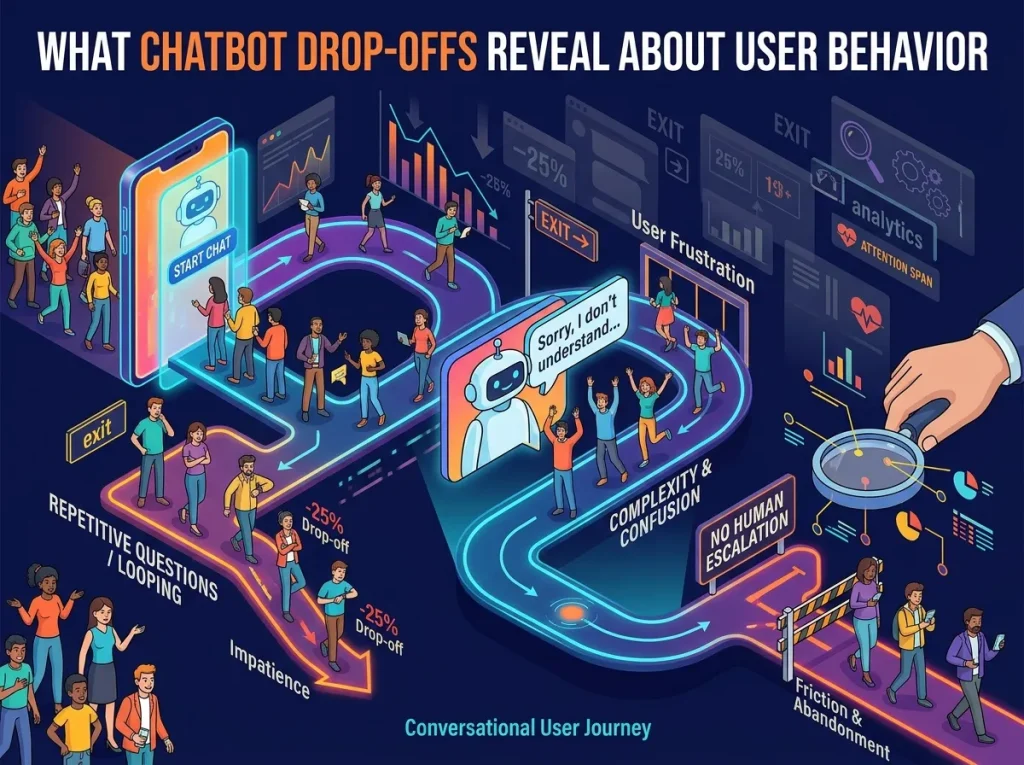
Chatbot drop-offs occur when users leave a conversation before reaching its intended completion point. Depending on the chatbot’s purpose, that endpoint might be a resolved support question, a completed lead form, a product recommendation, or a successful appointment booking.
Not every early exit represents a negative experience. A visitor who receives an immediate answer may close the chat because the problem has already been solved. Someone else might leave after realizing that the chatbot cannot handle a complex request. Treating both situations as identical can lead businesses to make the wrong improvements.
This is why chatbot performance should be evaluated alongside the user’s original intent. If someone asks about delivery costs and receives a clear answer, a short interaction may represent success. If another visitor begins a product inquiry but leaves after several confusing responses, the same short session could indicate a problem.
Understanding this distinction makes chatbot conversation drop-off a more useful measure. Instead of assuming that every abandoned session needs to be recovered, businesses can identify which exits indicate unresolved needs, unnecessary friction, or poor conversational design.
Why Users Abandon Chatbot Conversations
Users rarely leave a conversation for one universal reason. Their decisions are influenced by the relevance of the response, the effort required to continue, their expectations, and the complexity of the task.
Conversations That Feel Repetitive or Confusing
A chatbot loses credibility when it repeatedly asks questions the user has already answered or fails to recognize the meaning of a message. For example, a visitor looking for a refund may become frustrated if the chatbot keeps offering general product information instead of explaining the return process.
Repeated clarification requests can make the experience feel like work rather than assistance. When the chatbot cannot understand natural language, recognize context, or provide an appropriate next step, users may decide that continuing is not worth their time.
Conversational flow optimization can reduce this problem by making each question relevant to the previous response. A well-designed conversation should move toward a useful outcome instead of forcing visitors through unnecessary steps.
Too Many Questions Before Delivering Value
Some chatbots request names, email addresses, phone numbers, company details, and other information before providing meaningful assistance. Although these details may help sales and marketing teams qualify prospects, collecting them too early can create resistance.
Visitors often want to understand what they will receive in return for sharing their information. If the chatbot requests personal details before answering a simple question, users may leave rather than continue.
Businesses can reduce this friction by offering useful information first and requesting only the details needed for the next stage. A short, relevant interaction often creates a stronger foundation for data collection than a lengthy qualification process.
Poor Timing and Irrelevant Messages
A chatbot can interrupt users when it appears too quickly, opens repeatedly, or displays a message unrelated to the page they are viewing. A visitor reading a product description may appreciate help comparing features but find an unrelated promotional message distracting.
Thoughtful timing can make assistance feel natural rather than intrusive. Businesses that want to understand this relationship can explore Chatbot Message Timing to see how the timing of automated messages relates to user engagement.
The objective is not to initiate more conversations at every opportunity. It is to make assistance available when users are most likely to need it.
Limited Options for Complex Questions
Rule-based chatbots often work well for predictable questions but struggle when users describe unusual problems or combine several requests in one message. If a chatbot cannot recognize its limitations, it may continue providing irrelevant answers instead of offering an alternative.
Users are more likely to abandon conversations when they feel trapped in a system that cannot help them. Providing a clear option to contact a human agent, request a callback, or continue through another support channel can prevent a minor difficulty from becoming a frustrating experience.
Uncertainty About Privacy
Visitors may hesitate when a chatbot requests sensitive or unnecessary information. They may not understand why the information is needed, how it will be used, or whether it will be stored securely.
Privacy concerns can become a major source of interaction friction, particularly when conversations involve account information, payment questions, or personal details. Businesses should make data requests understandable and proportionate to the task.
A thoughtful approach to Chatbot Data Privacy Strategies can help businesses build trust by addressing how conversational data is collected, handled, and protected.
Measuring Chatbot Drop-Off Rates Without Misreading the Data

The chatbot drop-off rate measures the proportion of relevant chatbot interactions that end before users complete a defined goal. Its usefulness depends on how the business defines a conversation, identifies successful outcomes, and distinguishes abandonment from resolution.
A simple calculation is:
Chatbot drop-off rate = (Incomplete conversations ÷ Eligible conversations) × 100
Suppose a chatbot receives 1,000 eligible conversations during a reporting period. If 280 conversations end without the intended outcome, the drop-off rate is 28%, assuming those sessions have been correctly classified as incomplete.
The result becomes meaningful when compared with other indicators. A higher drop-off rate on a lead qualification chatbot may suggest that visitors find the questions too demanding. The same rate on a support chatbot might reflect users resolving their issues quickly, depending on how completion is measured.
Businesses should therefore avoid judging performance through one number alone. A useful measurement system considers the chatbot’s purpose, the quality of its responses, and the outcomes users achieve.
Looking Beyond the Chatbot Abandonment Rate
The chatbot abandonment rate is closely related to the drop-off rate, but the exact meaning depends on the tracking system. Some platforms count any conversation that ends without a designated completion event. Others identify abandonment after a period of inactivity or after users exit at a particular stage.
These differences matter when comparing performance across tools, campaigns, or reporting periods. A consistent definition helps teams determine whether an apparent improvement reflects a better experience or simply a change in measurement.
The chatbot completion rate provides a useful counterpoint by showing how many eligible conversations reach the intended endpoint. Other supporting measures include average response time, repeated questions, successful handoffs, resolved support requests, and completed lead submissions.
Together, these indicators help explain not only how frequently users leave but also whether the chatbot is delivering value.
Finding the Exact Points Where Conversations Break Down
A total drop-off rate can indicate that a problem exists, but it rarely explains where the problem begins. For that, businesses need to examine chatbot exit points throughout the conversation.
Imagine a sales chatbot that welcomes website visitors, asks about their business needs, recommends a service, and requests contact details. If most visitors leave immediately after the contact information request, the issue may involve privacy concerns, excessive form fields, or uncertainty about what happens next.
If users leave after receiving a recommendation, the problem may instead involve irrelevant suggestions, unclear pricing, or insufficient information to make a decision.
Chatbot user journey analysis connects these exit points with the steps that preceded them. Reviewing conversations by stage allows teams to identify recurring patterns rather than relying on assumptions about user behavior.
Conversation transcripts can provide additional context. They may reveal that the chatbot misunderstood a common phrase, offered the same response multiple times, or failed to explain an important option. These findings help teams prioritize changes based on actual user difficulties.
Segmenting the data by device, traffic source, page type, user intent, and new versus returning visitors can also uncover differences that an overall average hides. For example, a chatbot may work well for desktop visitors but create difficulties on mobile devices because its interface covers important page content.
Reducing Interaction Friction Through Better Conversational Design
Improving chatbot performance does not necessarily require a more complicated system. Often, the most effective changes involve making the existing conversation easier to understand and complete.
A natural conversational flow gives users a clear sense of direction. Each message should respond to what the visitor has said, explain available choices, or move the interaction toward a useful outcome. When a question is necessary, the chatbot should communicate why it is being asked.
Shorter conversations can also improve usability when they remove unnecessary steps. Businesses should review whether every question supports the intended goal and whether information can be collected later without disrupting the interaction.
For example, a support chatbot might first identify the issue and offer a relevant solution before requesting account details. A sales chatbot might explain the service category before asking for contact information. The right sequence depends on what users need and what the business must know to assist them.
Clear error recovery is equally important. If the chatbot does not understand a request, it should explain the limitation and offer a useful alternative instead of repeating a failed response. Human handoff options should be visible when the system cannot resolve a problem confidently.
These changes can improve the overall experience without making every conversation longer or adding more features.
The Relationship Between Drop-Offs, Engagement, and Retention
A chatbot that keeps users engaged is not necessarily one that produces the longest conversations. Engagement is valuable when users remain because the interaction is useful, relevant, and easy to follow.
Chatbot user retention can be evaluated through repeat usage, return visits, or continued engagement across multiple sessions, depending on the chatbot’s purpose. A customer who returns to a support chatbot because previous interactions were helpful may indicate strong confidence in the service. A visitor who repeatedly opens a chatbot but leaves without receiving answers may represent unresolved friction rather than successful retention.
Businesses should connect engagement analysis with outcomes such as customer satisfaction, issue resolution, qualified inquiries, and completed transactions. This helps distinguish meaningful participation from activity that does not contribute to the user’s goal.
The same principle applies to conversational design. A longer interaction may be appropriate for a complex product recommendation, while a short exchange may be ideal for checking business hours. The best experience depends on the task, not the number of messages exchanged.
Emotion-aware conversational systems may also help improve the tone of interactions when designed responsibly. Businesses exploring Emotion AI Chatbot Marketing can consider how context-sensitive responses may support more empathetic communication. Such systems should not assume that emotional states can be identified perfectly; they should use clear user signals and provide appropriate ways to correct misunderstandings.
Connecting Chatbot Drop-Offs With Sales and Marketing Outcomes
For businesses using chatbots to generate leads, recommend services, or support purchasing decisions, drop-offs can influence the entire customer journey. A visitor who abandons a qualification conversation may never reach the sales team, while a shopper who cannot find a product answer may leave without making a purchase.
However, not every incomplete conversation represents a lost opportunity. Some visitors are researching, comparing options, or gathering information before making a decision. Others may prefer to contact the business through email or phone.
This is why chatbot analytics should be connected with the broader sales and marketing process. Teams can assess whether completed conversations lead to qualified inquiries, booked appointments, or meaningful follow-up activity rather than treating every chat as an independent conversion event.
Businesses using Chatbot for Sales and Marketing can examine how automated conversations support lead generation and customer engagement. The important consideration is whether the chatbot helps users progress naturally toward their goals while supplying sales teams with relevant information.
When drop-off analysis is combined with lead quality and conversion data, businesses can identify which conversational improvements are most likely to support commercial outcomes.
Turning Chatbot Engagement Analysis Into Continuous Improvement
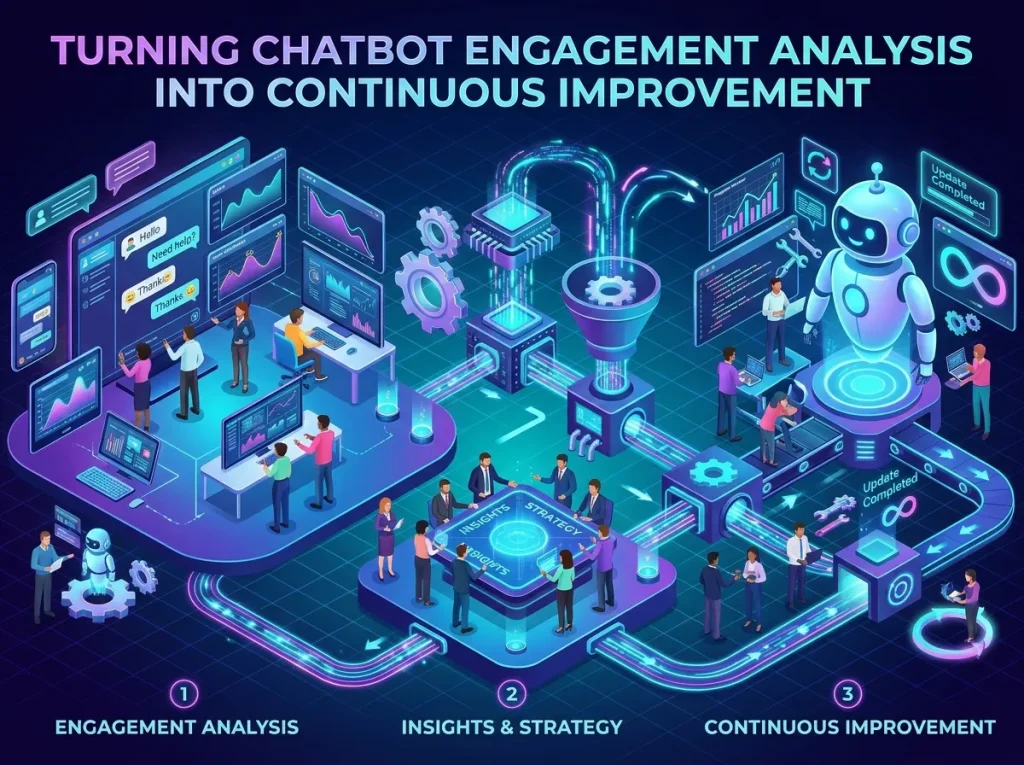
Chatbot performance changes as customer expectations, website content, products, and user behavior evolve. A conversation that works well today may become less effective after a pricing change, a new product launch, or a shift in the questions customers ask.
Regular chatbot engagement analysis helps businesses identify these changes. Teams can review recurring unanswered questions, compare exit rates across conversation stages, and investigate whether recent updates have improved or weakened completion.
Testing should focus on specific problems. If visitors leave after a lengthy introduction, the business might test a shorter opening message. If abandonment increases during lead qualification, it could compare a shorter form with the existing version. If a particular question creates confusion, the wording or response options may need adjustment.
Changes should be assessed against meaningful outcomes, not just a temporary reduction in drop-offs. A shorter conversation is not an improvement if it leads to more unresolved support requests or lower-quality leads.
It is also important to give users alternative ways to continue. Clear links, accessible contact details, and appropriate human support options help ensure that the chatbot remains one useful part of the customer experience rather than a barrier to service.
Conclusion
Chatbot drop-offs provide valuable insight into how people experience automated conversations. They can expose confusing responses, poorly timed messages, unnecessary questions, privacy concerns, and gaps in the chatbot’s ability to resolve user needs. Yet an early exit does not always indicate failure, particularly when visitors have already received the information they wanted.
Businesses can make better decisions by defining completion clearly, measuring drop-off rates consistently, examining chatbot exit points, and connecting engagement data with meaningful outcomes. Improvements to conversational flow, transparency, response relevance, and human support can reduce unnecessary friction and help users accomplish their goals.
The long-term objective is not to keep every visitor talking for longer. It is to create chatbot experiences that are useful, trustworthy, and easy to navigate. When businesses understand why users leave and respond with thoughtful improvements, chatbots can become a more effective part of customer service, sales, and marketing.
Frequently Asked Questions
1. What are chatbot drop-offs?
Chatbot drop-offs occur when users leave a conversation before reaching its intended outcome, such as resolving a support issue, submitting a lead form, or completing a booking.
2. What is a chatbot drop-off rate?
A chatbot drop-off rate measures the percentage of eligible conversations that end without the defined completion event. Accurate measurement depends on distinguishing incomplete sessions from conversations that successfully resolve a user’s need.
3. What causes users to abandon chatbot conversations?
Common causes include irrelevant answers, repetitive questions, lengthy qualification processes, poorly timed messages, limited human support, and concerns about sharing personal information.
4. How is the chatbot abandonment rate calculated?
A common approach is to divide incomplete conversations by the total number of eligible conversations and multiply the result by 100. Businesses should define incomplete conversations consistently before calculating the rate.
5. What is the difference between chatbot drop-offs and completion rates?
The drop-off rate measures conversations that end without the intended outcome, while the completion rate measures conversations that reach it. Their relationship depends on consistent tracking and how successful outcomes are defined.
6. How can businesses identify chatbot exit points?
Businesses can examine conversation-stage analytics, inactivity patterns, chat transcripts, repeated questions, and user behavior before an interaction ends. This helps reveal where users encounter difficulties.
7. Can a high chatbot drop-off rate be a positive sign?
Yes. If users receive immediate answers and leave because their needs are resolved, early exits may represent successful interactions. Businesses should evaluate exit data alongside resolution and satisfaction measures.
8. How does conversational flow optimization reduce drop-offs?
It makes conversations easier to follow by removing unnecessary questions, using relevant responses, providing clear choices, and offering alternatives when the chatbot cannot resolve a request.
9. How do chatbot drop-offs affect lead generation?
When prospective customers leave before receiving relevant information or completing qualification, businesses may miss opportunities to generate leads. Reviewing drop-offs alongside lead quality and conversion data helps identify meaningful improvements.
10. How often should chatbot drop-off performance be reviewed?
Businesses should review performance regularly and after significant chatbot, website, or campaign changes. The appropriate frequency depends on conversation volume, business goals, and how quickly customer needs evolve.