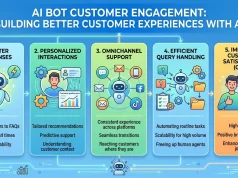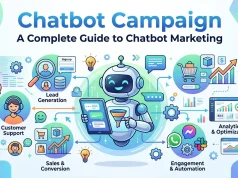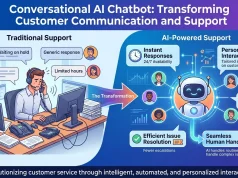
A chatbot for sales and marketing helps businesses engage visitors, answer questions, capture leads, qualify prospects, and support conversions through automated conversations. Modern AI-powered chatbots can provide personalized responses, connect prospects with sales teams, and improve customer experiences. When combined with a clear chatbot marketing strategy, automation, and performance tracking, businesses can use conversational technology to generate more opportunities and support sustainable growth.
Businesses are increasingly using conversational technology to create faster and more personalized interactions with potential customers. Website visitors may have questions about products, pricing, services, availability, or the next step in the buying process. If those questions are not answered quickly, potential customers may leave the website and look elsewhere.
A chatbot for sales and marketing can help solve this problem by providing immediate assistance throughout the customer journey. Instead of relying entirely on sales representatives or customer service teams, businesses can use automated conversations to engage visitors at the right time.
Modern chatbots are more than simple question-and-answer tools. With artificial intelligence, natural language processing, customer data, and integrations with marketing platforms, they can understand questions, recommend relevant information, capture contact details, qualify prospects, and transfer high-intent conversations to human representatives.
The real value comes from connecting chatbot technology with a broader marketing and sales strategy. When businesses understand their audience and design conversations around genuine customer needs, chatbots can become an important part of lead generation, customer engagement, and conversion optimization.
What Is a Chatbot for Sales and Marketing?
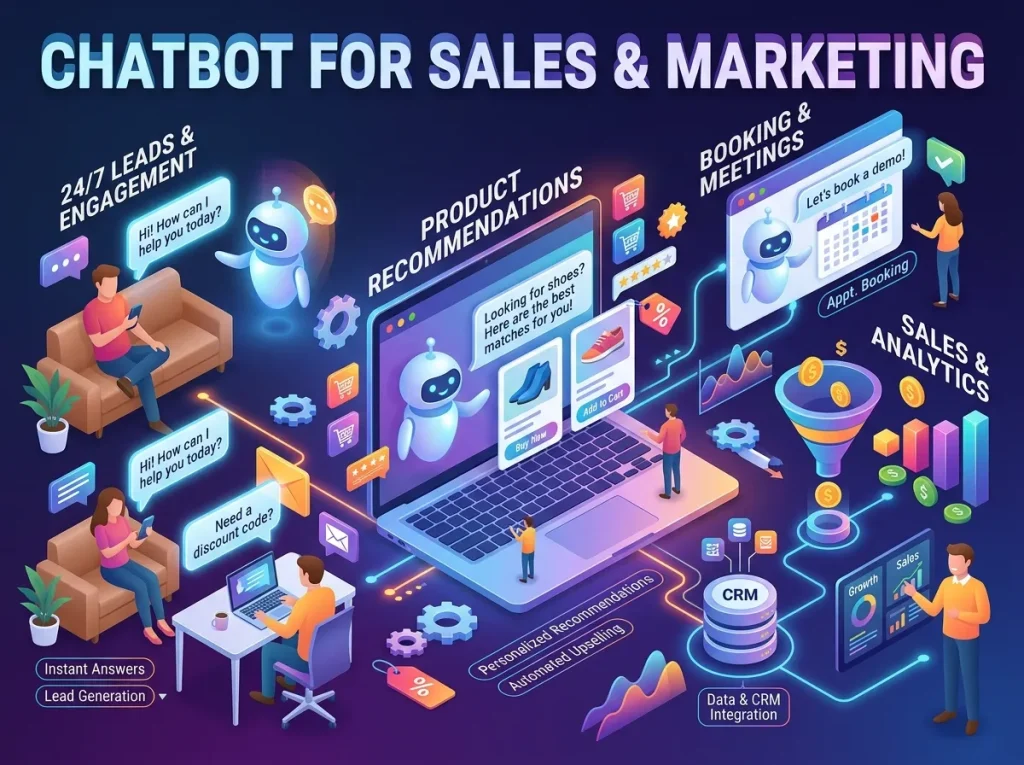
A chatbot for sales and marketing is an automated conversational system designed to interact with potential or existing customers and support marketing or sales objectives.
A marketing chatbot may welcome visitors, answer common questions, recommend content, collect contact information, and encourage visitors to subscribe or request additional information. A sales-focused chatbot can identify buying intent, qualify prospects, recommend products, schedule meetings, and connect qualified leads with sales representatives.
The technology can operate on websites, landing pages, social platforms, messaging applications, and other digital channels. This gives businesses more opportunities to interact with prospects without requiring a sales representative to be available for every initial conversation.
The most effective systems do not attempt to replace every human interaction. Instead, they automate repetitive conversations while allowing sales and marketing teams to focus on higher-value opportunities.
Why Businesses Use Chatbots for Sales and Marketing
Speed is one of the biggest advantages of conversational technology. A potential customer may visit a website outside normal business hours. A chatbot can still provide information and collect details that the sales team can follow up on later.
Chatbots can also create more consistent experiences. Every visitor can receive immediate responses to common questions without waiting for a representative.
Another advantage is scalability. A sales team can only handle a certain number of conversations at once, while an automated system can engage with many visitors simultaneously.
This does not mean that every conversation should be fully automated. Complex purchasing decisions often require human expertise. The strongest approach combines automation with human assistance, allowing the chatbot to handle initial interactions and route valuable opportunities to the appropriate team.
How Chatbots for Sales and Marketing Generate Leads
Lead generation is one of the most common applications of conversational technology. A chatbot for lead generation can engage visitors and encourage them to provide information such as their name, email address, company, business needs, or preferred service.
Traditional lead forms often require visitors to complete several fields before receiving anything in return. A conversational experience can make this process feel more interactive by asking questions one at a time.
For example, a business services chatbot might first ask what type of service the visitor needs. Based on the answer, it could provide relevant information and then ask whether the visitor would like to speak with an expert.
This approach can make lead capture feel more natural while helping the business understand the visitor’s needs before the sales conversation begins.
AI Chatbot for Sales
An AI chatbot for sales can support different stages of the buying journey. It can identify potential customers, answer product questions, recommend relevant solutions, and help visitors move toward a purchase or sales conversation.
AI can make these interactions more flexible than traditional rule-based chatbots. Instead of requiring visitors to select from a limited menu, an AI system can interpret natural-language questions and provide contextually relevant responses.
For example, a visitor might ask, “Which plan would work best for a small business with ten employees?” An AI chatbot can respond based on the available product information and direct the visitor toward the most relevant option.
The chatbot can also recognize buying signals. Questions about pricing, implementation, availability, product comparisons, or contract terms may indicate stronger purchase intent. These signals can help sales teams prioritize follow-up.
Building a Chatbot Marketing Strategy
A successful chatbot marketing strategy begins with the customer rather than the technology. Businesses should first determine what visitors need and where conversations can remove friction from the customer journey.
The chatbot should have a clear purpose. Some businesses may primarily use it for lead generation, while others may focus on product discovery, customer support, appointment booking, or content recommendations.
Conversation design should reflect the brand’s communication style. A professional B2B company may use a different tone from an ecommerce brand targeting younger consumers.
The chatbot should also have clear boundaries. Visitors should understand when they are communicating with an automated system, and the chatbot should provide a straightforward path to human assistance when necessary.
Businesses looking to strengthen their overall chatbot approach can explore Marketing Bot Best Practices for additional ideas around creating more effective customer conversations.
Sales Chatbot Automation
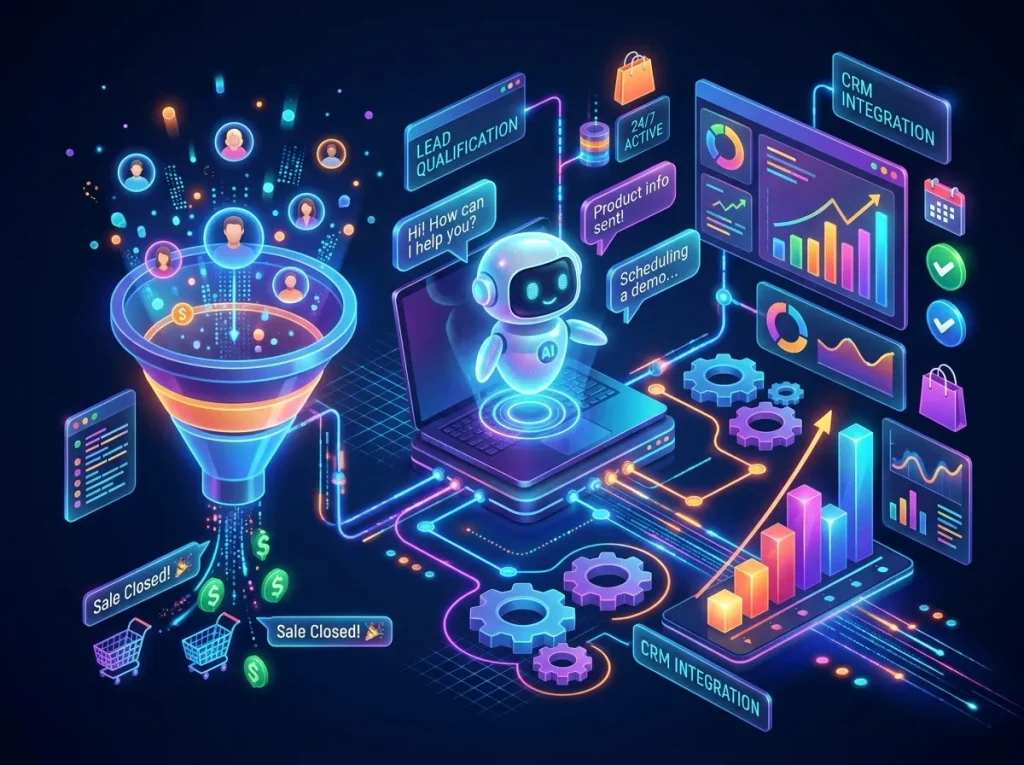
Sales chatbot automation allows businesses to automate repetitive parts of the sales process while maintaining opportunities for human involvement.
A chatbot can answer frequently asked questions, collect prospect information, identify basic requirements, recommend relevant resources, and schedule appointments. These tasks can save sales representatives significant time.
Automation is particularly useful during the early stages of the customer journey. Sales teams do not need to spend valuable time manually responding to every basic question when a chatbot can provide the initial information.
At the same time, automation should not create unnecessary barriers. If a visitor clearly wants to speak with a salesperson, the chatbot should make that option easy to access instead of forcing the visitor through a long automated conversation.
Chatbot for Lead Qualification
A chatbot for lead qualification helps businesses determine which prospects are most likely to become valuable customers.
Qualification questions can focus on factors such as company size, budget, location, business needs, timeline, product interest, or purchasing authority. The exact questions should depend on the company’s sales process.
For example, a B2B software company might ask whether the visitor represents a small business, growing company, or enterprise organization. It could then ask about the number of users and the primary business challenge.
The answers can be used to assign leads to different categories. High-intent prospects can be sent directly to sales, while early-stage visitors can receive educational resources and continue through automated nurturing.
This makes the sales process more efficient because representatives can focus their attention on leads with stronger potential.
AI Chatbot for Marketing
An AI chatbot for marketing can support more than lead capture. It can become an interactive layer across the customer journey.
For example, a visitor reading a blog article could ask the chatbot for related resources. A product-page visitor could request a comparison between two solutions. A returning customer could ask about a new product or promotion.
AI can also use conversational context to make interactions more relevant. Instead of showing the same message to every visitor, businesses can create experiences based on user intent, page context, or previous interactions where appropriate.
A complete discussion of this approach can be found in AI Chatbot for Marketing, which explores how AI chatbots can support business growth.
Chatbot Customer Engagement
Chatbot customer engagement focuses on creating useful interactions rather than simply pushing visitors toward a sale.
A chatbot can help customers discover educational resources, find answers, compare products, request support, or understand how a service works.
Engagement becomes more valuable when conversations are relevant to the visitor’s immediate needs. A chatbot that continuously displays generic promotional messages may become distracting. A chatbot that responds to genuine questions can become a useful part of the customer experience.
Businesses can also use chatbots to maintain engagement after a lead has been captured. For example, prospects may return to ask additional questions before making a decision. A conversational system can provide continuity while giving sales teams visibility into those interactions.
Chatbot Sales Automation
Chatbot sales automation can extend beyond initial lead capture. Depending on the business model, chatbots can support product discovery, qualification, appointment scheduling, follow-ups, and purchase assistance.
For ecommerce businesses, a chatbot might help visitors find products based on their preferences. For service businesses, it could identify the type of assistance needed and recommend an appropriate service.
B2B businesses can use chatbot automation to schedule consultations or product demonstrations. This reduces the number of manual steps between initial interest and sales contact.
The objective should not be to automate everything. Instead, businesses should identify repetitive activities where automation improves speed and convenience while preserving human involvement for complex decisions.
Conversational Marketing Chatbot
A conversational marketing chatbot changes the way businesses communicate with prospects by turning static website experiences into interactive conversations.
Traditional marketing often depends on visitors reading content, filling out forms, and navigating through pages. Conversational marketing allows visitors to ask questions and receive responses based on their interests.
This can be especially valuable for businesses with complicated products or services. Visitors may not know exactly which page contains the information they need. A chatbot can help guide them toward relevant resources.
Conversational marketing can also create stronger opportunities for personalization. Instead of presenting every visitor with the same message, businesses can use conversation data to understand interests and adapt future interactions.
For businesses exploring specialized applications, Chatbots in NFT Marketing provides an example of how conversational technology can be applied to engagement and sales within a specific marketing environment.
Connecting Chatbots With Marketing Communications
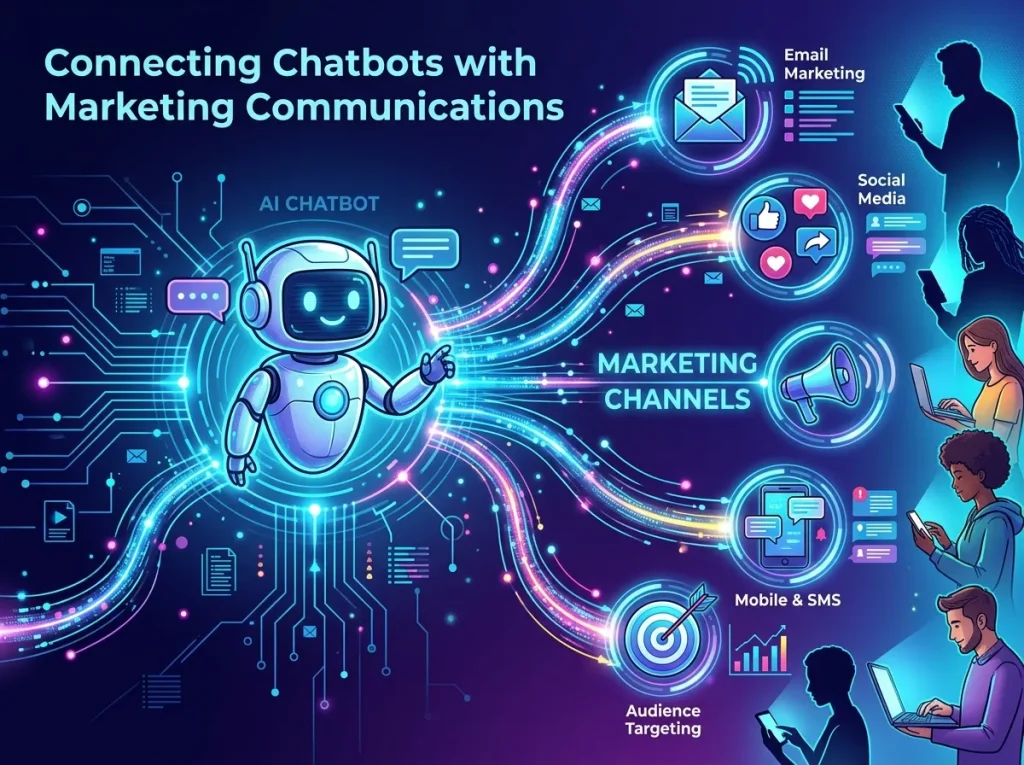
Chatbots work best when they are connected with other marketing channels rather than operating independently.
A visitor might discover a business through search, read a blog article, interact with a chatbot, subscribe to an email list, and later speak with sales. Each interaction can contribute to the overall customer journey.
Connecting chatbot conversations with email marketing, CRM systems, advertising platforms, and other communication channels can help businesses create a more consistent experience.
A broader understanding of coordinated communication can be found in Marketing Communications Mastery, which explores how different communication activities can work together.
Improving Chatbot Conversion Rates
Chatbot performance depends heavily on the quality of the conversation. Long introductions, unnecessary questions, generic responses, and unclear calls to action can reduce engagement.
The opening message should explain the chatbot’s value clearly. Instead of simply saying “How can I help?”, businesses can use context to provide useful options or ask a relevant question.
Businesses should also reduce unnecessary form fields. If the chatbot needs contact information, it should request only information that is genuinely useful at that stage.
Testing is another important part of optimization. Businesses can experiment with different opening messages, questions, calls to action, conversation lengths, and handoff points to determine which experiences produce better results.
Measuring Chatbot Performance
Businesses need clear metrics to determine whether their chatbot is contributing to sales and marketing goals.
Lead generation can be measured through the number of leads captured, while qualification performance can be evaluated through the percentage of chatbot leads that meet sales criteria.
Engagement can be measured through conversation starts, completed conversations, returning users, and interaction rates. Sales performance can include booked meetings, qualified opportunities, purchases, and revenue influenced by chatbot interactions.
Businesses should also monitor abandonment. If visitors frequently leave at a particular question, that point in the conversation may need to be simplified.
Customer feedback can provide another valuable measurement. A chatbot may generate leads while creating a poor user experience, so quantitative performance should be considered alongside qualitative feedback.
Integrating Chatbots With CRM and Sales Teams
A chatbot becomes more useful when important conversation information reaches the right people.
CRM integration can allow businesses to store lead information, conversation details, qualification responses, and other relevant data. Sales representatives can then review the context before contacting a prospect.
This can improve the quality of follow-up because the sales representative does not need to ask the same basic questions again.
The handoff process should be carefully designed. When a prospect demonstrates strong purchase intent, the chatbot should provide a clear path to a human representative, appointment scheduler, or sales contact.
Common Challenges With Sales and Marketing Chatbots
One common challenge is over-automation. Businesses may attempt to make every interaction automated, even when visitors need human assistance. This can create frustration and reduce trust.
Another challenge is poor conversation design. A technically advanced chatbot can still perform poorly if it asks irrelevant questions or provides unclear responses.
Data quality can also affect AI chatbot performance. Outdated product information, inaccurate pricing, or incomplete knowledge sources can lead to poor customer experiences.
Privacy and data handling are additional considerations. Businesses should carefully manage the information collected through chatbot interactions and communicate appropriately with users about how their data is handled.
Finally, businesses should avoid measuring chatbot success only by the number of conversations. A chatbot that handles thousands of low-value conversations may be less useful than one that generates a smaller number of highly qualified opportunities.
The Future of Chatbots for Sales and Marketing
AI is making chatbots increasingly capable of understanding natural language, recognizing intent, personalizing responses, and supporting more complex customer journeys.
As these capabilities develop, businesses may use chatbots across more stages of the customer lifecycle. They can support discovery, education, qualification, sales, onboarding, and customer retention.
However, human expertise will continue to matter. Customers often need empathy, judgment, negotiation, and specialized knowledge that automated systems cannot provide in every situation.
The strongest future approach is likely to combine AI efficiency with human expertise. Chatbots can handle repetitive interactions and identify opportunities, while people focus on complex conversations where human judgment creates the most value.
Conclusion
A chatbot for sales and marketing can become a valuable part of a modern customer acquisition strategy when it is designed around real customer needs. From lead generation and qualification to engagement, sales automation, and personalized communication, chatbots can reduce friction and help businesses respond to prospects more efficiently.
The most effective systems are not simply automated sales tools. They are conversational experiences that help visitors find information, understand products, solve problems, and move naturally toward the next stage of their journey.
By combining an effective chatbot marketing strategy, reliable automation, strong CRM integration, thoughtful conversation design, and continuous performance measurement, businesses can use AI chatbots to create better customer experiences while supporting measurable sales and marketing growth.
Frequently Asked Questions
1. What is a chatbot for sales and marketing?
A chatbot for sales and marketing is an automated conversational tool that interacts with prospects and customers to support activities such as lead generation, product discovery, qualification, customer engagement, appointment scheduling, and sales conversion.
2. How can an AI chatbot help sales teams?
An AI chatbot can answer common questions, identify buying intent, qualify prospects, collect lead information, recommend products, schedule meetings, and transfer high-value prospects to sales representatives. This allows sales teams to focus more time on qualified opportunities.
3. Can chatbots generate leads?
Yes. A chatbot for lead generation can engage website visitors, ask relevant questions, collect contact information, and encourage prospects to take actions such as requesting a consultation, booking a demo, or subscribing to updates.
4. What is chatbot marketing?
Chatbot marketing uses automated conversations to engage prospects and customers, provide information, generate leads, recommend products, and support conversions. It can be integrated with websites, messaging platforms, email campaigns, and other marketing channels.
5. What is the difference between an AI chatbot and a traditional chatbot?
Traditional chatbots generally rely on predefined rules, menus, and responses. AI chatbots can understand natural-language questions and provide more flexible responses based on context, intent, and available information.
6. How does a chatbot qualify leads?
A chatbot qualifies leads by asking questions related to customer needs, company size, budget, product interest, purchasing timeline, or other relevant criteria. The responses can help determine whether a prospect should be sent directly to sales or placed into a nurturing process.
7. Can chatbots replace sales representatives?
Chatbots can automate many repetitive sales activities, but they should not be viewed as complete replacements for sales representatives. Human professionals remain valuable for complex questions, negotiations, relationship building, and high-value purchasing decisions.
8. How can businesses improve chatbot customer engagement?
Businesses can improve engagement by creating useful conversations, asking relevant questions, personalizing responses, keeping conversations concise, providing clear next steps, and offering easy access to human support when needed.
9. What metrics should businesses use to measure chatbot performance?
Useful metrics include conversations started, engagement rate, conversation completion rate, lead volume, qualified leads, conversion rate, booked meetings, purchases, sales opportunities, revenue influenced, and conversation abandonment.
10. What makes a chatbot marketing strategy successful?
A successful chatbot marketing strategy connects conversational technology with clear business goals and customer needs. Strong conversation design, relevant personalization, accurate information, CRM integration, human handoffs, and continuous performance optimization are all important for long-term results.