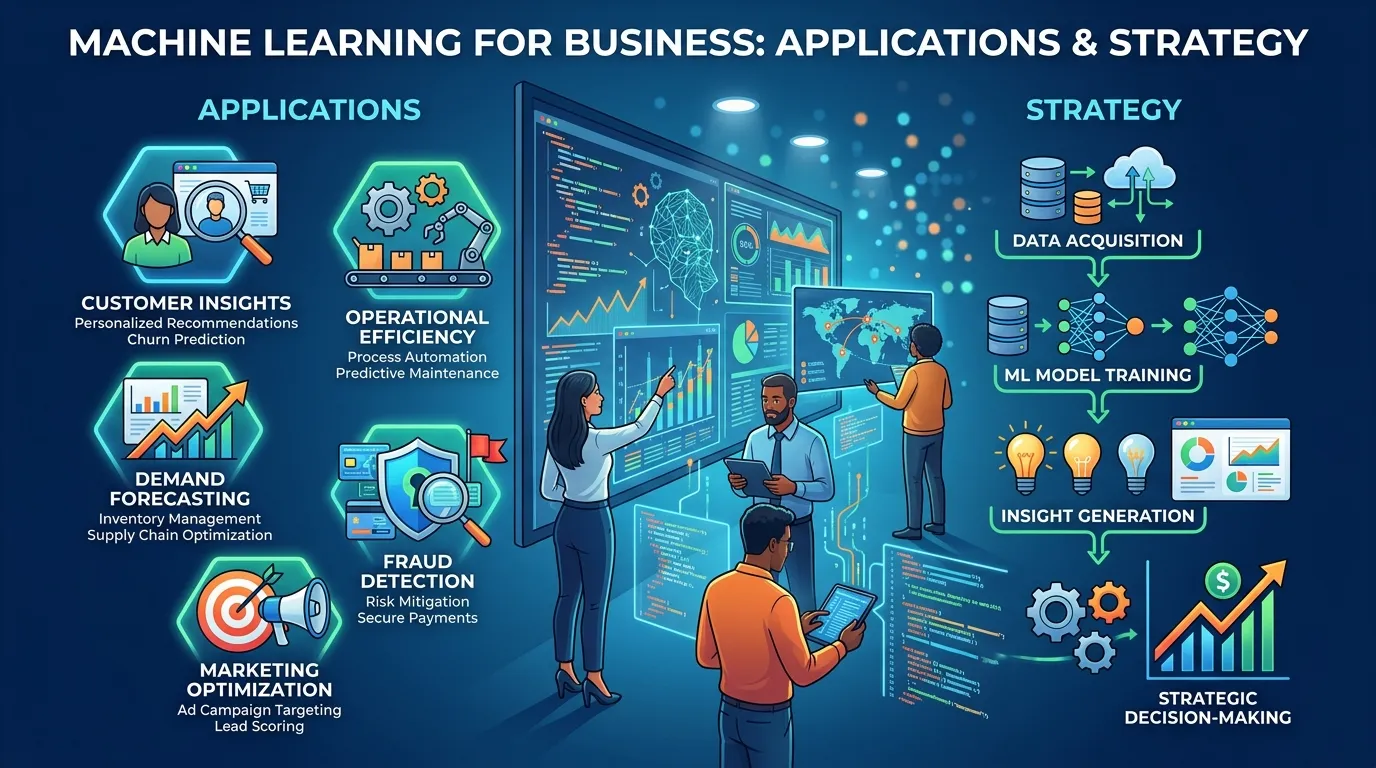
Machine learning for business helps companies use data, automation, and intelligent systems to improve decisions, understand customers, optimize operations, and identify new growth opportunities. From predictive analytics and customer personalization to automation and risk management, machine learning can support businesses across industries. When combined with a clear business strategy, machine learning can turn large amounts of data into useful insights and measurable business value.
Businesses generate enormous amounts of data every day. Customer interactions, website activity, transactions, sales records, operational information, and marketing performance all create valuable data that can help organizations make better decisions. However, collecting data is only the beginning. Businesses also need effective ways to analyze that information and identify patterns that may not be obvious through traditional analysis.
This is where machine learning for business becomes increasingly valuable. Machine learning allows systems to analyze data, recognize patterns, make predictions, and improve their performance as they process more information. Instead of relying entirely on manual analysis, businesses can use intelligent models to support faster and more informed decisions.
Machine learning is no longer limited to large technology companies. Businesses across marketing, finance, ecommerce, healthcare, manufacturing, customer service, logistics, and other industries are exploring ways to use machine learning to improve efficiency and create better customer experiences.
The real value comes from applying machine learning to meaningful business problems. When technology is connected to specific objectives, it can become a practical tool for improving operations, reducing costs, increasing revenue, and creating sustainable competitive advantages.
What Is Machine Learning for Business?
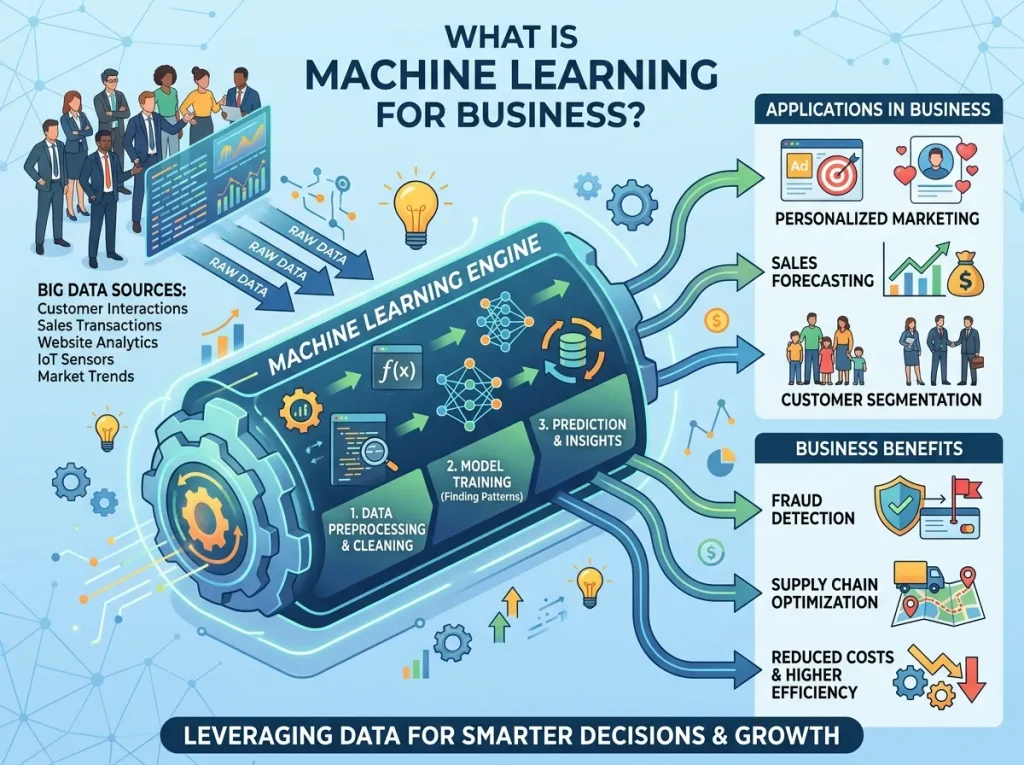
Machine learning for businesses refers to the use of machine learning technologies to solve business problems and improve organizational performance. Instead of programming every decision manually, machine learning systems can identify patterns in historical data and use those patterns to produce predictions, classifications, recommendations, or automated actions.
For example, an ecommerce business can use machine learning to recommend products based on customer behavior. A financial company can analyze transactions to identify unusual activity. A marketing team can use predictive models to determine which customers are more likely to convert.
The technology can support both simple and complex business processes. It may help automate repetitive tasks, identify trends, forecast demand, personalize customer experiences, or support strategic planning.
The important point is that machine learning should serve a business purpose. Implementing technology simply because it is considered innovative does not guarantee value. Businesses need to identify the problems they want to solve and determine where machine learning can provide a meaningful advantage.
Machine Learning in Business
Machine learning in business can influence almost every stage of an organization’s operations. Sales teams can use predictive models to prioritize leads, marketing teams can analyze customer behavior, and operations teams can forecast demand or identify inefficiencies.
Customer experience is another important area. Machine learning can analyze customer interactions and help businesses understand preferences, predict needs, and deliver more personalized experiences. This can make communication more relevant while helping companies use their marketing resources more effectively.
Machine learning can also improve internal decision-making. Rather than relying entirely on historical assumptions or manual reports, managers can use data-driven predictions to evaluate potential outcomes.
The impact depends on the quality and availability of data. Machine learning models require relevant and reliable information to produce useful results. Businesses therefore need to consider data quality, governance, privacy, and security alongside the technology itself.
Business Applications of Machine Learning
The business applications of machine learning continue to expand as companies discover new ways to use intelligent data analysis. Customer segmentation is one common application. Machine learning can analyze customer behavior and identify groups with similar characteristics, allowing businesses to create more relevant marketing and sales strategies.
Fraud detection is another important application. Financial institutions and ecommerce companies can analyze transaction patterns and identify unusual activity that may require further investigation.
Demand forecasting can help businesses predict future sales and improve inventory planning. This can reduce the risk of overstocking or running out of products.
Machine learning can also support recommendation systems, predictive maintenance, employee analytics, pricing optimization, sentiment analysis, and supply chain management.
These applications demonstrate that machine learning is not limited to a single department. Its value can extend across the organization when data is available and the underlying business problem is clearly defined.
Machine Learning Business Solutions
Machine learning business solutions are often designed around specific organizational challenges rather than technology alone. A company struggling with customer churn, for example, may develop a predictive model that identifies customers who are more likely to leave.
A sales organization may use machine learning to prioritize leads based on their likelihood of conversion. A manufacturer may use predictive maintenance models to identify equipment that could require attention before a breakdown occurs.
These solutions can improve efficiency because employees receive more relevant information when making decisions. Rather than manually reviewing large datasets, teams can focus their attention on the insights produced by intelligent systems.
However, successful implementation requires collaboration between technical teams and business stakeholders. Data scientists may understand how to build models, but business teams understand the operational context. Combining both perspectives helps ensure that machine learning solutions solve real problems.
AI and Machine Learning for Business

The relationship between AI and machine learning for business is often discussed together because machine learning is one of the technologies that supports modern artificial intelligence. AI systems can perform tasks associated with human intelligence, while machine learning allows systems to learn patterns from data and improve predictions or decisions.
Businesses can combine AI and machine learning with natural language processing, computer vision, automation, recommendation engines, and conversational systems.
For example, customer service teams can use AI-powered chatbots to respond to common questions, while machine learning can help those systems improve their ability to understand customer intent. Businesses interested in conversational marketing can explore B2B Chatbot Marketing for more insight into how intelligent chatbot technology can support business growth.
AI and machine learning can also support global customer experiences. Natural language processing systems can help businesses process and translate customer communications across languages. AI-NLP Chatbot Translation provides additional context around AI-powered language capabilities.
Machine Learning Business Use Cases
There are many machine learning business use cases, but the strongest applications generally involve large amounts of data and decisions that benefit from prediction or automation.
Customer churn prediction is one example. By analyzing historical customer behavior, businesses can identify patterns associated with customers leaving and take action before the relationship ends.
Lead scoring is another valuable use case. Machine learning can evaluate customer interactions, demographics, engagement, and other information to help sales teams prioritize prospects.
Personalization is also becoming increasingly important. Businesses can analyze browsing history, purchasing behavior, and content engagement to provide more relevant recommendations.
In operations, machine learning can support demand forecasting and predictive maintenance. In finance, it can assist with fraud detection and risk assessment. In marketing, it can help identify audiences and optimize campaign performance.
The best use case is not necessarily the most technologically advanced one. A relatively simple machine learning application that solves an expensive business problem can provide more value than a complex project with no clear business outcome.
Machine Learning for Business Growth
Machine learning for business growth can create value by helping organizations make faster and more informed decisions. Growth often depends on understanding customers, identifying opportunities, improving efficiency, and using resources effectively.
Machine learning can support these areas by revealing patterns that would be difficult to identify manually. Businesses can use customer data to discover purchasing trends, identify high-value customers, and predict future demand.
Marketing is another major growth area. Machine learning can help businesses personalize campaigns, identify audiences, predict customer behavior, and improve the allocation of advertising budgets.
Chatbots can also contribute to growth by supporting customer interactions around the clock. Businesses can use conversational technology to answer questions, qualify leads, and direct prospects toward appropriate products or services. Marketing with Chatbots explores how chatbot technology can support engagement and sales.
Growth does not always mean acquiring more customers. Machine learning can also increase the value of existing customers through personalization, retention strategies, cross-selling, and improved service.
Machine Learning Automation for Businesses
Machine learning automation for businesses combines predictive intelligence with automated workflows. Traditional automation generally follows predefined rules, while machine learning can make systems more adaptive by identifying patterns and generating predictions.
For example, a traditional system might send the same message to every customer who reaches a particular stage. A machine learning system could analyze customer behavior and determine which customers are most likely to respond to different messages.
Automation can also support internal operations. Businesses may automate data classification, customer segmentation, fraud alerts, recommendations, inventory forecasting, and other repetitive processes.
The goal should not be to automate everything. Human judgment remains important, especially for complex decisions, sensitive customer interactions, and situations where model predictions may be uncertain.
The most effective approach combines machine intelligence with human oversight. Employees can focus on strategic and creative work while automated systems handle repetitive data-intensive tasks.
Predictive Analytics for Business
Predictive analytics for business uses historical and current data to estimate what may happen in the future. Machine learning can strengthen predictive analytics by identifying relationships and patterns within large datasets.
Sales forecasting is a common example. Businesses can analyze historical sales, customer behavior, seasonality, and other factors to estimate future demand.
Predictive analytics can also help businesses understand customer behavior. A company might predict which customers are likely to purchase, which leads are most likely to convert, or which customers may be at risk of leaving.
This information can improve decision-making because businesses can take action based on likely outcomes rather than reacting only after something happens.
Predictive analytics can also support advertising and media buying. Machine learning can analyze large volumes of audience and campaign information to help identify opportunities for more efficient advertising. Businesses exploring automated advertising strategies can learn more through Programmatic Ads.
Machine Learning Business Strategy
A strong machine learning business strategy begins with business objectives rather than technology. Companies should first determine what they want to improve and then evaluate whether machine learning is an appropriate solution.
For example, reducing customer churn, improving forecasting accuracy, increasing marketing conversions, or reducing operational costs can all become strategic objectives. Once the objective is clear, the organization can identify the data required and determine what type of model or system could support the goal.
Strategy also involves considering implementation costs, employee skills, infrastructure, data quality, security, and compliance. Machine learning projects can become expensive when organizations attempt to build complex systems without a clear understanding of the expected business value.
Successful strategies generally begin with manageable use cases. Businesses can test a model, evaluate its impact, learn from the results, and expand the technology gradually.
This approach reduces unnecessary risk while allowing organizations to demonstrate value before making larger investments.
Challenges of Using Machine Learning in Business
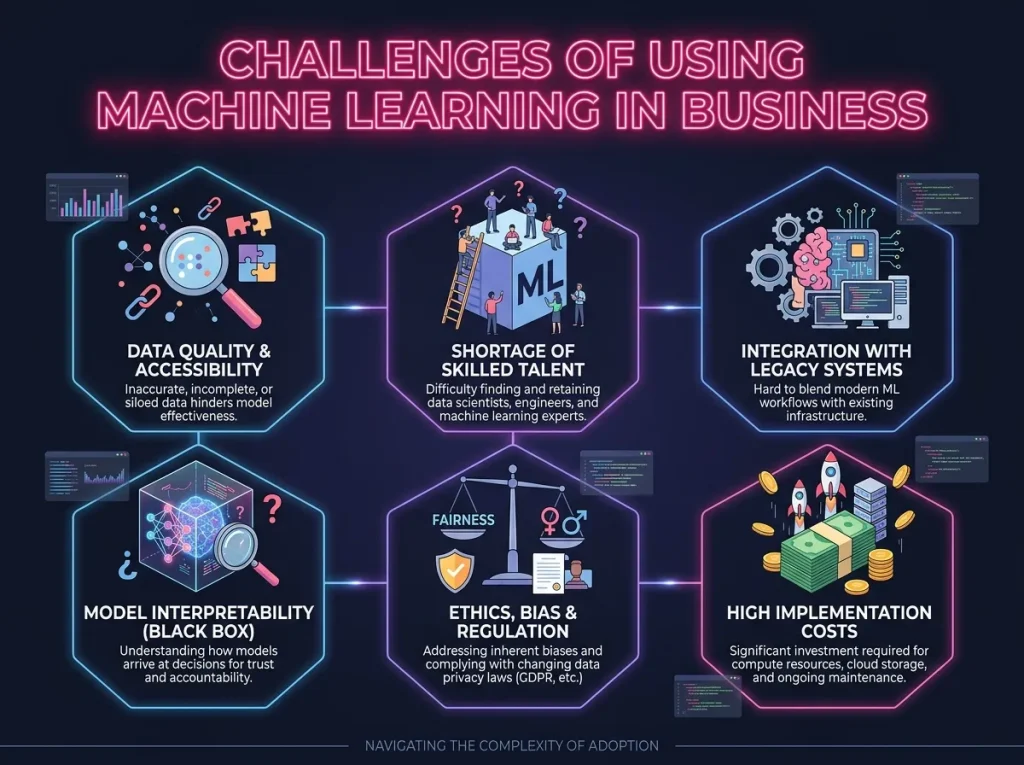
Although machine learning offers significant opportunities, businesses also face challenges when implementing it. Data quality is one of the most important. Incomplete, inaccurate, outdated, or biased data can affect model performance.
Privacy and security are also critical considerations, especially when systems process customer or employee information. Businesses need appropriate controls to protect sensitive data and comply with relevant regulations.
Another challenge is explaining model results. Some machine learning systems can be difficult for non-technical stakeholders to understand. Businesses should consider explainability when machine learning decisions affect customers, employees, financial outcomes, or other sensitive areas.
Employee adoption can also influence success. Teams need to understand how machine learning supports their work and where human judgment remains necessary.
Finally, models may require ongoing monitoring. Customer behavior, markets, and business conditions change over time, so a model that performs well today may require adjustment in the future.
The Future of Machine Learning for Business
The future of machine learning for business will likely involve deeper integration between intelligent systems, automation, analytics, and everyday business operations. Rather than existing as separate technical projects, machine learning capabilities are increasingly becoming part of marketing platforms, customer service systems, sales tools, financial software, and operational technologies.
Businesses will also have more opportunities to combine machine learning with generative AI, natural language processing, computer vision, and intelligent automation.
As these technologies become easier to access, competitive advantage will increasingly depend on how effectively organizations apply them to real business problems. Companies that focus on useful applications, high-quality data, responsible implementation, and measurable outcomes will be better positioned to gain value from machine learning.
The technology itself is only one part of the equation. Business strategy, people, processes, and data all determine whether a machine learning investment produces meaningful results.
Conclusion
Machine learning for business provides organizations with new ways to analyze data, automate processes, understand customers, predict future outcomes, and support better decisions. Its applications range from customer personalization and lead scoring to fraud detection, demand forecasting, predictive maintenance, and intelligent automation.
The most successful businesses do not adopt machine learning simply because it is a growing technology. They connect it to clear objectives and measurable business outcomes. A well-defined strategy helps organizations identify valuable use cases while managing data, security, costs, and operational challenges.
As AI and machine learning continue to evolve, businesses have an opportunity to use these technologies not only to improve efficiency but also to create better customer experiences and discover new paths to growth. When applied thoughtfully, machine learning can become an important part of a modern, data-driven business strategy.
Frequently Asked Questions
1. What is machine learning for business?
Machine learning for business refers to using machine learning technology to analyze data, identify patterns, make predictions, automate processes, and support business decisions. It can be applied across marketing, sales, finance, customer service, operations, and other departments.
2. How is machine learning used in business?
Businesses use machine learning for customer segmentation, demand forecasting, recommendation systems, fraud detection, lead scoring, predictive maintenance, personalization, customer churn prediction, and many other applications.
3. What are the main benefits of machine learning for businesses?
The main benefits include improved decision-making, greater operational efficiency, better customer experiences, more accurate predictions, process automation, improved personalization, and opportunities for business growth.
4. What are some machine learning business use cases?
Common use cases include predicting customer churn, scoring sales leads, forecasting demand, detecting fraud, recommending products, personalizing marketing campaigns, analyzing customer sentiment, and predicting equipment maintenance requirements.
5. How can machine learning help business growth?
Machine learning can help businesses understand customer behavior, identify valuable prospects, personalize experiences, improve marketing performance, optimize operations, and make more accurate predictions. These improvements can support revenue growth and customer retention.
6. What is the difference between AI and machine learning for business?
Artificial intelligence is a broad field focused on creating systems capable of performing tasks associated with human intelligence. Machine learning is a technology within AI that allows systems to learn patterns from data and use those patterns to make predictions or decisions.
7. Can small businesses use machine learning?
Yes. Small businesses can use machine learning through commercially available software, AI-powered platforms, recommendation systems, chatbots, analytics tools, and automation services. They do not necessarily need to build their own machine learning models.
8. How does predictive analytics help businesses?
Predictive analytics uses historical and current data to estimate future outcomes. Businesses can use it for sales forecasting, customer behavior prediction, demand planning, risk analysis, lead scoring, and other decisions that benefit from forward-looking insights.
9. What challenges do businesses face when adopting machine learning?
Common challenges include poor data quality, implementation costs, privacy and security concerns, lack of technical expertise, integration difficulties, employee adoption, model explainability, and the need for ongoing monitoring and maintenance.
10. How should businesses develop a machine learning strategy?
Businesses should begin with a specific problem or measurable objective, assess available data, identify an appropriate use case, evaluate potential costs and benefits, and test the solution on a manageable scale. Successful applications can then be expanded across the organization.