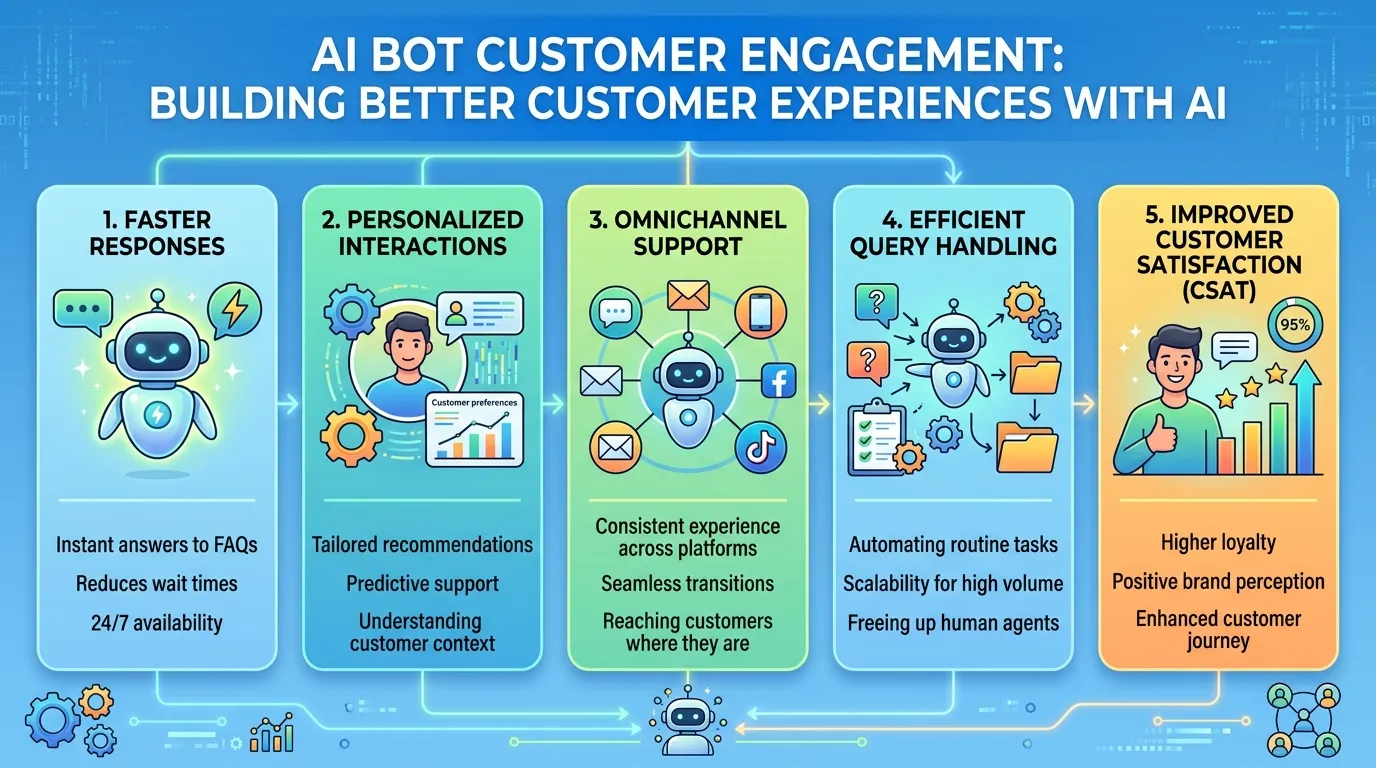
AI bot customer engagement helps businesses connect with customers through faster, personalized, and automated conversations. AI-powered bots can answer questions, provide recommendations, support customers, collect feedback, and guide users toward useful actions while improving efficiency and customer satisfaction.
Customer expectations have changed significantly as digital communication has become a major part of the buying and support experience. Customers often expect quick answers, personalized interactions, and convenient communication regardless of the time they contact a business. Traditional customer service processes may struggle to meet these expectations when teams have limited time or resources.
This is where AI bot customer engagement can provide valuable support. AI-powered bots can communicate with customers through websites, messaging platforms, applications, and other digital channels. They can respond to common questions, understand conversational requests, recommend relevant information, and help customers move through different stages of their journey.
Unlike simple rule-based chatbots, modern AI systems can provide more flexible and context-aware conversations. When implemented properly, they can support customer service teams while creating more consistent and responsive experiences.
What Is AI Bot Customer Engagement?
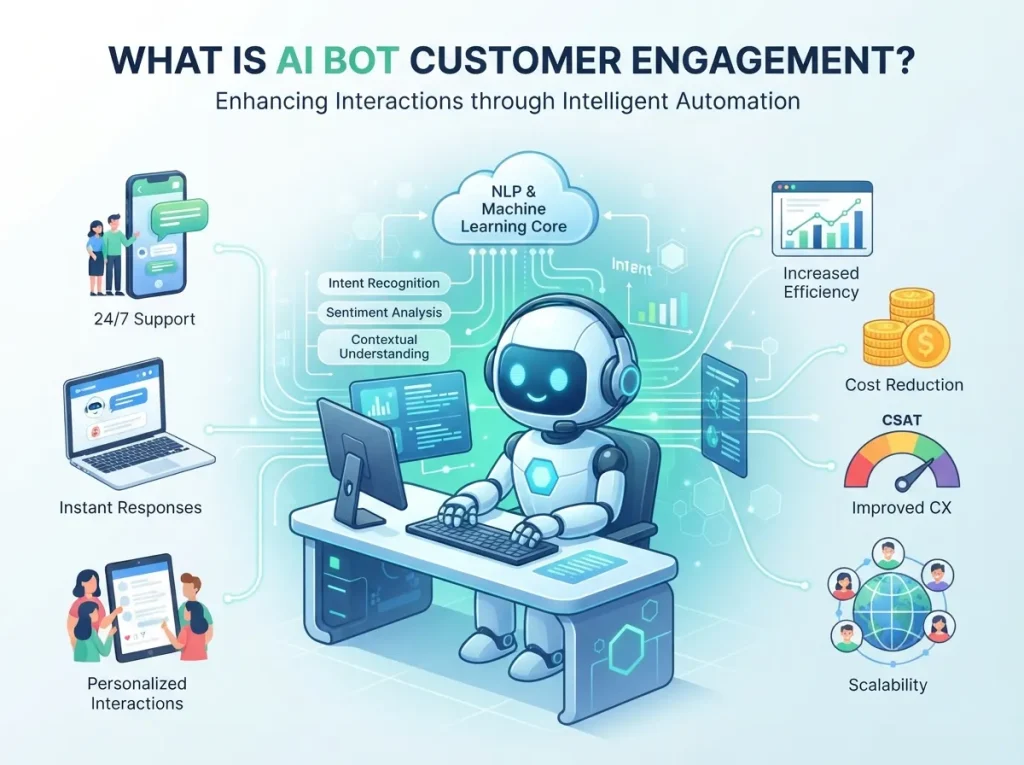
AI bot customer engagement refers to using artificial intelligence-powered bots to interact with customers and create meaningful digital experiences. These interactions can happen before, during, or after a purchase.
For example, a customer might ask about a product, request help with an order, look for a recommendation, or want information about a service. An AI bot can respond immediately and guide the customer toward an appropriate solution.
The goal is not simply to automate conversations. Effective engagement focuses on making interactions useful, relevant, and convenient. Businesses can use AI bots to understand customer needs, deliver personalized information, and create smoother communication throughout the customer journey.
Why AI Bots Are Important for Customer Engagement
Speed is one of the biggest advantages of AI-powered engagement. Customers do not always contact businesses during normal working hours, and waiting for a response can negatively affect their experience.
AI bots can provide immediate responses to many common questions. They can also handle multiple conversations simultaneously, helping businesses maintain communication when human teams are busy.
Another advantage is consistency. A well-designed AI system can provide standardized information across different customer interactions. This can reduce confusion and help businesses maintain a consistent communication experience.
AI can also support personalization. Instead of giving every customer exactly the same response, an intelligent system can use available context to make conversations more relevant.
AI Chatbot Customer Engagement
AI chatbot customer engagement combines conversational interfaces with artificial intelligence to make customer interactions more responsive and useful.
An AI chatbot can help customers discover products, answer frequently asked questions, provide account information, explain services, and direct complex requests to human representatives.
The effectiveness of these interactions depends heavily on the quality of the chatbot’s knowledge and conversational design. A bot should understand common customer questions and provide clear responses rather than forcing users through complicated menus.
Businesses can also use AI chatbots to identify customer intent. If someone is researching a product, the bot might provide information. If another customer needs technical assistance, it can guide them toward troubleshooting or human support.
AI-Powered Customer Engagement Across the Customer Journey
AI-powered customer engagement can support customers at multiple stages rather than being limited to customer service.
During the awareness stage, AI bots can answer questions and provide educational information. During consideration, they can help users compare products or understand features. During purchasing, they can answer last-minute questions and guide customers toward the right product or service.
After a purchase, AI bots can provide order information, onboarding assistance, troubleshooting, or product recommendations.
This creates a connected experience where customers can receive assistance throughout their relationship with a business.
Customer Engagement Chatbots for Better Communication
Customer engagement chatbots can serve as an accessible communication channel between customers and businesses. They can provide support on websites, social platforms, messaging applications, and other digital environments.
The most successful chatbots focus on usefulness rather than simply increasing the number of automated conversations. Customers should be able to accomplish something meaningful through the interaction.
For example, a chatbot could help a visitor find a product, book an appointment, understand a service, locate information, or resolve a simple problem.
When the bot cannot solve a customer’s issue, it should make the transition to human support easy. This prevents customers from becoming frustrated by repetitive automated responses.
AI Bots for Customer Service
AI bots for customer service can reduce the pressure on support teams by handling repetitive and predictable questions.
Common use cases include answering questions about business hours, products, shipping, pricing, account processes, returns, and basic troubleshooting. The bot can also collect relevant information before transferring a complex case to a human agent.
This can improve the overall support workflow because human representatives receive more context when they take over a conversation.
However, AI should not completely replace human support. Complex complaints, sensitive issues, unusual requests, and situations requiring judgment are often better handled by trained employees.
The best approach combines automation with human expertise.
Automated Customer Engagement

Automated customer engagement allows businesses to maintain communication without requiring employees to manually respond to every interaction.
Automation can be used for welcome messages, product recommendations, reminders, follow-ups, feedback requests, and customer education.
For example, after a customer interacts with a business, an AI system could provide relevant information or suggest the next step. Automation can also help re-engage customers who have previously shown interest in a product or service.
The important factor is relevance. Automated communication should be based on useful customer context rather than sending generic messages to everyone.
Businesses can also explore Chatbot Loyalty Programs to understand how chatbot-based interactions can support customer retention and encourage repeat engagement.
Conversational AI for Customer Engagement
Conversational AI for customer engagement focuses on creating interactions that feel more natural than traditional automated systems.
Instead of requiring customers to select predefined options, conversational AI can allow them to ask questions using everyday language. The system can interpret the request and respond accordingly.
This can make customer interactions more flexible. A customer might ask a long question containing several details, and the AI can attempt to understand the overall intent instead of requiring the person to navigate a rigid menu.
Natural conversations can also make digital experiences more accessible for users who prefer communicating through questions rather than searching through website pages.
AI Customer Interaction and Personalization
AI customer interaction becomes more valuable when conversations are personalized. Customers are more likely to engage with information that is relevant to their specific needs.
AI can use contextual information, where appropriate and responsibly collected, to tailor recommendations and responses. For example, a returning customer may receive information based on their previous interaction, while a new visitor may receive introductory assistance.
Personalization should always respect customer privacy and applicable data protection requirements. Businesses should be transparent about how customer information is used and avoid collecting unnecessary data.
The goal is to make communication more relevant without making customers feel that their privacy is being ignored.
Creating an Effective Chatbot Engagement Strategy
A successful chatbot engagement strategy begins with understanding customer needs. Businesses should identify the questions customers ask most frequently and the areas where automation can provide genuine value.
The bot should have a clear purpose. A chatbot designed to provide customer support will require different functionality from one designed primarily for product recommendations or lead generation.
Businesses should also establish clear escalation rules. When an AI bot cannot confidently resolve a request, customers should have an easy way to connect with a human.
Conversation design is equally important. Responses should be concise, helpful, and easy to understand. Customers should not have to read unnecessarily long messages to find the information they need.
Testing is another important part of the strategy. Businesses should regularly review conversations to identify misunderstandings, incomplete answers, and opportunities for improvement.
AI-Driven Customer Experience
AI-driven customer experience goes beyond individual chatbot conversations. It involves using artificial intelligence to improve different parts of the customer’s digital journey.
AI can help businesses identify customer intent, personalize recommendations, automate support, analyze interactions, and identify common customer concerns.
When these capabilities work together, businesses can create more connected experiences. A customer might begin with an AI chatbot, move to a product recommendation, complete a purchase, and later receive automated support.
The experience becomes more seamless because AI supports the customer across multiple stages.
Businesses interested in expanding their AI chatbot capabilities can also explore AI Chatbot for Marketing, which covers how AI chatbots can support broader marketing activities.
Automated Customer Communication
Automated customer communication can help businesses stay connected with customers while reducing repetitive manual work.
AI-powered communication can support appointment reminders, order updates, onboarding messages, product education, feedback requests, and follow-up interactions.
However, automation should not make communication feel robotic. Businesses should carefully design messages around customer intent and provide opportunities for customers to request human assistance.
Timing also matters. Sending too many automated messages can reduce engagement and create frustration. A strong strategy focuses on sending the right information at the right stage of the customer journey.
Using AI Bots to Improve Customer Retention
Customer engagement does not end when a customer completes a purchase. Businesses need to continue providing value if they want to build long-term relationships.
AI bots can support retention by answering post-purchase questions, providing product assistance, recommending relevant products, collecting feedback, and reminding customers about useful services.
Loyalty programs can also become more interactive when combined with conversational experiences. Customers may be able to check rewards, discover offers, or receive personalized recommendations directly through a chatbot.
This makes engagement more convenient while giving businesses additional opportunities to maintain relationships with existing customers.
AI Bots and Human Customer Support
AI bots work best when they complement human support rather than completely replacing it.
Simple and repetitive requests can often be automated, allowing employees to focus on complicated issues that require empathy, judgment, or specialized knowledge.
A good system should therefore create a smooth handoff between AI and human agents. When a conversation is transferred, the customer should not have to repeat all the information they have already provided.
Human representatives can then review the conversation and continue from the appropriate point.
This combination can improve efficiency while preserving the personal aspect of customer service.
Measuring AI Bot Customer Engagement

Businesses need to measure whether their AI bot is actually improving customer engagement. Useful metrics can include conversation volume, response time, engagement rate, resolution rate, customer satisfaction, conversion rate, and escalation rate.
Businesses can also examine where customers leave conversations or repeatedly ask the same questions. These patterns can reveal problems with chatbot responses or conversation design.
Customer feedback is particularly valuable. Even if an AI bot resolves a large number of conversations, customers may still be dissatisfied if the interactions feel confusing or unhelpful.
Performance measurement should therefore combine quantitative data with qualitative feedback.
Common Mistakes to Avoid
One common mistake is trying to automate everything. Not every customer interaction should be handled by an AI bot. Complex and sensitive situations often require human support.
Another mistake is providing overly generic responses. If the bot cannot understand customer intent, the experience may feel frustrating rather than helpful.
Businesses should also avoid making the chatbot difficult to escape. Customers should always have a clear way to request human assistance when necessary.
Poorly maintained knowledge bases can create another problem. If information changes but the AI system is not updated, customers may receive inaccurate answers.
Finally, businesses should not measure success only by the number of conversations handled. The real objective is to improve the customer experience and create useful business outcomes.
The Future of AI Bot Customer Engagement
AI bot customer engagement will continue to evolve as conversational AI becomes more capable and businesses collect more customer experience insights.
Future systems are likely to become more contextual, personalized, and integrated with other business platforms. AI bots may increasingly connect customer service, marketing, sales, loyalty, and product support into a more unified experience.
Businesses can also use AI-driven chatbot marketing to create more personalized interactions throughout the customer lifecycle. For additional ideas, Mastering AI-Driven Chatbot Marketing explores how AI can be incorporated into modern chatbot marketing strategies.
The businesses that benefit most will be those that use AI thoughtfully. Technology should solve genuine customer problems rather than being implemented simply because automation is available.
AI Bots for Event and Webinar Engagement
Businesses can also use AI bots to improve engagement around events, webinars, and virtual experiences. Chatbots can help answer attendee questions, provide event details, send reminders, assist with registration, and keep participants engaged before and after an event. Brands looking to strengthen their event strategy can also explore Virtual Event Marketing Best Practices to learn more about improving attendance and engagement through effective virtual event promotion.
Conclusion
AI bot customer engagement gives businesses an opportunity to provide faster, more personalized, and more convenient customer experiences. From AI chatbot customer engagement and customer service to personalized recommendations and automated communication, AI can support customers across many stages of their journey.
The most effective approach combines automation with human support. Businesses should focus on useful conversations, relevant personalization, clear escalation paths, responsible data practices, and continuous improvement.
When implemented strategically, AI bots can become more than automated support tools. They can become an important part of a customer experience strategy that improves engagement, strengthens relationships, and supports long-term business growth.
Frequently Asked Questions
1. What is AI bot customer engagement?
AI bot customer engagement is the use of artificial intelligence-powered bots to communicate with customers, answer questions, provide assistance, personalize interactions, and support different stages of the customer journey.
2. How can AI bots improve customer engagement?
AI bots can improve engagement by providing fast responses, personalized information, 24/7 assistance, product recommendations, automated follow-ups, and convenient communication across digital channels.
3. What are customer engagement chatbots used for?
Customer engagement chatbots can be used for customer support, product recommendations, lead qualification, feedback collection, order assistance, loyalty programs, FAQs, and personalized communication.
4. Can AI bots replace customer service teams?
AI bots can handle many repetitive customer service tasks, but they should not completely replace human teams. Complex, sensitive, or unusual issues often require human judgment and empathy.
5. What is conversational AI for customer engagement?
Conversational AI for customer engagement uses artificial intelligence to understand natural-language customer requests and respond through more flexible, human-like conversations.
6. How does AI personalize customer interactions?
AI can use relevant customer context and interaction data to provide more personalized recommendations, responses, and follow-ups. Businesses should use customer information responsibly and respect applicable privacy requirements.
7. What is a chatbot engagement strategy?
A chatbot engagement strategy is a plan for using chatbots to improve customer communication. It includes defining chatbot goals, identifying customer needs, designing conversations, personalizing interactions, and creating human-support escalation paths.
8. How can businesses measure AI bot engagement?
Businesses can measure AI bot engagement using metrics such as conversation volume, engagement rate, response time, resolution rate, customer satisfaction, conversions, and human escalation rates.
9. Are AI bots useful for customer retention?
Yes. AI bots can support retention by providing post-purchase assistance, personalized recommendations, loyalty information, feedback requests, and ongoing customer communication.
10. What is the biggest benefit of AI-powered customer engagement?
One of the biggest benefits is the ability to provide fast and scalable customer interactions while maintaining opportunities for personalization. AI can handle routine conversations while human employees focus on more complex customer needs.