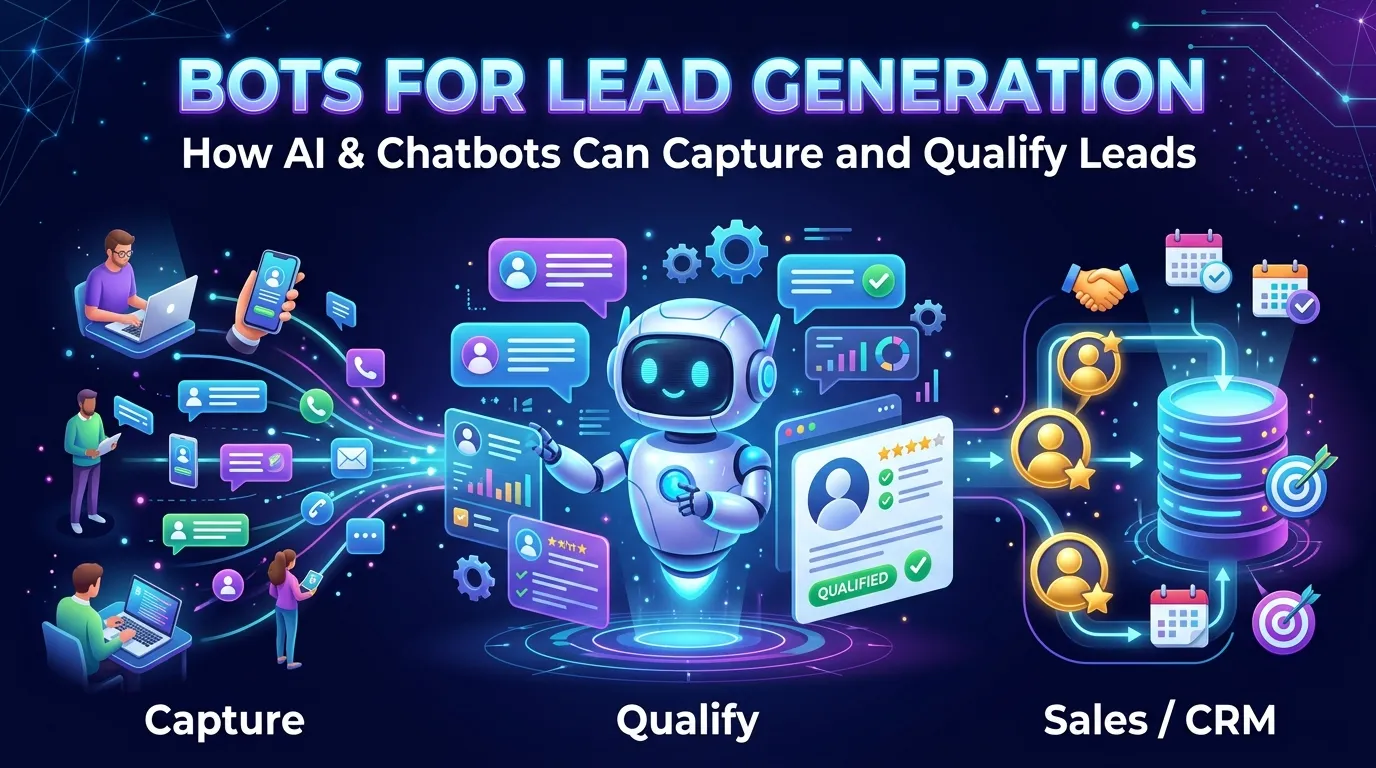
Bots for lead generation help businesses attract, engage, capture, and qualify potential customers through automated conversations. AI-powered bots can answer questions, collect lead information, personalize interactions, and connect qualified prospects with sales teams.
Businesses are constantly looking for better ways to attract potential customers, respond to inquiries, and turn website visitors into qualified leads. Traditional lead generation methods can work well, but they often depend on forms, emails, phone calls, and manual follow-ups. These approaches can become difficult to manage when a business receives a large number of visitors or inquiries.
This is where bots for lead generation can make a significant difference. AI-powered bots and chatbots can interact with visitors in real time, answer questions, collect contact information, understand customer needs, and guide prospects toward the next step.
Modern businesses can use bots across websites, landing pages, messaging platforms, and event campaigns. When properly designed, they can create a faster and more personalized experience while helping marketing and sales teams focus on the most valuable prospects.
What Are Bots for Lead Generation?
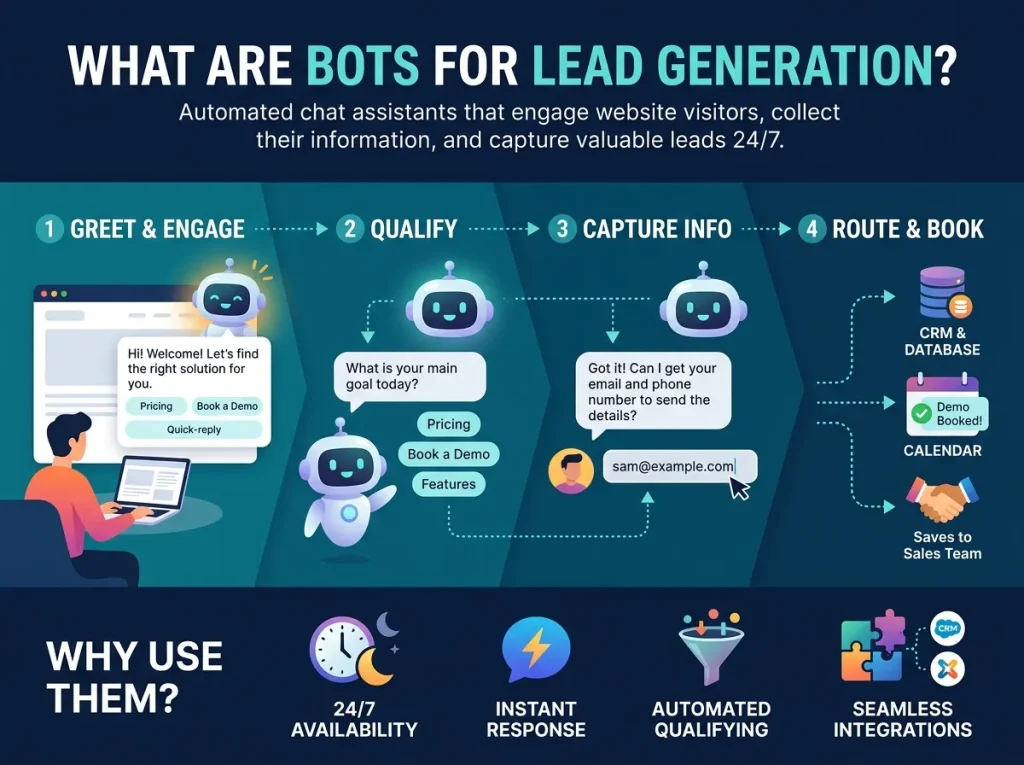
Bots for lead generation are automated software tools designed to attract, engage, capture, and qualify potential customers. They can communicate with website visitors or prospects through conversational interfaces and collect information that helps businesses understand their interests.
A lead generation bot may ask visitors about their needs, industry, budget, company size, or preferred service. It can then recommend relevant information or encourage the visitor to complete an action such as booking a consultation, requesting a demo, or submitting contact details.
Unlike a traditional contact form, a conversational bot can guide visitors through the process one question at a time. This can make lead capture feel more interactive and less demanding.
The most effective bots do not simply collect names and email addresses. They provide useful assistance while gathering information that can help businesses determine whether a visitor is a suitable prospect.
Why Businesses Are Using Lead Generation Bots
Visitors often leave websites without filling out a form because they cannot immediately find the information they need. Others may have questions that prevent them from taking the next step.
Lead generation bots can address these problems by providing immediate assistance. A visitor can ask a question and receive an automated response without waiting for a sales representative.
Bots can also operate outside normal business hours. A potential customer visiting a website at night can still receive answers, provide contact information, or request a follow-up.
Another advantage is consistency. A well-designed bot can follow the same lead capture process for every visitor while adapting questions according to the person’s responses.
This creates opportunities for businesses to generate more leads without requiring sales teams to manually handle every initial interaction.
How AI Bots for Lead Generation Work
AI bots for lead generation use conversational technology to understand user input and respond according to predefined rules, artificial intelligence, or a combination of both.
A simple bot may use buttons and predefined questions. More advanced systems can interpret natural language and provide responses based on the visitor’s questions and context.
For example, a visitor might type, “I need marketing software for a small business.” An AI-powered bot could ask what type of marketing the visitor wants to automate, recommend an appropriate resource, and request an email address for additional information.
The bot can also identify signals that suggest strong purchase intent. Someone asking about pricing, implementation, or product demonstrations may be closer to making a decision than someone simply asking a general educational question.
This information can help businesses prioritize leads and create more relevant follow-up experiences.
Using Lead Generation Chatbots on Business Websites
Lead generation chatbots are commonly placed on websites where visitors can interact with them through a chat window.
The chatbot can appear on a homepage, service page, pricing page, blog article, or landing page. Its questions can be adapted according to the purpose of each page.
For example, a chatbot on a pricing page might help visitors understand plans and encourage them to request a consultation. A chatbot on a blog could recommend related resources and ask whether the visitor wants to receive additional information.
The goal should not be to interrupt visitors constantly. A chatbot should appear at an appropriate time and provide a clear reason for starting a conversation.
Good conversational design makes the experience helpful rather than intrusive.
Automated Lead Generation Bots and Lead Capture
Automated lead generation bots can reduce the amount of manual work required during the early stages of lead generation.
Instead of waiting for a visitor to submit a form and then manually reviewing every submission, a bot can collect information and organize prospects based on their responses.
For example, a business could ask visitors about their company size, business needs, preferred service, and timeline. The bot could then categorize the visitor as a potential customer, existing customer, or general information seeker.
This automation can help sales teams focus their attention on leads that show stronger buying signals.
Automation also makes it possible to maintain consistent lead capture processes across multiple pages and campaigns.
Chatbots for Capturing Leads
Chatbots for capturing leads should make the conversion process simple and relevant. Asking too many questions at the beginning can discourage visitors, while asking too few questions may provide insufficient information for sales teams.
A useful approach is to start with a simple question that encourages engagement. Once the visitor responds, the bot can gradually collect additional information.
For example, the conversation might begin with:
“What are you looking for today?”
The visitor can then select an option such as product information, pricing, support, consultation, or general information.
Based on the response, the bot can ask more specific questions.
This conversational approach can feel more natural than presenting visitors with a long form containing multiple fields.
Businesses can also use interactive elements to make chatbot experiences more engaging. Gamification can encourage participation when it is relevant to the audience. For example, Gamify Your Chatbot explores how game mechanics can be used to make chatbot interactions more engaging.
AI-Powered Lead Generation
AI-powered lead generation can go beyond basic question-and-answer automation. AI can help bots understand user intent, personalize responses, analyze conversations, and identify potential buying signals.
For example, two visitors may ask different questions about the same product. An AI-powered system can interpret their questions and provide responses that match their individual interests.
AI can also help businesses identify patterns across conversations. If many visitors repeatedly ask about a particular feature, pricing concern, or implementation issue, the business can use that information to improve its website and marketing content.
However, AI should not be used simply because it is available. Businesses should first identify the customer problem they want the bot to solve and then select technology that supports that objective.
Conversational Lead Generation
Conversational lead generation focuses on turning traditional lead capture into an interactive conversation.
Instead of asking a visitor to complete a static form, businesses can guide the person through a series of questions. The conversation can be personalized based on the visitor’s answers.
This approach can be particularly useful for complex B2B services where visitors may need guidance before deciding what they need.
For example, a digital marketing agency could ask whether a visitor needs SEO, content marketing, paid advertising, social media marketing, or a combination of services. The bot could then recommend the most relevant information and collect contact details if the visitor wants further assistance.
Conversational experiences can also help businesses understand customers better because the questions and responses reveal more context than a basic form submission.
Chatbot Lead Qualification
Generating a large number of leads is not enough if most of them are unlikely to become customers. Chatbot lead qualification helps businesses identify which prospects may be more valuable.
A chatbot can ask qualification questions related to company size, industry, budget, project requirements, timeline, or decision-making authority.
For example, a software company selling enterprise solutions could ask whether the visitor represents a small business, mid-sized company, or enterprise organization.
The chatbot can then assign different categories to the lead based on the responses.
Qualified leads can be sent to a CRM or sales team for follow-up, while less qualified visitors can receive educational content instead.
This creates a more efficient connection between marketing and sales.
Automated Lead Capture
Automated lead capture allows businesses to collect contact information without requiring employees to monitor every interaction.
Once a visitor shows interest, the chatbot can request an email address, phone number, or other appropriate information. The data can then be transferred to a CRM or marketing automation platform, depending on the company’s technology setup.
The process should always be transparent. Visitors should understand why their information is being requested and what will happen after they provide it.
Businesses should also avoid asking for unnecessary information. A simple email address may be enough for an early-stage interaction, while additional qualification information can be collected later.
Reducing unnecessary friction can make the lead capture experience more user-friendly.
Lead Generation Automation Bots Across Marketing Channels
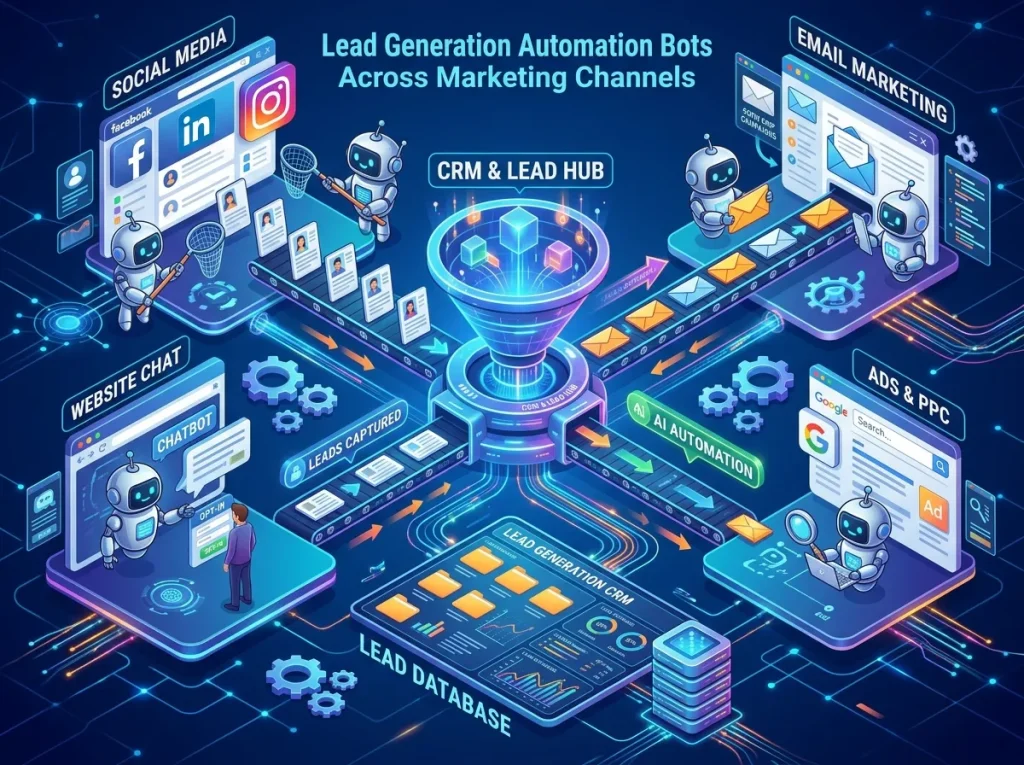
Lead generation automation bots are not limited to websites. Businesses can use automated conversations across different digital channels depending on where their audiences spend time.
Bots can support social media campaigns, messaging platforms, landing pages, email experiences, and digital events.
Event marketing is one example where conversational automation can be useful. Before an event, a bot can help potential attendees find information and register. During the event, it can answer common questions and guide participants toward sessions or resources.
After an event, the bot can help collect feedback, recommend relevant content, and identify attendees who may be interested in speaking with a sales representative.
Businesses that use event campaigns can also connect chatbot data with broader performance measurement. Resources such as Event Marketing KPIs can help marketers think about how engagement and conversions should be measured across event activities.
Personalizing Bots for Better Lead Generation
Personalization can make chatbot conversations more relevant. A bot can use information such as the visitor’s page, previous interaction, selected interest, or responses during the conversation to adjust its messaging.
For example, a visitor reading an article about email automation could receive recommendations related to email marketing rather than generic company information.
Personalization should have a clear purpose. It should help visitors find useful information faster rather than simply making the interaction appear more sophisticated.
Businesses interested in improving this area can explore Chatbot Personalization, which focuses on using personalized chatbot experiences to improve customer experience and conversions.
Using Bots to Improve the Customer Journey
Lead generation should not be treated as an isolated activity. A chatbot can support different stages of the customer journey.
At the awareness stage, the bot can answer basic questions and recommend educational content. During consideration, it can help visitors compare options or explain features. At the decision stage, it can assist with pricing questions, product demonstrations, or consultation requests.
After a conversion, the same technology can help with onboarding, support, or additional product recommendations.
This creates a more connected experience between marketing, sales, and customer service.
Measuring Lead Generation Bot Performance
Businesses should track chatbot performance to understand whether their investment is producing meaningful results.
Useful metrics can include the number of chatbot conversations, engagement rate, completed conversations, contact information collected, qualified leads, booked meetings, conversion rates, and revenue generated from chatbot-assisted leads.
The quality of leads is especially important.
A chatbot that generates hundreds of contacts may appear successful, but if those contacts rarely become customers, the strategy may need improvement.
Businesses should also monitor where users abandon conversations. If many visitors stop responding after a particular question, the question may be confusing, unnecessary, or too intrusive.
Regular testing can improve both engagement and conversion performance.
Common Mistakes When Using Bots for Lead Generation
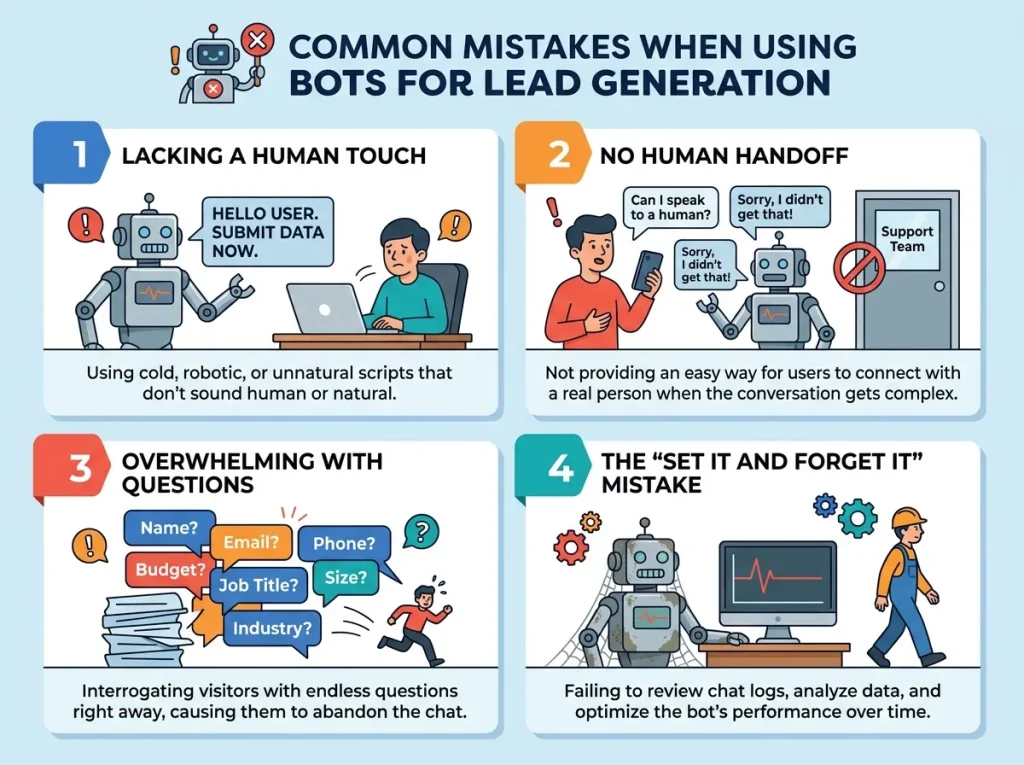
One common mistake is making the chatbot too aggressive. Constant pop-ups or immediate sales messages can frustrate visitors.
Another problem is creating overly long conversations. Visitors should not have to answer dozens of questions before receiving useful information.
Businesses should also avoid making the bot pretend to be human when it is not. Clear communication helps build trust.
Poorly designed responses can also damage the user experience. If the bot cannot answer a question, it should provide a useful alternative, such as directing the visitor to a relevant resource or offering contact with a human representative.
Finally, businesses should not ignore the data collected by their bots. Information from conversations can provide valuable insights into customer needs, objections, and buying behavior.
The Role of Bots in Event Lead Generation
Events can generate large numbers of interactions, making automation particularly valuable. Chatbots can help attendees find event information, discover sessions, receive reminders, and connect with exhibitors or sales teams.
A chatbot can also support lead collection during and after an event. For example, attendees could answer a few questions about their interests and receive recommendations for relevant sessions or resources.
This can make event engagement more personalized while giving marketers additional information about attendee interests.
For businesses exploring this approach, Chatbot-Driven Event Marketing provides another perspective on using conversational technology to improve attendee engagement.
Conclusion
Bots for lead generation can help businesses create faster, more interactive, and more efficient ways to attract and qualify potential customers. From lead generation bots and AI bots for lead generation to chatbot lead qualification and automated lead capture, these technologies can support many parts of the modern customer journey.
The most effective approach is not simply to automate every interaction. Businesses should design bots around genuine customer needs, keep conversations simple, provide useful answers, and connect qualified leads with the right follow-up process.
When combined with personalization, content, CRM systems, and marketing automation, lead generation bots can become a valuable part of a broader digital marketing strategy.
Frequently Asked Questions
1. What are bots for lead generation?
Bots for lead generation are automated tools that interact with potential customers and help businesses capture and qualify leads. They can answer questions, collect contact details, identify customer needs, and guide visitors toward actions such as booking a meeting or requesting a demonstration.
2. How do lead generation bots work?
Lead generation bots start conversations with visitors and ask relevant questions based on their needs or behavior. They can collect contact information, provide useful resources, qualify prospects, and send valuable lead information to marketing or sales systems.
3. Are AI bots effective for lead generation?
AI bots can be effective because they can understand natural language, personalize responses, and identify potential buying signals. Their effectiveness depends on how well they are designed, the quality of their information, and how they connect with the company’s overall sales and marketing process.
4. What is the difference between a chatbot and a lead generation bot?
A chatbot is a broad term for software that communicates with users. A lead generation bot is specifically designed to support lead acquisition by engaging visitors, collecting information, qualifying prospects, and encouraging conversions.
5. Can chatbots qualify leads?
Yes. Chatbots can ask qualification questions about factors such as business needs, company size, budget, industry, project timeline, and purchasing intent. Based on the answers, leads can be categorized and directed to the appropriate sales or marketing process.
6. How do chatbots capture leads?
Chatbots can capture leads by asking visitors for information such as an email address or phone number after providing useful assistance. They can also collect information about customer requirements and send that data to a CRM or marketing platform.
7. Can lead generation bots work outside business hours?
Yes. Automated bots can operate around the clock, allowing visitors to ask questions and provide information even when a sales or customer service team is unavailable. This can help businesses avoid missing potential opportunities outside normal working hours.
8. How can businesses improve chatbot lead generation?
Businesses can improve chatbot lead generation by keeping conversations simple, asking relevant questions, personalizing responses, providing useful information, using clear calls to action, and regularly analyzing conversion and abandonment data.
9. Can bots be used for B2B lead generation?
Yes. Bots can be particularly useful for B2B lead generation because they can collect detailed information about business needs, company size, project requirements, and purchase timelines. This information can help sales teams identify and prioritize qualified prospects.
10. How should businesses measure lead generation chatbot performance?
Businesses can measure performance using metrics such as conversations started, engagement rate, completed conversations, leads captured, qualified leads, meetings booked, conversion rate, and revenue influenced by chatbot interactions. Lead quality should be considered alongside the total number of leads generated.