Chatbot message timing determines when automated messages appear and how quickly bots respond to users. Effective scheduling combines contextual triggers, appropriate response delays, behavioral signals, and frequency controls to make conversations more useful. By measuring engagement, task completion, customer satisfaction, and conversion outcomes, businesses can deliver relevant messages without overwhelming users.
Chatbot message timing plays an important role in shaping how users experience automated conversations. Even a helpful message can feel intrusive if it appears too early, arrives too frequently, or interrupts a user who is trying to complete a task. On the other hand, a well-timed message can answer a question, remove uncertainty, and encourage users to continue interacting with a business.
Effective chatbot communication depends on more than the content of a response. Businesses must also consider when a message appears, how long a bot waits before responding, and whether the timing matches the user’s behavior and expectations. These decisions influence engagement, customer satisfaction, and the likelihood that a conversation will lead to a meaningful outcome.
A thoughtful approach to chatbot message scheduling helps businesses create conversations that feel relevant rather than mechanical. By combining user behavior, conversational context, and clear communication rules, organizations can deliver messages that support customers without overwhelming them.
Why Chatbot Message Timing Matters
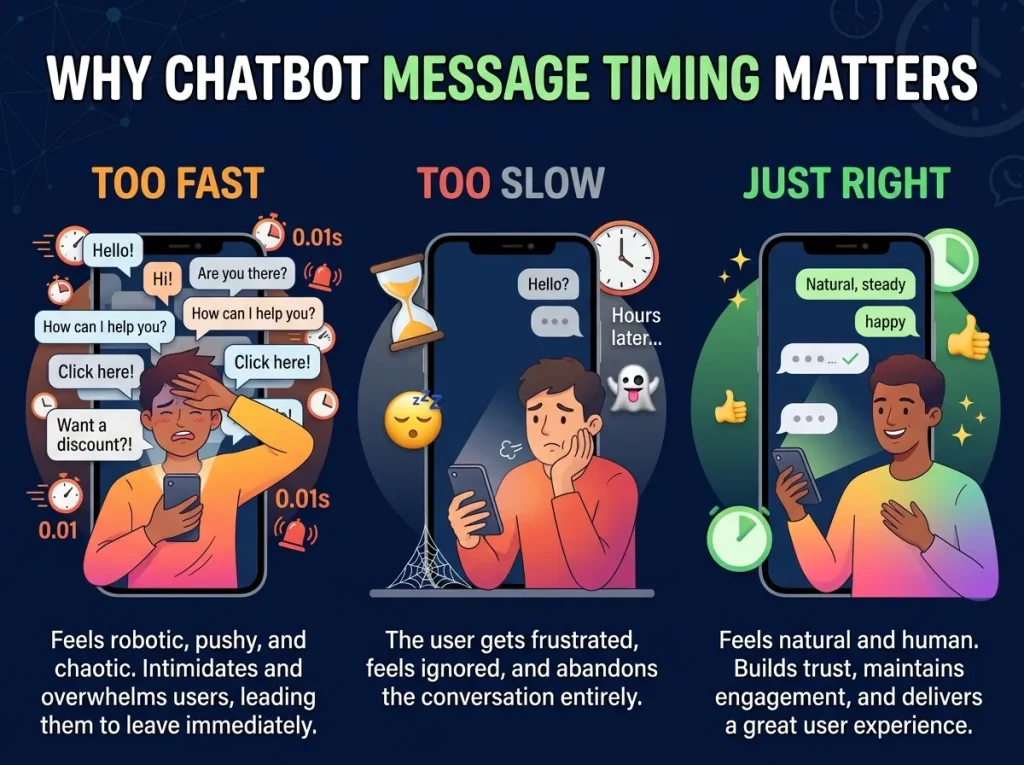
Users expect digital conversations to feel responsive, but instant messaging is not always the best solution. A chatbot that immediately displays several promotional messages may distract visitors before they understand the website or decide what they need. Similarly, a bot that takes too long to acknowledge a question can make users feel ignored.
Optimal chatbot response timing depends on the purpose of the interaction. A customer asking about an order status generally expects a quick answer, while a visitor exploring a complicated service may benefit from a more gradual conversation. The timing should reflect the urgency and complexity of the request rather than follow one fixed rule for every situation.
Timing also affects how people interpret a chatbot’s intentions. A message that appears after a user encounters a relevant problem can feel helpful. The same message, delivered without context, may feel like an unwanted sales interruption. This difference can influence whether users engage with the bot, dismiss it, or leave the website.
Businesses should therefore treat timing as part of the overall conversational experience. The goal is not to send the greatest number of messages or minimize every delay. It is to provide useful assistance at moments when users are most likely to welcome it.
Finding the Right Moment to Start a Conversation
The first chatbot message establishes the tone for the entire interaction. If a greeting appears immediately when someone opens a website, it may be useful when the visitor needs urgent assistance. However, on other pages, an immediate pop-up can interrupt reading or prevent users from understanding the information already available.
Chatbot message scheduling allows businesses to decide when an opening message should appear. The timing can depend on factors such as the page being viewed, the visitor’s actions, the type of service offered, or whether the user has already interacted with the chatbot during the session.
For example, a visitor browsing a product page might benefit from an invitation to ask about features after spending some time reviewing the product. Someone visiting a help center, however, may appreciate immediate access to support because their purpose is already clear.
The opening message should also communicate its value. Instead of displaying a generic greeting without direction, a chatbot can offer a relevant option, such as help comparing products, finding information, or resolving a common question. The invitation should make it easy for users to decide whether to participate.
Businesses can test different opening conditions to understand which ones encourage useful conversations. The most effective schedule is not necessarily the one that generates the most clicks. It should help users access assistance without disrupting their original purpose for visiting the site.
How Long Should a Chatbot Wait Before Responding?
Conversational message timing includes the interval between a user’s message and the chatbot’s reply. A response that arrives quickly can create a smooth interaction, particularly when someone asks a simple question. Unnecessary waiting can make automated support feel inefficient and reduce confidence in the system.
However, every response does not need to appear at exactly the same speed. Some requests require a database lookup, an order-status check, or a more complex process. When an answer takes longer, the chatbot can acknowledge the request and explain that it is checking the information rather than leaving the user uncertain.
For straightforward questions, a short response delay is usually preferable. When the system must retrieve information or complete a task, a brief progress message can maintain transparency. If the request requires a human representative, the chatbot should communicate the next step clearly instead of repeatedly sending automated replies that do not resolve the issue.
Response timing should also account for the user’s previous message. A detailed question may require a more complete answer, while a simple confirmation can often be handled with a concise response. The system should prioritize relevance and clarity over artificial pauses designed only to make automation appear more human.
A reliable chatbot should never use delay as a substitute for useful communication. When waiting is necessary, the user should understand what is happening and whether further action is required.
Matching Message Timing to User Behavior
User behavior-based messaging adjusts communication according to what users do during an interaction. Rather than sending every visitor the same message at the same moment, a chatbot can respond to relevant signals such as repeated questions, navigation patterns, product comparisons, or requests for additional information.
For instance, a visitor who repeatedly checks shipping details may need reassurance about delivery options. A person exploring several service pages may be comparing providers and could benefit from a clear explanation of available plans. A customer who has already found the answer to a question may not need another follow-up message.
These behavioral signals should be interpreted carefully. Spending a long time on a page does not always mean someone is interested in buying; the visitor might have stepped away or left the page open. Repeated visits may indicate interest, but they can also reflect confusion. Timing decisions should therefore combine behavioral signals with the context of the conversation instead of treating one action as conclusive evidence.
Personalized message scheduling can make interactions more relevant when it uses appropriate information and respects user preferences. Businesses should avoid collecting unnecessary data or making sensitive assumptions about visitors. Clear consent practices, transparent messaging, and easy ways to dismiss or control nonessential messages help maintain trust.
When used thoughtfully, behavior-based timing allows a chatbot to respond to the user’s situation instead of following a rigid sequence of automated prompts.
Designing Conversational Timing That Feels Natural

A successful chatbot conversation has a rhythm. Messages should appear in a logical order, provide enough information for the user to respond, and avoid creating pressure to continue. If a bot asks several questions at once or sends follow-up prompts before the user has time to answer, the conversation can feel confusing and demanding.
Chatbot interaction timing should reflect the structure of the conversation. A bot collecting information for a service request might ask one clear question, wait for the response, and then continue. A chatbot explaining a complicated process might divide the information into manageable parts, allowing users to request additional details when needed.
The way a chatbot communicates is just as important as its schedule. A thoughtful chatbot interaction design approach helps align message order, question format, response options, and conversational pacing with the user’s needs. This makes it easier for users to understand what the bot is asking and what they can do next.
Businesses should also provide clear exits from the conversation. Users may want to return to browsing, speak with a person, or stop receiving prompts. A well-designed interaction respects these choices rather than repeatedly trying to restart a conversation after the user has declined assistance.
Natural timing does not mean imitating every aspect of human conversation. It means avoiding unnecessary interruptions, responding consistently, and giving users enough control to move through the interaction at a comfortable pace.
Automated Message Delivery Without Overwhelming Users
Automated message delivery allows chatbots to send acknowledgments, reminders, updates, and follow-up messages according to defined conditions. This can improve consistency and reduce the need for staff to manually manage every communication. However, automation becomes counterproductive when messages are repetitive, irrelevant, or delivered too frequently.
A useful messaging schedule distinguishes between essential updates and optional engagement prompts. An order confirmation, for example, provides information the customer expects. A promotional follow-up may be less important and should not interrupt a customer who is already receiving several notifications.
Frequency controls help prevent excessive communication. Businesses can establish limits on how many nonessential messages a user receives within a particular period and suppress additional prompts when the user has already completed the relevant action. A customer who has submitted a support request should not continue receiving messages asking whether they need help with the same issue.
Automated sequences should also respond to changing circumstances. If a customer completes a purchase, cancels a request, or asks to speak with a representative, the chatbot should update the conversation state and stop messages that no longer apply.
These safeguards are especially valuable for customer relationships that continue beyond a single session. A consistent marketing bot customer retention approach can use relevant communication to maintain engagement while avoiding excessive reminders or repetitive promotional messages.
The purpose of automation is to make communication more dependable, not to increase the volume of messages. Every scheduled message should have a clear reason for being sent.
Real-Time Chatbot Messaging and Contextual Responses
Real-time chatbot messaging allows a bot to respond to current user actions, requests, or changes in a service process. It is particularly useful when information loses value if it arrives too late. Examples include delivery updates, account notifications, appointment confirmations, and immediate assistance during a checkout process.
Real-time messaging works best when the information is relevant to the user’s current situation. If a customer asks about a delayed order, an updated status can be more useful than a generic explanation of the shipping policy. If someone encounters an error while submitting a form, a prompt explaining how to correct the issue can prevent unnecessary frustration.
Not every event requires an immediate notification. Sending a message for every small system change may create noise and distract users from important information. Businesses should distinguish between events that require immediate attention and updates that can be grouped into a single notification.
The chatbot should also avoid presenting outdated information as current. If a response depends on a live inventory check, account record, or booking status, the system should retrieve the relevant data before confirming the result. When live information is unavailable, the bot should explain the limitation instead of inventing an answer.
A good real-time messaging system combines responsiveness with accuracy. Fast communication is valuable only when the message is reliable and useful.
Using Chatbot Engagement Timing to Encourage Participation
Chatbot engagement timing focuses on identifying moments when users are likely to benefit from an invitation to continue interacting. The objective is not simply to increase conversation starts but to encourage meaningful participation that supports the user’s needs.
A message might invite a visitor to explore a relevant feature after they view a product explanation, offer assistance when they encounter a common obstacle, or provide a useful next step after a question has been answered. The invitation should relate directly to the activity that triggered it.
Businesses can evaluate engagement timing through several indicators, including conversation-start rates, response rates, completed interactions, user satisfaction, and abandonment rates. These measures reveal whether prompts are helping users or merely attracting brief attention.
For example, an opening message might generate many clicks but lead to few completed conversations. Another message might attract fewer users but help a larger proportion resolve their questions. The second approach may provide greater value even though its initial engagement rate is lower.
Engagement also depends on message clarity. A short invitation with a specific benefit is generally easier to understand than a long promotional message with several unrelated options. Users should be able to identify why the chatbot is contacting them and what they can expect if they respond.
Businesses should review both immediate engagement and longer-term effects. If frequent prompts increase short-term interaction but also lead to more dismissals or complaints, the timing strategy may need adjustment.
Personalization and Message Timing Across the Customer Lifecycle
The appropriate timing of a chatbot message can change as the customer relationship develops. A first-time visitor may need help understanding a product, while an existing customer may want assistance with an account, delivery, or troubleshooting. Applying the same messaging schedule to both groups can make the experience less relevant.
Personalized message scheduling can account for the stage of the customer journey, the user’s stated preferences, and the purpose of the interaction. A new visitor might receive a contextual invitation to explore product information, while an existing customer who requests support should receive direct assistance without unnecessary promotional prompts.
Timing should also change according to the result of previous interactions. If a customer has already received an answer, the bot should avoid asking the same question again. If the user has requested a follow-up at a particular time, the system should respect that preference where its capabilities and permissions allow it.
Personalization does not require using every available piece of customer data. Often, the most helpful signals are simple and directly related to the current task. A user’s selected product, recent support question, or explicit request for an update may provide enough context to improve the message.
A responsible approach keeps personalization transparent and proportionate. Businesses should follow applicable privacy requirements, honor communication preferences, and avoid using inferred behavior to pressure users into decisions.
Chatbot Message Timing and Conversion Optimization
Timing can influence conversions by determining whether users receive assistance at a useful point in their decision-making process. A visitor who is uncertain about pricing may benefit from a clear explanation, while someone who has already completed checkout should not receive a message encouraging them to buy the same product again.
Chatbot conversion optimization depends on understanding where users encounter obstacles and whether a timely message can help resolve them. Businesses can examine conversation transcripts, common questions, checkout abandonment patterns, and task completion data to identify opportunities for relevant assistance.
For example, if users frequently ask about a feature before selecting a plan, the chatbot might offer a concise explanation when the relevant information is needed. If customers abandon a form because they do not understand a required field, contextual assistance may be more useful than a general follow-up message sent several minutes later.
Timing experiments can compare different trigger conditions, delays, and message wording. However, businesses should test one meaningful change at a time when possible and ensure that comparisons account for differences in traffic and user behavior. A higher conversion rate does not automatically mean the message improved the experience if it also increased complaints or interrupted users.
An effective chatbot conversion optimization approach evaluates both business outcomes and user experience. Relevant measures may include completed purchases, qualified leads, task completion, support resolution, and message dismissal rates.
The strongest results often come from removing friction rather than increasing pressure. A well-timed answer that resolves a real concern can be more effective than repeated prompts urging a visitor to act.
Reducing Response Delays and Handling Complex Requests
Chatbot response delay can damage the experience when users do not know whether the system has received their message or is still processing a request. Delays may occur because of slow integrations, overloaded systems, complex queries, or temporary service interruptions.
Businesses should monitor response times across common interaction types instead of relying only on an overall average. A chatbot may respond quickly to basic questions but take considerably longer when checking order information or retrieving account details. Understanding these differences helps teams identify where improvements are needed.
When processing takes longer than expected, the chatbot can acknowledge the request and communicate a realistic next step. It should avoid repeatedly displaying the same waiting message or promising a completion time that the system cannot support.
Complex questions also require an appropriate fallback. If the bot cannot confidently resolve an issue, it should ask a focused clarification question, provide a relevant alternative, or transfer the conversation to a human agent when available. The user should not have to repeat the same information unnecessarily during the handoff.
Customer support automation can help teams manage routine requests and prioritize more complex cases. A well-implemented customer support automation system can reduce repetitive work while allowing people to focus on cases that require judgment, empathy, or specialized knowledge.
Improving response speed is therefore not just a matter of making the bot reply faster. It also involves making sure that each response advances the user’s request and that difficult cases receive an appropriate resolution.
Measuring and Improving Chatbot Message Timing
Effective chatbot timing requires ongoing evaluation. User expectations, website behavior, product offerings, and support demands can change, so a schedule that works well today may not remain suitable indefinitely.
Businesses should begin by identifying the purpose of each message. An immediate acknowledgment, a proactive assistance prompt, a service reminder, and a promotional follow-up serve different purposes and should not be evaluated using the same criteria.
For each message, teams can define an appropriate trigger, a frequency limit, a response expectation, and a measurable outcome. A support acknowledgment may be evaluated by response speed and resolution time, while a contextual product prompt may be evaluated by completed conversations and assisted conversions.
Controlled experiments can help determine whether changing a delay or trigger improves performance. For example, a business can compare a prompt shown after a meaningful user action with one displayed after a fixed time interval. The comparison should consider not only engagement but also dismissals, complaints, task completion, and other indicators of user experience.
Feedback is equally important. Conversation reviews may reveal that a message appears too early, repeats information, or arrives after the user has already completed the relevant task. These observations can help teams refine their rules more effectively than relying on aggregate engagement statistics alone.
Privacy and consent should remain part of the measurement process. Businesses should collect only the information necessary for their stated purposes and ensure that their messaging practices follow applicable requirements.
Building a More Helpful Chatbot Communication Experience

Chatbot message timing is most effective when it combines responsiveness, relevance, and respect for user attention. A chatbot should recognize when a person needs immediate assistance, when additional context would be useful, and when silence is preferable to another automated prompt.
Consistent scheduling rules help businesses avoid repetitive communication, while behavior-based triggers allow messages to respond to the user’s actual situation. Reliable tracking and performance measurement then show whether those decisions improve the experience.
The goal is not to make every conversation faster or send messages at every possible opportunity. It is to create a communication rhythm that supports users throughout their interaction with a business. When messages arrive at appropriate moments, chatbots can provide clearer assistance, improve engagement, support conversions, and strengthen customer relationships without becoming intrusive.
Frequently Asked Questions
1. What is chatbot message timing?
Chatbot message timing refers to when a chatbot sends a message, responds to a user, or follows up during an interaction. It includes the timing of opening greetings, automated updates, reminders, and contextual prompts. Effective timing helps users receive relevant information without unnecessary interruptions.
2. Why is chatbot message scheduling important?
Chatbot message scheduling helps businesses control when automated communication occurs. It can prevent repetitive messages, reduce interruptions, and ensure that users receive assistance when it is most relevant. A thoughtful schedule can improve engagement and customer satisfaction while supporting business goals.
3. What is the optimal chatbot response time?
The optimal response time depends on the type of interaction. Simple questions should generally receive quick replies, while requests that require data retrieval or complex processing may take longer. When a delay is necessary, the chatbot should acknowledge the request and explain what happens next.
4. How does user behavior-based messaging work?
User behavior-based messaging uses relevant actions, such as viewing a product page, asking repeated questions, or requesting specific information, to determine when a message should appear. The system should interpret these signals in context rather than assume that one behavior always indicates the same intention.
5. What is the difference between real-time messaging and scheduled messaging?
Real-time messaging responds to current events or user actions, such as a support request or order update. Scheduled messaging follows predefined timing rules, such as a reminder sent at an agreed time. Both approaches can be useful when messages are relevant, accurate, and appropriate for the user.
6. How can businesses prevent chatbots from sending too many messages?
Businesses can establish frequency limits, suppress messages after a task is completed, avoid repeating prompts that users have dismissed, and distinguish essential updates from promotional messages. They should also provide clear ways for users to decline optional communication.
7. Can chatbot message timing improve conversion rates?
Yes. A well-timed message can answer a question, clarify a product feature, or resolve an obstacle that prevents a user from completing an action. Businesses should test timing changes and measure completed conversions alongside user satisfaction, dismissals, and other indicators of experience quality.
8. How can businesses personalize chatbot message timing?
Businesses can use relevant contextual information, such as the current page, the user’s stated preferences, or the stage of a support request, to determine when a message should appear. Personalization should be proportionate, respect privacy requirements, and avoid unnecessary assumptions about user intent.
9. How should chatbot response delays be handled?
When a request takes longer to process, the chatbot should acknowledge it and provide a useful status update if possible. If the system cannot resolve the request, it should ask a relevant clarification question or offer an appropriate handoff instead of leaving the user waiting without direction.
10. Which metrics help evaluate chatbot message timing?
Useful metrics include response time, conversation-start rate, response rate, task completion, resolution time, conversion rate, message dismissal rate, and customer satisfaction. Businesses should select metrics based on each message’s purpose and evaluate whether timing improves outcomes without creating unwanted interruptions.