Marketing Bot Customer Retention uses chatbots, AI, and automation to strengthen relationships with existing customers. From automated customer engagement and personalized recommendations to automated support and loyalty communication, marketing bots can help businesses remain connected with customers throughout their journey. When implemented thoughtfully, retention automation can improve the customer experience while supporting long-term engagement and repeat business.
Marketing Bot Customer Retention refers to the use of marketing bots, chatbots, artificial intelligence, and automated communication systems to keep existing customers engaged with a brand. While many businesses focus heavily on attracting new customers, retaining existing customers can be just as important for creating sustainable growth. Marketing bots provide businesses with a way to maintain timely, personalized, and consistent communication throughout the customer lifecycle.
Modern customers expect quick responses, useful information, and convenient interactions. They may want help understanding a product, checking an order, finding relevant information, or resolving a simple issue without waiting for a support representative. A well-designed marketing bot can handle many of these interactions while creating opportunities for continued engagement.
Customer retention is not simply about sending more messages. It is about delivering useful interactions at appropriate moments. When automation is combined with customer data, behavioral signals, personalization, and thoughtful communication, businesses can create experiences that encourage customers to remain connected with the brand.
What Is Marketing Bot Customer Retention?
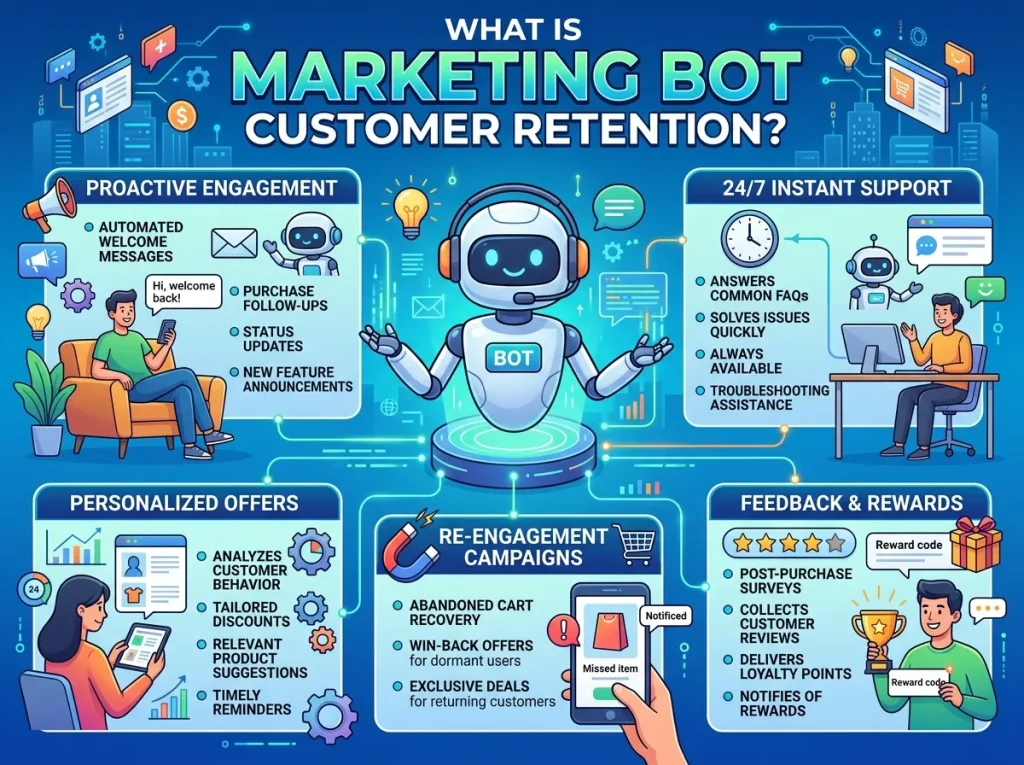
Marketing Bot Customer Retention is the use of automated conversational technologies to encourage existing customers to remain engaged with a business. These systems can communicate with customers through websites, messaging platforms, applications, and other digital channels.
Unlike traditional marketing campaigns that may rely on scheduled emails or advertisements, marketing bots can respond to customer actions in real time. A customer visiting a website may receive assistance based on the page they are viewing, while an existing customer may receive relevant information based on previous interactions.
The objective is to make customer communication more timely and useful. A bot can answer common questions, recommend relevant products, provide reminders, share helpful information, and direct customers toward appropriate resources.
Retention becomes stronger when customers feel that interactions are relevant to their needs rather than simply being repetitive promotional messages.
Why Marketing Bots Matter for Customer Retention
Customer relationships can weaken when communication becomes inconsistent or when customers struggle to get assistance. A customer who cannot quickly find an answer may look for alternatives elsewhere. Marketing bots can help reduce some of these friction points by providing immediate assistance.
A bot can remain available outside traditional business hours, respond to common questions, and guide customers toward useful information. This availability can create a more convenient experience, particularly for businesses serving customers across different time zones.
Marketing bots can also support ongoing engagement. Instead of interacting with customers only when they are ready to purchase, businesses can use automated conversations to provide product education, recommendations, reminders, and relevant updates.
The technology is particularly useful when combined with a broader retention strategy. Automation should support the customer experience rather than replace thoughtful communication entirely.
Developing a Marketing Bot Retention Strategy
A Marketing Bot Retention Strategy focuses on using automated conversations to support customers after their initial interaction or purchase. The strategy can include customer education, product recommendations, support, feedback collection, loyalty communication, and re-engagement.
The most effective retention strategies are connected to specific customer needs. A new customer may need help understanding how to use a product, while a returning customer may benefit from recommendations based on previous purchases.
Businesses can also use bots to identify moments when customers may need additional assistance. For example, repeated visits to a help page may indicate that a customer needs clarification. A bot can offer relevant assistance without forcing the customer to search through multiple pages.
A retention strategy should therefore focus on usefulness, relevance, and timing. Customers are more likely to respond positively when automated interactions solve genuine problems.
Businesses developing conversational campaigns can also benefit from reviewing Marketing Bot Best Practices, particularly when creating automated experiences that need to remain helpful and natural.
Chatbot Customer Retention
Chatbot Customer Retention involves using conversational interfaces to maintain relationships with existing customers. Chatbots can help customers find information, resolve basic questions, discover relevant products, and remain connected with the brand.
One major advantage is continuity. A customer can interact with a chatbot during different stages of the customer journey, from post-purchase questions to future product research.
For example, an online retailer might use a chatbot to answer questions about product use, provide information about related products, or help customers find suitable accessories. A software company could use a chatbot to provide onboarding information and direct customers toward educational resources.
The chatbot becomes part of the customer experience rather than simply functioning as a sales tool.
This distinction is important. Customers may become frustrated if every chatbot interaction immediately pushes a promotion or purchase. Retention-focused conversations should prioritize assistance and relevance.
Automated Customer Engagement
Automated Customer Engagement allows businesses to communicate with customers based on predefined events, preferences, or behavioral signals. Marketing bots can initiate or respond to conversations when customers take certain actions.
For example, a customer who visits a product page repeatedly might receive an invitation to learn more about the product. A customer who has not interacted with the business for an extended period might receive a personalized re-engagement message.
Automation makes these interactions scalable. A business may have thousands of customers, making manual communication with every individual difficult. Automated systems can handle routine interactions while allowing human teams to focus on more complex customer needs.
However, automated engagement should be carefully designed. Too many messages can create communication fatigue, while irrelevant messages can damage the customer experience.
The objective should be meaningful interaction rather than maximum message volume.
AI Customer Retention Strategy
An AI Customer Retention Strategy combines artificial intelligence with customer data and behavioral information to create more personalized retention experiences. AI can help identify patterns in customer behavior and support more relevant conversations.
For example, an AI-powered system may analyze previous interactions, product interests, purchase history, or engagement patterns to determine which information could be relevant to a particular customer.
AI can also support conversational understanding. Instead of requiring customers to select from a rigid menu, modern conversational systems can interpret natural-language questions and provide contextually relevant responses.
This can make customer interactions feel more flexible and efficient.
AI should still be used carefully. Customer data needs to be handled responsibly, and automated recommendations should be relevant and transparent. The goal is to improve the customer experience rather than create unnecessary personalization.
Customer Retention Automation
Customer Retention Automation connects automated communication with specific stages of the customer lifecycle. Instead of treating all customers identically, businesses can create different automated experiences based on customer behavior and relationship status.
A new customer may receive onboarding communication, while an established customer may receive product education or loyalty-related messages. Customers who have become less active may receive re-engagement communication.
Automation can also support feedback collection. After a purchase or customer support interaction, a bot can invite the customer to provide feedback. This information can help businesses understand common problems and identify areas where the customer experience can be improved.
Retention automation is most effective when it is connected to actual customer needs and business processes.
Marketing Automation Bots and Personalization
Marketing Automation Bots can support personalized communication at scale. Personalization does not necessarily mean creating a completely different message for every customer. It can involve using relevant information to make interactions more useful.
A bot might recognize a returning customer, remember the context of a previous interaction, or recommend information related to the customer’s interests.
For example, a customer who previously explored a specific product category could receive assistance related to that category rather than a generic message covering the entire product range.
This type of personalization can reduce friction and make conversations more relevant.
Marketing automation bots can also work alongside other marketing technologies. Customer relationship management systems, email platforms, analytics tools, and ecommerce systems can provide information that improves the context available to conversational systems.
Chatbot Customer Engagement
Chatbot Customer Engagement focuses on creating useful interactions between customers and a business. Engagement can involve answering questions, providing recommendations, collecting feedback, delivering updates, or directing customers toward relevant resources.
An effective chatbot should be easy to interact with. Customers should not have to navigate complicated menus to reach basic information.
Natural-language capabilities can make interactions more convenient because customers can describe their needs in their own words. The chatbot can then identify the intent and provide an appropriate response.
Chatbot engagement can also support content discovery. A customer asking how to solve a particular problem can be directed toward an article, video, product page, or support resource that addresses the issue.
Businesses looking to connect conversational engagement with broader marketing outcomes can explore how a Chatbot for Marketing can support customer interactions across different stages of the buying journey.
Automated Customer Support and Retention
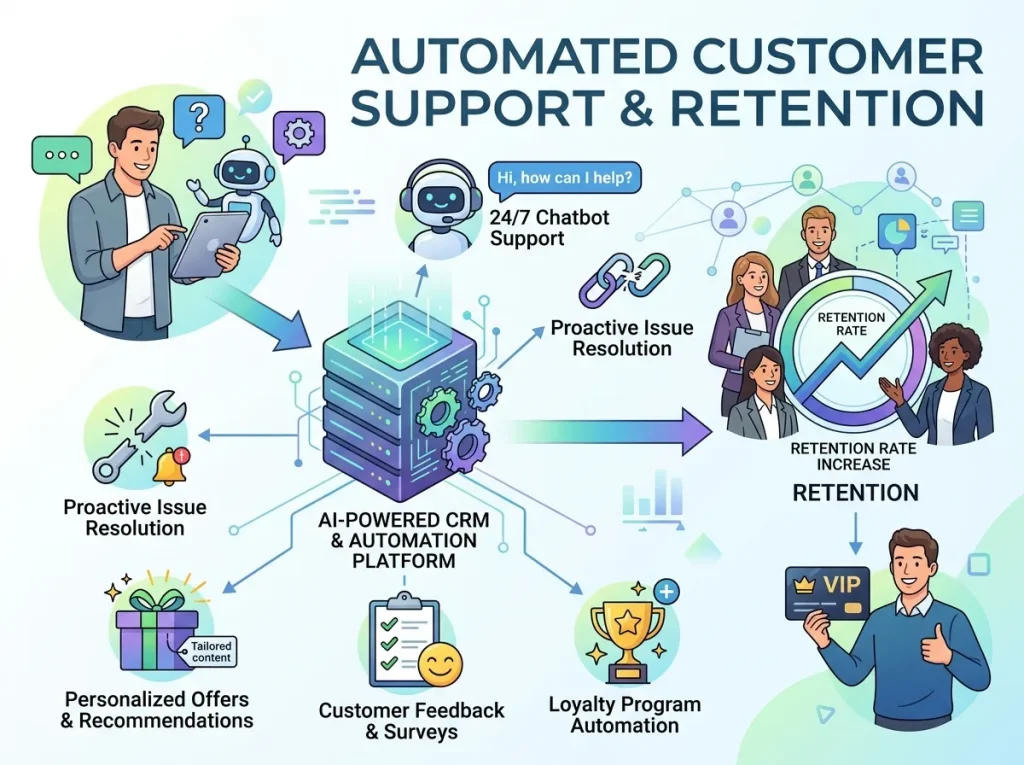
Automated Customer Support is another important part of customer retention. Customers often leave a business because they experience repeated problems or cannot get timely assistance.
Marketing bots can handle common questions related to product information, account processes, order updates, service details, and other routine issues. When a question requires human expertise, the bot can transfer the conversation to a support representative.
This combination of automation and human support can create a more efficient customer experience. The bot handles straightforward requests while human employees focus on complex or sensitive situations.
Support automation should not be designed simply to prevent customers from reaching people. Customers should have a clear path to human assistance when automated responses are insufficient.
When customers can get appropriate help without unnecessary friction, automated support can contribute to a more positive relationship with the brand.
Customer Loyalty Automation
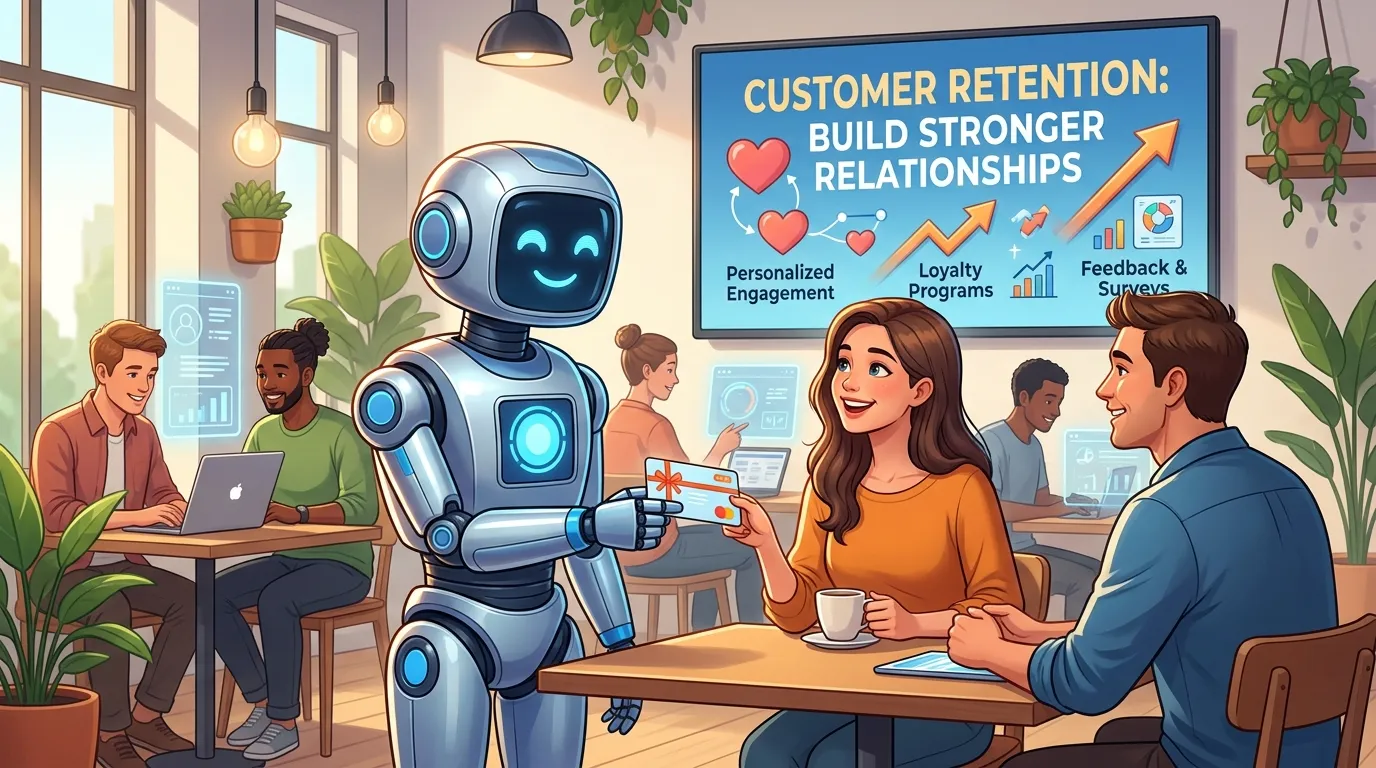
Customer Loyalty Automation uses automated systems to support loyalty programs, repeat engagement, and customer appreciation. Marketing bots can communicate information about rewards, points, special offers, membership benefits, or relevant promotions.
A loyalty-focused bot can also answer questions about program rules and help customers understand how they can use available benefits.
Personalized communication can make loyalty programs easier to understand and more engaging. Instead of requiring customers to search for information, the chatbot can provide relevant answers within the conversation.
However, loyalty communication should provide genuine value. Repeated promotional messages without useful benefits can reduce engagement rather than strengthen it.
The strongest loyalty experiences combine rewards with convenience, recognition, helpful information, and consistent service.
AI-Powered Retention Marketing
AI-Powered Retention Marketing expands the role of automation by using AI to analyze customer behavior, identify engagement patterns, and support personalized communication.
AI can help businesses identify customers who are highly engaged, customers who may need additional assistance, and customers who have become less active. These signals can help marketers develop different communication approaches for different customer groups.
AI can also help personalize recommendations. For example, a customer who previously interacted with a specific category may receive information related to that interest rather than generic marketing content.
Retention marketing can also connect with lead-generation activities. Businesses can use AI-powered conversational systems to qualify prospects, answer questions, and provide relevant resources before and after conversion. The broader relationship between automation and acquisition is explored through AI-Powered Lead Generation.
This demonstrates that acquisition and retention do not have to operate as completely separate marketing activities. Data and conversational systems can support the customer journey across multiple stages.
Marketing Bots and Re-Engagement
Customer inactivity does not always mean that a customer has permanently lost interest. People may become inactive because they are busy, have not found what they need, or simply have not had a reason to return.
Marketing bots can support re-engagement by providing relevant information or reminding customers about useful services and resources.
A re-engagement conversation should be based on context. For example, a customer who previously used a particular service might receive information about a relevant update rather than a generic sales message.
Timing is also important. Sending repeated reminders too frequently can make communication feel intrusive.
AI can help businesses identify appropriate engagement signals, but human oversight remains valuable when designing the messaging and deciding how frequently customers should be contacted.
Measuring Marketing Bot Customer Retention
Measuring the performance of Marketing Bot Customer Retention requires more than counting the number of chatbot conversations. Businesses need to understand whether automated interactions are contributing to meaningful customer outcomes.
Useful metrics can include repeat purchases, customer engagement, support resolution rates, chatbot completion rates, returning visitors, reactivation rates, customer satisfaction, and retention-related conversions.
Conversation quality can also be reviewed. If customers repeatedly ask the same question after receiving an automated answer, the response may not be solving the underlying problem.
Businesses can use these insights to improve their conversational experiences over time. High-performing interactions can be expanded, while confusing or ineffective conversations can be revised.
Conversion measurement can also help identify which chatbot experiences contribute to meaningful actions. A related Chatbot Conversion Optimization approach can help businesses understand how conversational experiences influence conversions without making every customer interaction purely sales-focused.
Balancing Automation With Human Interaction
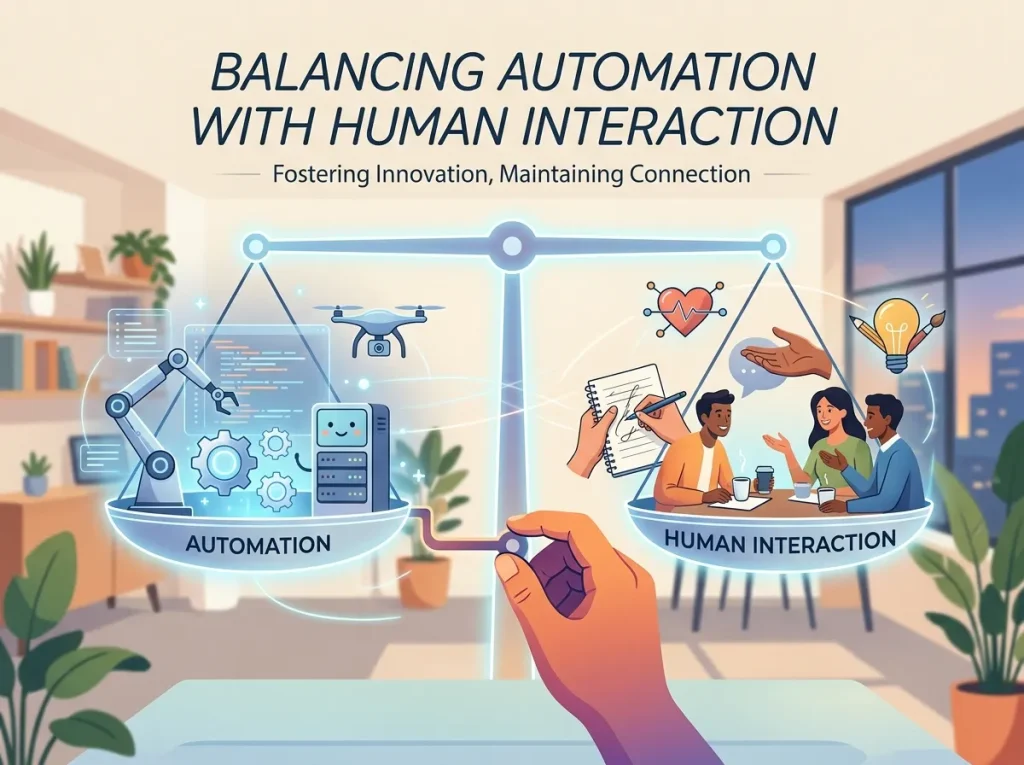
Automation can improve speed and scalability, but it should not eliminate human interaction where human judgment is important.
Customers may have complex questions, sensitive concerns, unusual requests, or situations that require empathy and detailed understanding. In these circumstances, a human representative may provide a better experience.
A strong retention system therefore creates a clear relationship between automation and human support. Bots can handle repetitive questions and gather initial information, while human teams can take over when the conversation requires greater expertise.
This approach can also reduce workload for support teams. Instead of spending significant time answering repetitive questions, employees can focus on conversations where their knowledge adds greater value.
Privacy and Responsible Customer Data Use
Marketing bots often depend on customer data to provide personalized experiences. This makes responsible data handling an important part of retention marketing.
Businesses should understand what information they collect, why it is collected, how it is used, and how it is protected. Customers should also receive appropriate transparency regarding automated communication and data usage.
Personalization should remain relevant and proportionate. Using excessive or unnecessary information can make automated conversations feel intrusive.
Responsible data practices can support trust, which is itself an important part of customer retention.
The Future of Marketing Bot Customer Retention
Marketing bots are likely to become increasingly integrated with customer relationship management, analytics, ecommerce, support, and marketing automation platforms. As conversational AI improves, customers may be able to complete more tasks directly through natural-language interactions.
Future retention systems may become more context-aware, allowing businesses to provide more relevant assistance across multiple channels.
However, technology alone will not determine the quality of customer relationships. The underlying customer experience still matters. If a product does not meet expectations or a service consistently creates problems, automation cannot completely solve the issue.
Marketing bots are most valuable when they make an already useful customer experience easier, faster, and more personalized.
Conclusion
Marketing Bot Customer Retention gives businesses a scalable way to maintain customer relationships through automated conversations, personalized engagement, support, recommendations, and loyalty communication. From Chatbot Customer Retention to AI-Powered Retention Marketing, these technologies can help businesses remain connected with customers beyond the initial purchase.
The strongest retention strategies focus on relevance rather than message volume. Marketing bots should provide useful information, reduce friction, support customer needs, and connect customers with human assistance when necessary.
When customer data, AI, automation, and human support work together, businesses can create a more consistent customer experience while building stronger opportunities for long-term engagement and repeat business.
Frequently Asked Questions
1. What is Marketing Bot Customer Retention?
Marketing Bot Customer Retention is the use of chatbots, AI, and automated marketing systems to maintain relationships with existing customers. These technologies can provide support, personalized information, recommendations, reminders, and other interactions designed to keep customers engaged.
2. How can chatbots improve customer retention?
Chatbots can improve retention by providing quick answers, supporting customers outside normal business hours, recommending relevant resources, and reducing friction during customer interactions. They can also connect customers with human representatives when more complex assistance is required.
3. What is a Marketing Bot Retention Strategy?
A Marketing Bot Retention Strategy is a structured approach to using automated conversational systems to support existing customers. It may include customer support, onboarding, personalized recommendations, loyalty communication, feedback collection, and re-engagement.
4. Can AI help with customer retention?
AI can support customer retention by analyzing customer behavior, identifying engagement patterns, personalizing interactions, and helping businesses deliver more relevant communication. AI should complement customer service and marketing processes rather than replace appropriate human interaction.
5. What is Customer Retention Automation?
Customer Retention Automation uses automated systems to maintain customer engagement across different stages of the customer lifecycle. It can support onboarding, follow-up communication, support, loyalty programs, feedback collection, and re-engagement.
6. How do marketing bots support customer loyalty?
Marketing bots can support customer loyalty by providing information about rewards, answering questions about loyalty programs, offering personalized recommendations, and making it easier for customers to access relevant benefits.
7. What is automated customer support?
Automated customer support uses chatbots and other automated systems to answer common customer questions and handle routine requests. More complex issues can be transferred to human representatives for additional assistance.
8. Can marketing bots replace human customer service?
Marketing bots can handle many routine interactions, but they should not necessarily replace human customer service. Complex, sensitive, or unusual situations often require human judgment and communication.
9. How should businesses measure chatbot retention performance?
Businesses can evaluate chatbot retention performance using metrics such as repeat purchases, customer engagement, reactivation, support resolution, conversation completion, customer satisfaction, and retention-related conversions. The most relevant metrics depend on the business’s objectives.
10. Why is personalization important in retention marketing?
Personalization can make automated communication more relevant by connecting messages and recommendations with customer interests, behavior, and previous interactions. When used responsibly, it can reduce irrelevant communication and create a more useful customer experience.