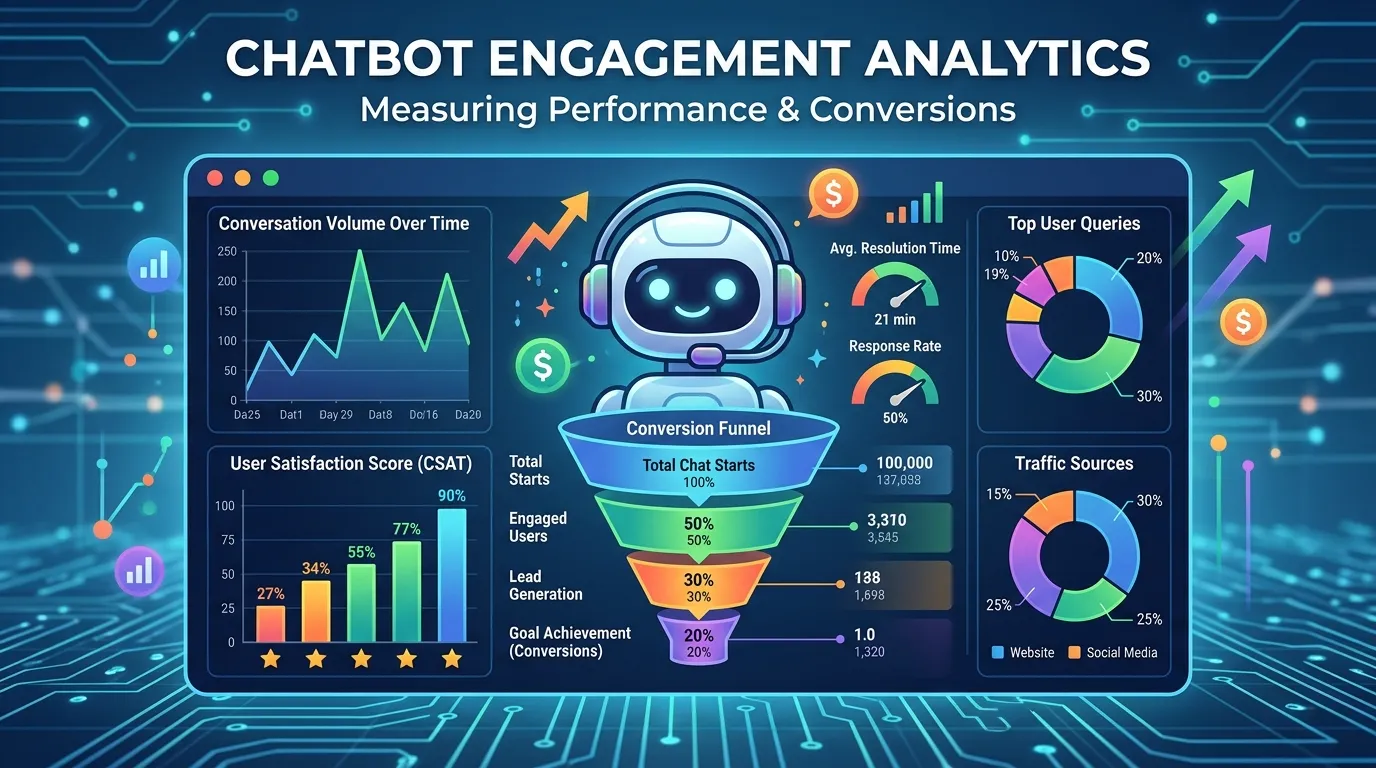
Chatbot Engagement Analytics helps businesses understand how users interact with chatbots, where conversations succeed or fail, and how chatbot experiences contribute to engagement, leads, and conversions. By analyzing conversations, response behavior, completion rates, user actions, and conversion activity, businesses can identify opportunities to improve their chatbot experience. Effective analytics turns chatbot interactions into useful insights that can support customer engagement, marketing performance, and long-term business growth.
What Is Chatbot Engagement Analytics?
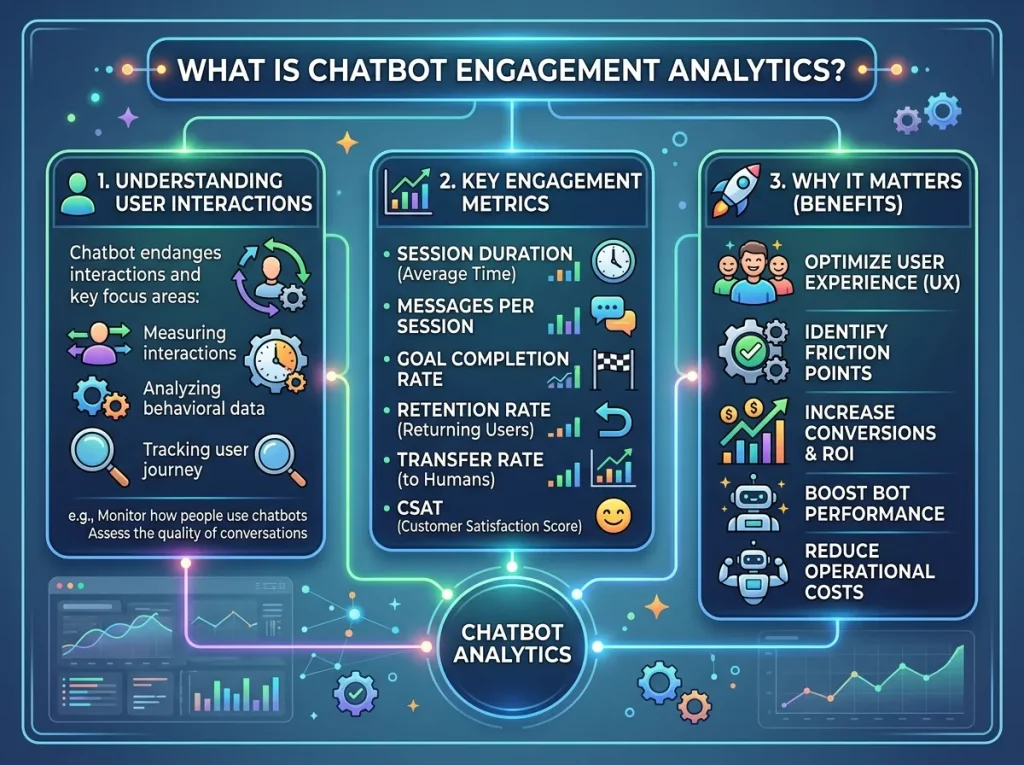
Chatbot Engagement Analytics is the process of collecting, analyzing, and interpreting data generated through chatbot interactions. Every conversation can provide information about what users ask, how they respond, where they leave, which options they select, and whether their interaction leads to a desired business outcome.
A chatbot may handle customer questions, recommend products, capture leads, schedule appointments, provide support, or guide visitors toward specific resources. However, simply having a chatbot available does not show whether it is actually delivering a useful experience.
Analytics provides a clearer picture of chatbot performance. Businesses can examine conversation volume, engagement levels, response patterns, conversion activity, and user behavior to understand how effectively the chatbot is supporting its intended purpose.
This makes analytics an important part of chatbot management because it connects individual conversations with broader marketing and customer experience objectives.
Why Chatbot Engagement Analytics Matters
Chatbots can interact with large numbers of users, but high conversation volume does not automatically mean high engagement. A chatbot could receive thousands of conversations while failing to answer user questions or move visitors toward meaningful outcomes.
This is why businesses need to examine the quality of interactions rather than focusing only on the number of conversations.
Effective Chatbot Engagement Metrics can reveal whether visitors are starting conversations, continuing conversations, selecting recommended options, requesting additional information, or completing important actions.
Analytics can also reveal friction. If users repeatedly abandon a conversation after a particular question, the wording or interaction design may need attention. If users frequently ask questions that the chatbot cannot answer, the knowledge base or conversational logic may need improvement.
By analyzing these patterns, businesses can make evidence-based improvements to their chatbot experiences.
Chatbot Engagement Metrics
Chatbot Engagement Metrics provide measurable indicators of how users interact with a chatbot. Common metrics can include conversation starts, active users, messages per conversation, engagement duration, completion rates, fallback frequency, and conversation abandonment.
The most useful metrics depend on the chatbot’s purpose. A customer-support chatbot may prioritize resolution rates and escalation activity, while a marketing chatbot may focus more heavily on lead generation, engagement, and conversion.
Businesses should avoid treating every metric as equally important. Instead, they should identify measurements that correspond to the chatbot’s primary objectives.
For example, a chatbot designed to capture leads should be evaluated partly on qualified lead submissions, while a chatbot focused on customer service may need stronger emphasis on successful issue resolution.
Looking at several related metrics together creates a more complete picture than relying on a single number.
Developing a Chatbot Analytics Strategy
A Chatbot Analytics Strategy connects chatbot data with broader business goals. Rather than collecting every possible data point, businesses can focus on information that helps them understand customer behavior and improve outcomes.
The strategy should consider what the chatbot is expected to accomplish. Is it designed to increase engagement, generate leads, answer questions, support customers, recommend products, or guide visitors?
Once the primary purpose is clear, analytics can be organized around relevant outcomes.
A chatbot analytics strategy can also help teams establish benchmarks. Historical data may reveal typical conversation volumes, engagement rates, abandonment patterns, and conversion activity. Future performance can then be compared with those benchmarks to identify changes.
This creates a more consistent approach to chatbot optimization and makes it easier for marketing and customer experience teams to communicate about performance.
Conversational Analytics and Customer Behavior
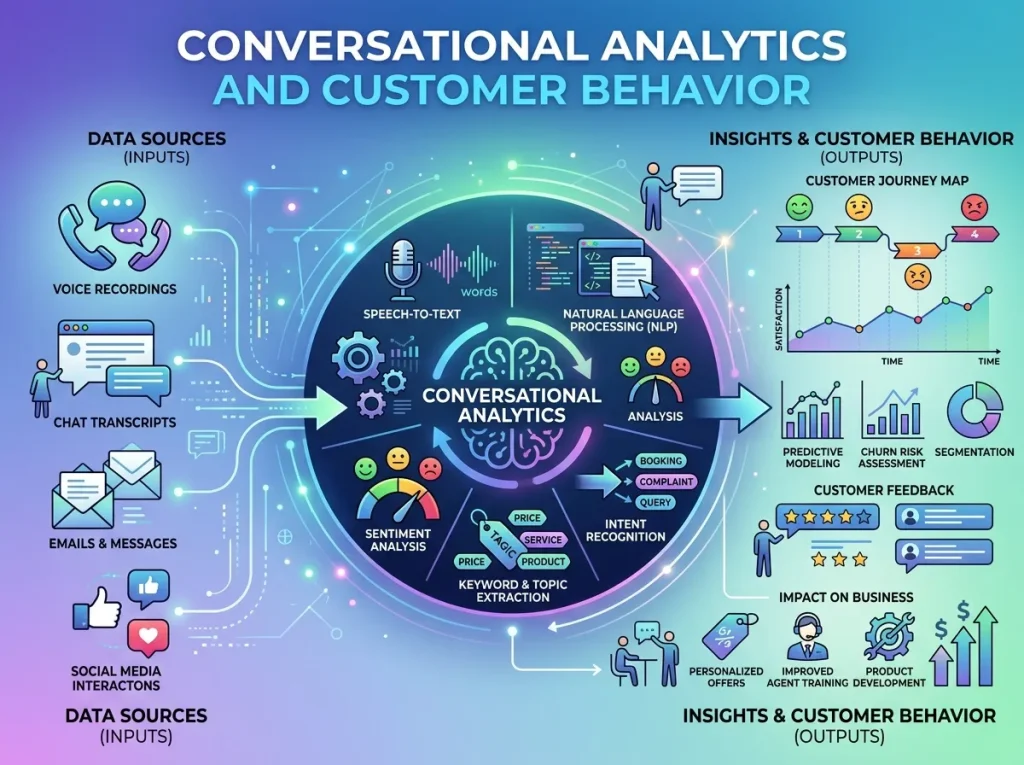
Conversational Analytics focuses on understanding the information contained within user-chatbot interactions. It goes beyond counting conversations by examining what people actually discuss and how they respond.
Conversation data can reveal frequently asked questions, common objections, product interests, customer concerns, and areas where users need additional information.
For marketing teams, these insights can also inform content and campaign planning. If customers repeatedly ask about a specific feature, pricing consideration, or use case, that information may indicate an opportunity to create supporting content.
Conversational analytics can therefore become a source of customer intelligence. Instead of treating chatbot conversations as isolated interactions, businesses can analyze patterns across many conversations to understand broader customer needs.
This can also help businesses identify changes in customer behavior over time.
Chatbot Performance Tracking
Chatbot Performance Tracking allows businesses to monitor how chatbot experiences perform over time. Tracking should consider both engagement and outcomes.
A chatbot may initially perform well but gradually experience lower engagement if its information becomes outdated or customer expectations change. Regular performance tracking can reveal these shifts.
Tracking can also help businesses evaluate changes made to the chatbot. For example, after modifying conversation flows or adding new responses, teams can compare performance before and after the change.
This makes analytics useful for continuous improvement. Rather than making chatbot changes based purely on assumptions, teams can examine measurable outcomes and user behavior.
Performance tracking can also identify differences between traffic sources. Visitors arriving from organic search may behave differently from users arriving through paid campaigns, email, social media, or direct traffic.
Chatbot User Engagement
Chatbot User Engagement reflects how actively visitors interact with the conversational experience. Engagement can include starting a conversation, responding to prompts, exploring options, requesting information, clicking recommended resources, or completing a desired action.
High engagement can indicate that users find the chatbot relevant, but engagement should always be interpreted in context. A long conversation is not necessarily positive if users are repeatedly asking the same question because they are not receiving useful answers.
Quality therefore matters alongside quantity.
Businesses can evaluate engagement by examining conversation depth, interaction completion, response patterns, and user outcomes. These insights can help determine whether the chatbot is genuinely helping visitors or simply generating activity.
A well-designed marketing chatbot can support this experience by connecting users with relevant information and opportunities. Businesses exploring the broader role of chatbots can learn more from Chatbot for Marketing.
Customer Interaction Analytics
Customer Interaction Analytics expands chatbot analysis beyond individual conversations by examining patterns across customer interactions.
For example, a business may discover that customers frequently begin with questions about one product but eventually show interest in another service. This can provide useful information about customer needs and cross-selling opportunities.
Interaction analytics can also identify points where customers require human assistance. If certain topics consistently lead to chatbot escalation, businesses can evaluate whether those conversations should be redesigned or transferred to support teams earlier.
These insights can improve the relationship between automated and human customer service.
The objective is not necessarily to eliminate human interaction. Instead, analytics can help businesses understand where automation works effectively and where human expertise provides additional value.
Chatbot Conversion Tracking
Chatbot Conversion Tracking measures whether chatbot interactions contribute to meaningful business actions. These actions can include form submissions, product purchases, appointment bookings, demo requests, registrations, or other defined conversions.
Conversion tracking is particularly important for marketing chatbots because engagement alone does not necessarily produce business value.
A visitor may interact with a chatbot for several minutes but leave without taking a meaningful action. Another visitor may have a short conversation and immediately complete a purchase or submit a lead form.
Understanding these outcomes helps businesses determine which conversational experiences contribute most effectively to their objectives.
Conversion tracking can also reveal which conversation paths are associated with successful outcomes. This information can help marketers improve prompts, recommendations, offers, and calls to action.
AI Chatbot Analytics
AI Chatbot Analytics adds another layer of analysis to chatbot interactions by examining how AI-powered systems respond to natural language and changing user requests.
AI chatbots can handle a broader range of questions than traditional rule-based systems, but their flexibility also creates a need for effective monitoring.
Businesses can analyze whether AI responses are relevant, whether users continue conversations after receiving them, and whether certain topics result in repeated clarification requests or escalations.
AI chatbot analytics can also reveal emerging questions that were not explicitly included in traditional conversation flows. This can help teams identify new customer needs and improve the chatbot’s knowledge resources.
However, AI performance should not be judged only by how sophisticated a response sounds. The more important question is whether the response helps the user achieve the intended outcome.
Businesses interested in applying AI to marketing can explore AI Chatbot for Marketing for additional context on AI-powered chatbot applications.
Chatbot Performance Metrics
Chatbot Performance Metrics help businesses evaluate the effectiveness and reliability of their conversational systems. Depending on the use case, relevant metrics may include response completion, engagement rate, fallback rate, escalation rate, conversation duration, lead conversion, and customer satisfaction.
Businesses can also evaluate performance across different user segments. New visitors may behave differently from returning customers, while mobile users may interact differently from desktop visitors.
Segmenting chatbot performance can reveal patterns that would otherwise be hidden in overall averages.
For example, a chatbot might perform well for product-related questions but struggle with support requests. Instead of concluding that the chatbot is generally ineffective, businesses can examine the specific conversation types that create problems.
This level of analysis allows improvements to focus on actual weaknesses.
Chatbot Campaigns and Engagement Analytics

Chatbots can also be integrated into specific marketing campaigns. A Chatbot Campaign may support a product launch, promotional activity, lead-generation initiative, event, content campaign, or customer engagement program.
Campaign-specific analytics can help marketers understand how users respond to chatbot experiences associated with particular promotions.
For example, a chatbot campaign could answer questions about a new product, recommend relevant resources, collect contact information, or direct visitors toward a purchase page.
Comparing campaign performance can help businesses understand which messages and conversational approaches generate stronger engagement.
Businesses can explore Chatbot Campaign to understand how chatbot campaigns can become part of a broader chatbot marketing strategy.
Measuring Chatbot Engagement Effectively
Chatbot Engagement Measurement should combine behavioral data with business outcomes. Looking only at conversation volume may provide an incomplete understanding of performance.
For example, increasing conversation volume could appear positive, but if abandonment also increases significantly, the additional activity may not represent improved engagement.
Similarly, a decrease in conversation volume may not necessarily indicate poor performance if the chatbot is resolving questions more efficiently.
This is why businesses should consider metrics together. Engagement, completion, satisfaction, conversion, and escalation data can provide a more balanced picture.
Measurement should also be consistent. Using the same definitions and reporting periods makes it easier to identify meaningful trends.
Chatbot Analytics and Digital Experiences
Chatbots are increasingly part of broader digital experiences. They can appear on websites, landing pages, customer portals, ecommerce platforms, and digital event environments.
In digital events, for example, chat functionality can support attendee questions, navigation, registration assistance, and engagement. Digital event technology can provide additional opportunities for collecting interaction data and understanding attendee behavior.
Resources such as Digital Event Software provide context on the wider technology ecosystem in which digital interactions can take place.
Connecting chatbot data with other digital experience data can help businesses understand the complete customer or attendee journey rather than viewing chatbot activity separately.
Turning Chatbot Data Into Marketing Insights
Chatbot data can provide valuable insights when businesses connect conversational behavior with broader marketing information.
Repeated customer questions can influence content creation. Frequently selected product options can inform campaign messaging. Common objections can provide ideas for educational resources. High-performing conversation paths can influence landing-page experiences and calls to action.
This creates a connection between conversational analytics and content strategy.
Instead of treating chatbot analytics as a technical reporting function, businesses can use the information to understand customer expectations and improve marketing communication.
Over time, these insights can contribute to a more customer-focused marketing ecosystem.
Improving Chatbot Experiences Through Analytics
Analytics can help businesses identify where chatbot experiences need improvement. Common signals include high abandonment, repeated fallback responses, frequent escalation, low conversion rates, or low engagement with recommended actions.
However, data should be interpreted alongside the actual conversation experience. A metric may indicate a problem without explaining why it is occurring.
Reviewing conversation transcripts and combining qualitative observations with quantitative metrics can provide a stronger understanding.
For example, a high abandonment rate might result from confusing questions, excessive conversation length, irrelevant recommendations, or a lack of clear next actions.
Analytics identifies the signal, while conversation analysis can help explain the underlying reason.
Conclusion
Chatbot Engagement Analytics gives businesses a clearer understanding of how users interact with conversational experiences and whether those interactions contribute to meaningful outcomes. From Chatbot Engagement Metrics and Conversational Analytics to Chatbot Conversion Tracking, AI Chatbot Analytics, and Chatbot Performance Metrics, different forms of analysis can reveal important patterns in customer behavior.
The most valuable approach is not simply collecting more data. Businesses need to connect chatbot data with clear objectives and interpret engagement alongside conversion, satisfaction, and customer experience.
When analytics becomes part of ongoing chatbot management, businesses can identify opportunities to improve conversations, strengthen customer engagement, support marketing campaigns, and create more useful digital experiences. In this way, chatbot data becomes more than a performance report—it becomes a source of practical customer and marketing insight.
Frequently Asked Questions
1. What is Chatbot Engagement Analytics?
Chatbot Engagement Analytics is the process of analyzing data generated through chatbot interactions. It helps businesses understand user behavior, conversation patterns, engagement levels, performance, and conversions.
2. Which chatbot engagement metrics are most important?
Important metrics depend on the chatbot’s purpose, but common measurements include conversation starts, engagement rate, conversation depth, completion rate, abandonment, fallback frequency, escalation, conversions, and customer satisfaction.
3. Why is conversational analytics important?
Conversational analytics helps businesses understand what users are actually asking and how they respond to chatbot interactions. It can reveal common questions, customer concerns, objections, and opportunities to improve the conversational experience.
4. How does chatbot analytics improve customer engagement?
Analytics can identify where users lose interest, encounter difficulties, or fail to find useful information. Businesses can use these insights to improve conversation flows, responses, recommendations, and overall chatbot experiences.
5. What is chatbot conversion tracking?
Chatbot Conversion Tracking measures whether chatbot interactions lead to desired actions such as purchases, registrations, bookings, form submissions, or lead generation.
6. What is the difference between chatbot engagement and chatbot conversion?
Chatbot engagement measures how users interact with the chatbot, while conversion measures whether those interactions result in a specific business outcome. A user can be highly engaged without completing a conversion.
7. What are AI Chatbot Analytics used for?
AI Chatbot Analytics can help businesses evaluate AI response quality, conversation patterns, user behavior, fallback activity, escalations, and outcomes. It can also reveal new customer questions and emerging interaction trends.
8. How can businesses track chatbot performance?
Businesses can track performance using analytics platforms or chatbot reporting systems that measure conversations, engagement, completion, abandonment, response behavior, conversions, and other relevant indicators.
9. Can chatbot analytics help marketing campaigns?
Yes. Chatbot analytics can show how users respond to campaign-related conversations and whether those interactions contribute to leads, engagement, purchases, registrations, or other campaign objectives.
10. How often should chatbot performance be analyzed?
Chatbot performance should be monitored regularly rather than only reviewed when a problem occurs. The appropriate frequency depends on conversation volume, campaign activity, business objectives, and how frequently the chatbot is updated.