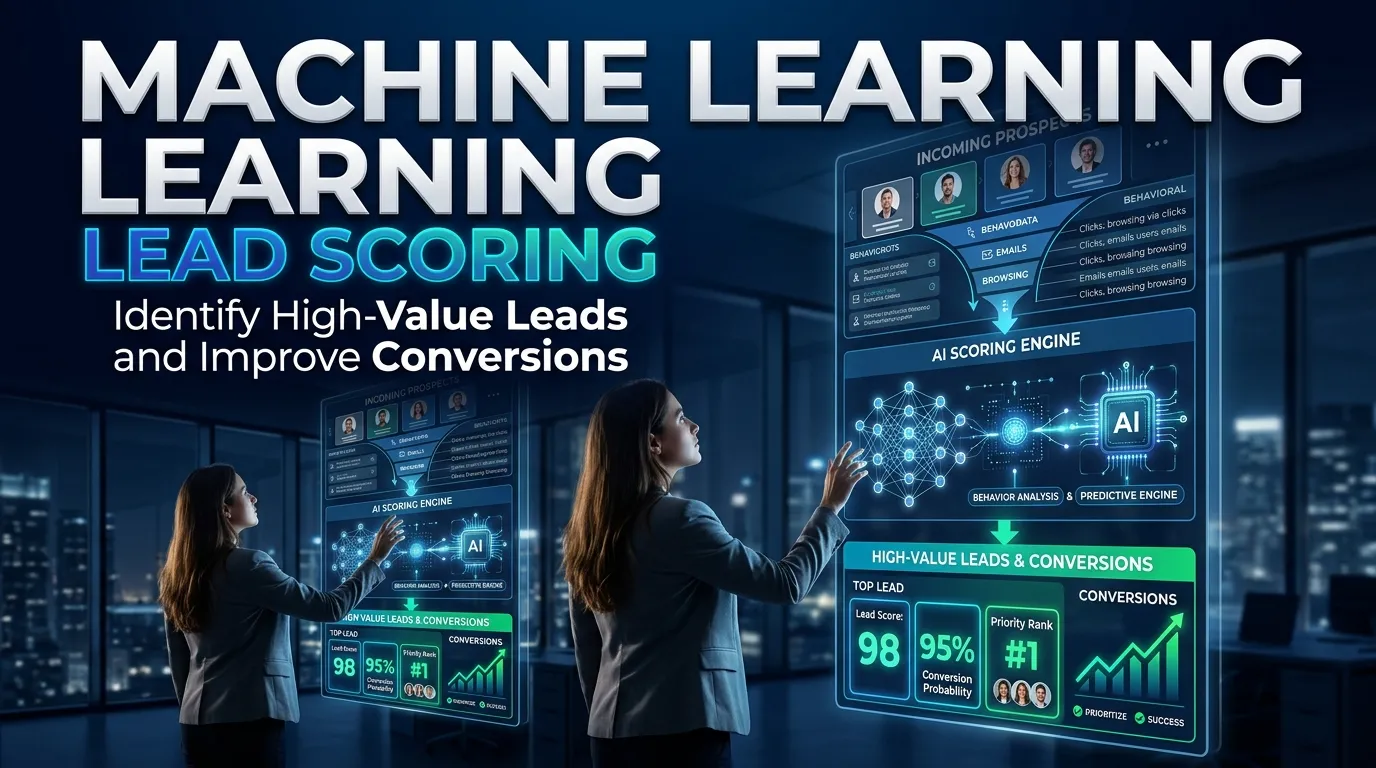
Machine learning lead scoring helps businesses identify promising prospects by analyzing customer characteristics, engagement patterns, and historical conversion data. Through predictive models, automated qualification, behavioral scoring, and data-driven prioritization, organizations can improve follow-up decisions and make better use of sales resources. Reliable data, ongoing evaluation, responsible information handling, and human oversight are essential for turning machine learning predictions into meaningful business results.
Businesses generate leads through websites, digital campaigns, social media, email marketing, and other customer acquisition channels. However, not every lead has the same level of interest or likelihood of becoming a customer. Sales teams need a reliable way to identify promising prospects, prioritize follow-ups, and focus their efforts where they can make the greatest impact. Machine learning lead scoring helps address this challenge by using data-driven models to estimate lead quality and predict the likelihood of conversion.
Traditional lead scoring often relies on manually assigned points for customer characteristics and specific actions. Although this approach can be useful, it may struggle to recognize complex patterns across large datasets or adapt quickly when customer behavior changes. Machine learning offers a more flexible approach by analyzing historical interactions, demographic information, engagement signals, and sales outcomes to identify patterns associated with successful conversions.
When implemented thoughtfully, machine learning lead scoring can improve lead prioritization, support more timely sales engagement, and help businesses allocate marketing resources more effectively. Its value depends on the quality of available data, the suitability of the model, and the ability to connect predictions with practical sales decisions.
Understanding the Role of Machine Learning in Lead Scoring
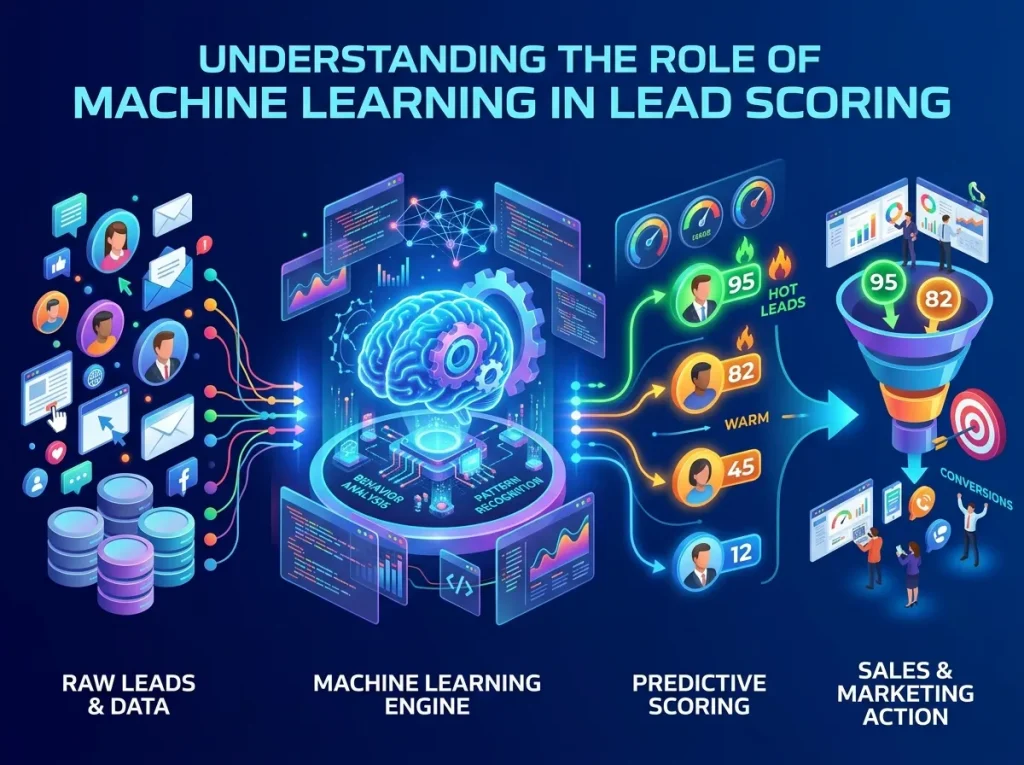
Machine learning lead scoring uses algorithms to analyze information about potential customers and estimate how likely they are to take a desired action, such as requesting a consultation, becoming a qualified opportunity, or completing a purchase.
The system learns from historical examples. If a business has records of leads that converted and leads that did not, a model can examine differences in their characteristics and behavior. These patterns may include the pages they visited, the content they downloaded, their responses to marketing messages, the type of organization they represent, or the length of time they spent progressing through the sales process.
After training, the model can generate scores for new leads based on the patterns it has learned. Sales teams can use these scores to decide which prospects should receive immediate attention and which may benefit from additional nurturing.
The approach differs from simply assigning points to individual actions. A machine learning model can consider multiple signals together and identify relationships that may not be obvious through manual analysis. For example, a particular combination of industry, website activity, and previous engagement may be more strongly associated with conversion than any single factor on its own.
However, a high score should not be treated as a guarantee of future behavior. It represents an estimate based on available data and model assumptions. Businesses should use it alongside sales judgment, customer context, and clearly defined qualification criteria.
AI-Powered Lead Scoring for More Informed Decisions
AI-powered lead scoring helps businesses evaluate prospects using patterns identified from customer data. By combining information from marketing platforms, customer relationship management systems, website analytics, and sales records, organizations can develop a more detailed understanding of lead quality.
For example, a business selling enterprise software might receive hundreds of inquiries each week. Some prospects may represent large organizations with a relevant business need, while others may be exploring the market without any immediate intention to purchase. An AI-powered system can evaluate available signals and help sales representatives distinguish between these groups.
The scoring process may consider company characteristics, product-page visits, email interactions, demo requests, previous sales conversations, and historical conversion outcomes. The importance of each signal depends on the business and the patterns present in its data.
Automation can make the process more efficient by updating scores as new interactions occur. If a prospect requests a demonstration after several weeks of research, the system may increase the lead’s priority. If engagement declines or new information changes the prospect’s fit, the score may change accordingly.
Businesses should still maintain human oversight. Automated predictions are useful for organizing work, but unusual circumstances, incomplete records, and changing customer requirements may require individual evaluation. The most effective systems combine algorithmic insights with informed decisions from marketing and sales professionals.
How Predictive Lead Scoring Models Work
Predictive lead scoring models use historical data to estimate the likelihood that a lead will achieve a defined outcome. Rather than relying exclusively on manually chosen rules, these models learn relationships between available lead information and actual business results.
The process begins with selecting a prediction target. A company might want to estimate which leads will become marketing-qualified leads, progress to a sales opportunity, or complete a purchase within a particular period. Defining the outcome clearly helps determine which data should be collected and how model performance should be evaluated.
Historical records are then prepared for analysis. These records may contain customer attributes, engagement history, acquisition sources, qualification outcomes, and sales results. Data preparation is important because duplicates, inconsistent labels, missing values, and outdated information can reduce the reliability of the model.
An algorithm is trained using examples from the historical dataset. Depending on the problem, businesses may use logistic regression, decision trees, random forests, gradient-boosting methods, or other suitable techniques. The model learns which combinations of signals are associated with the target outcome.
Before deployment, predictions should be evaluated on data that was not used to train the model. This helps reveal whether the system can generalize beyond the examples it has already seen. Once deployed, performance should continue to be monitored as customer behavior, marketing channels, and business conditions change.
A predictive model is only as useful as the decisions it supports. If its scores do not improve prioritization or conversion outcomes, the business may need to revise its target definition, data inputs, or operational process.
Automating Lead Qualification With Machine Learning
Automated lead qualification helps businesses evaluate incoming prospects more consistently and reduce the amount of manual work required to identify suitable opportunities.
In a traditional process, a marketing or sales representative may review each lead individually, check relevant details, and decide whether the prospect meets established criteria. This approach can become difficult to manage when lead volume increases or when teams work across multiple markets and channels.
Machine learning can support this process by comparing incoming leads with patterns associated with previously qualified prospects. It may estimate whether a new contact fits the target customer profile, exhibits relevant interest, or appears likely to progress through the sales process.
For instance, a software provider may find that successful opportunities often come from organizations within specific industries that repeatedly engage with product information and request consultations. A model can learn from these patterns and flag similar leads for review.
Automated qualification does not eliminate the need for clear business definitions. Marketing and sales teams should agree on what constitutes a qualified lead, which outcomes matter, and when a lead should be passed to a sales representative. The model can then support those decisions rather than replacing the underlying process.
Businesses should also account for leads with limited information. A newly acquired contact may have little recorded activity, making a confident prediction difficult. Such leads may need further nurturing or manual assessment instead of being automatically classified as low value.
The Role of Machine Learning in Lead Generation
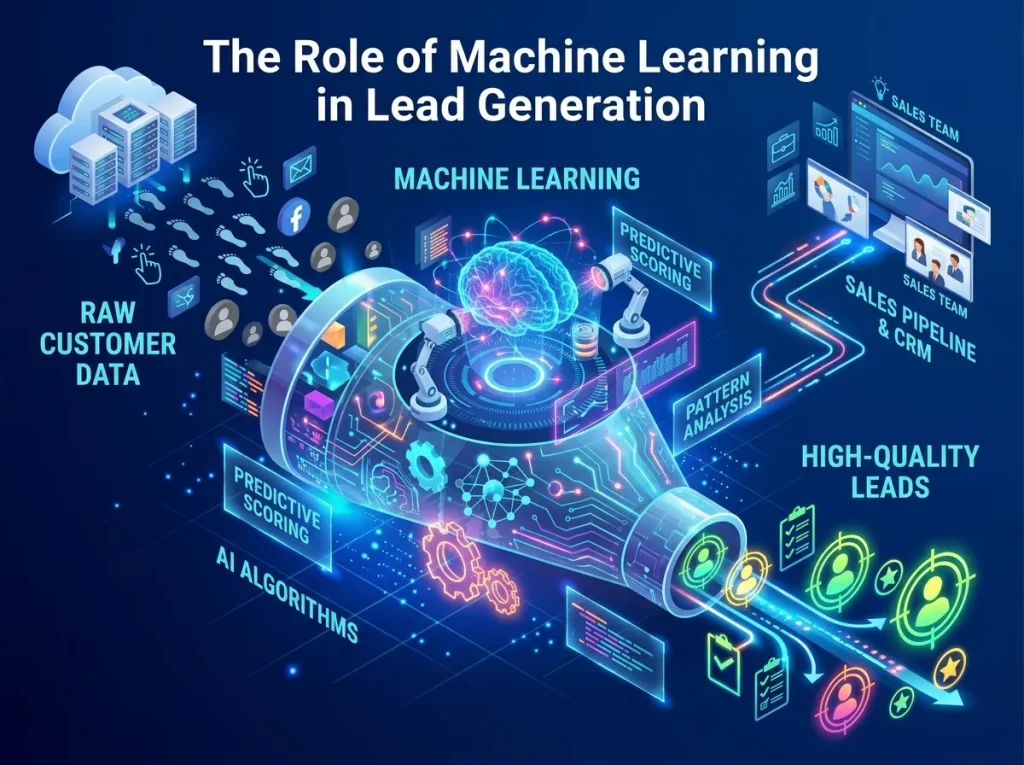
Machine learning in lead generation extends beyond ranking leads after they enter a database. It can also help businesses understand which acquisition sources attract suitable prospects and which audience characteristics are associated with valuable customers.
Marketing teams can compare leads from organic search, paid campaigns, webinars, social media, partner referrals, and other channels. When these sources are connected with downstream sales outcomes, machine learning can help identify differences between sources that generate large volumes of contacts and those that produce stronger opportunities.
For example, one campaign might attract many people who download a free resource but rarely progress to sales conversations. Another may generate fewer leads, yet a larger proportion may match the target customer profile and become paying customers. A data-driven approach helps businesses evaluate these differences more clearly.
Machine learning can also support audience targeting and campaign optimization by identifying patterns in historical customer data. These insights may help marketers refine messaging, adjust channel investments, and improve the relevance of future campaigns.
Businesses should avoid assuming that historical patterns will always remain accurate. Changes in advertising platforms, market demand, customer preferences, and competitive conditions can alter campaign performance. Predictions should therefore be reviewed alongside current evidence.
When lead generation data is connected to meaningful business outcomes, machine learning becomes a useful tool for improving both acquisition efficiency and lead quality.
Using Predictive Lead Analysis to Understand Prospect Behavior
Predictive lead analysis examines available lead data to identify patterns that may indicate future actions. It helps businesses move beyond reviewing past activity and develop estimates about what prospects may do next.
Relevant signals can include repeated visits to product pages, interactions with pricing information, responses to educational content, previous inquiries, company characteristics, and the progression of similar leads through the sales pipeline. A model may identify combinations of these signals that are associated with stronger purchase intent.
Consider a prospect who has visited a service page several times, reviewed a case study, and requested additional information. These actions may suggest increased interest, particularly if similar patterns have preceded successful conversions in the past. Predictive analysis can help bring such leads to a sales team’s attention.
However, observed behavior does not always reveal intent accurately. Someone may visit a pricing page for research purposes, while a serious buyer may complete extensive research without leaving many trackable signals. Businesses should treat predictions as estimates rather than direct knowledge of a prospect’s intentions.
Predictive analysis becomes more valuable when teams connect it with sales feedback and customer outcomes. If certain predicted behaviors consistently fail to translate into opportunities, the model may need adjustment. If specific signals repeatedly precede successful sales conversations, the business may use those insights to improve follow-up timing.
Improving Customer Intent Scoring
Customer intent scoring estimates how strongly a prospect’s available behavior and characteristics indicate interest in a product, service, or solution. In machine learning systems, intent scoring can help sales teams distinguish between general curiosity and signals that may justify a more direct conversation.
Intent signals vary by industry and purchasing process. A consumer researching product features may show interest through comparison-page visits, while a business buyer might engage with technical documentation, implementation information, pricing details, or a consultation request.
The meaning of each signal depends on context. Repeated engagement with relevant information may be useful, but it does not necessarily mean a prospect is ready to buy. Businesses should consider the combination of actions, their timing, the lead’s customer fit, and previous patterns among similar prospects.
Machine learning can identify relationships among these signals and estimate which prospects are more likely to progress. The resulting score can help teams decide whether to offer educational content, schedule a follow-up, or initiate a sales conversation.
Intent scores should remain transparent enough for teams to understand their practical purpose. Sales representatives benefit from knowing which available signals contributed to a high priority, particularly when deciding how to approach a prospect. Clear explanations also make it easier to identify misleading patterns or inappropriate data inputs.
Predicting Lead Conversion More Accurately
Lead conversion prediction estimates the probability that a prospect will complete a defined action within a particular period. This outcome might be a purchase, a qualified sales opportunity, a product trial, or another event that matters to the business.
A useful conversion model requires a clearly defined target. Predicting whether a lead will ever convert is different from predicting whether a lead will purchase within the next 30 days. The prediction window influences which historical examples are relevant and how performance should be measured.
Conversion prediction can help sales teams prioritize their time, but it can also support broader business decisions. Marketing managers may use predicted outcomes to evaluate campaign quality, while sales leaders may use aggregated predictions to understand the potential value of the pipeline.
For example, a company might have many active opportunities, but their expected value can vary considerably. Combining conversion probabilities with opportunity values may provide a more informative forecast than simply counting the number of open deals. Such estimates still depend on reliable data and should not be interpreted as guaranteed revenue.
Models should be assessed using metrics appropriate to the business objective. Accuracy alone may be misleading when only a small percentage of leads convert. Measures such as precision, recall, calibration, and performance within high-priority lead groups can provide a more useful picture of whether predictions support practical decisions.
The objective is not perfect prediction. It is to improve decisions compared with the existing process and to understand the uncertainty that remains.
Behavioral Lead Scoring and Engagement Patterns
Behavioral lead scoring focuses on actions prospects take while interacting with a business. These actions may include visiting specific pages, watching product demonstrations, attending webinars, downloading resources, responding to messages, or requesting additional information.
Machine learning can help evaluate how these behaviors relate to conversion outcomes. A single action may have limited predictive value, while a sequence of related interactions could provide stronger evidence of interest. The model can examine these combinations across historical records and use them to estimate the likelihood of future outcomes.
For example, reading an introductory article may suggest early-stage interest, while returning to a product page and requesting a consultation may indicate that the prospect is evaluating a solution more seriously. The significance of these actions should be established through data rather than assumed in advance.
Behavioral scoring also needs to account for recency. An interaction that occurred yesterday may be more relevant than one recorded many months ago, depending on the product and sales cycle. However, recency should be handled in a way that reflects the actual buying process rather than applying arbitrary time limits.
Businesses should be careful about data quality and privacy. Tracking should be proportionate, appropriate, and consistent with applicable requirements. Behavioral information should support relevant communication rather than encourage intrusive or unexplained targeting.
Supporting Data-Driven Lead Prioritization
Data-driven lead prioritization uses predictive scores and business rules to determine which prospects deserve attention first. It translates model outputs into practical decisions about follow-up, nurturing, and resource allocation.
A high score may indicate that a lead has characteristics associated with successful conversions, but prioritization should also account for urgency, customer fit, sales capacity, and business value. For instance, a lead requesting a demonstration may need immediate attention even if the model has limited information about them.
Organizations can combine machine learning predictions with clear operational rules. Leads may be grouped into high-, medium-, and low-priority categories, each connected to an appropriate response. High-priority leads could receive prompt sales review, medium-priority leads could enter targeted nurturing, and lower-priority leads could receive broader educational communication while more data is collected.
These categories should be calibrated to the team’s capacity. If too many leads are classified as high priority, the model may not meaningfully improve workload management. If too few qualify, promising prospects could be missed. Regular review helps maintain a useful balance.
Prioritization should also remain connected to outcomes. Businesses can compare response times, opportunity creation, conversion rates, and sales productivity before and after introducing the model. This evaluation reveals whether the scoring system is helping teams make better use of their time.
Understanding Sales Lead Scoring Algorithms
Sales lead scoring algorithms are the computational methods used to assign scores or probabilities to leads. The right algorithm depends on the volume and quality of available data, the complexity of the prediction task, and the level of interpretability required.
Logistic regression is often useful when businesses need a relatively straightforward model for estimating the probability of a defined outcome. Decision trees can provide understandable decision paths, while random forests and gradient-boosting methods can capture more complex relationships within structured data.
More advanced approaches may be appropriate when the organization has substantial data and specialized technical resources. However, greater complexity does not automatically produce better results. A simpler model trained on reliable data can outperform a complicated system built on incomplete or poorly labeled records.
Algorithm selection should consider how the score will be used. A model that helps a sales representative decide which lead to contact next may need different levels of detail and explanation than one used for aggregated campaign forecasting.
Businesses should also monitor model drift. Over time, changes in customer behavior, acquisition channels, product offerings, or sales processes can weaken the relationship between historical patterns and current outcomes. Regular testing, retraining where appropriate, and human review help maintain reliability.
Connecting Machine Learning Lead Scoring With Chatbot Marketing
Chatbots can generate useful information during customer interactions by answering questions, collecting relevant details, and helping visitors find suitable resources. When these interactions are recorded appropriately and connected with other lead data, they may contribute to a broader machine learning lead scoring process.
For example, a chatbot may identify the type of service a visitor is interested in, answer questions about product features, or collect a request for a consultation. These details can provide additional context for qualification and follow-up, provided that the business handles the information responsibly.
Businesses exploring AI chatbots for marketing can consider how conversational tools support lead capture, customer questions, and relevant engagement. Chatbot information can complement website activity, form submissions, and CRM records rather than functioning as an isolated source of data.
The quality of these interactions matters. If chatbot questions are confusing, answers are inaccurate, or data is recorded inconsistently, the resulting signals may reduce scoring reliability. Businesses should therefore evaluate the usefulness of chatbot interactions and make sure the information collected supports a clear purpose.
Performance measurement is also important. chatbot engagement analytics can help businesses understand whether conversational interactions lead to meaningful engagement and conversions. These insights may reveal which interactions provide useful qualification signals and where the customer experience needs improvement.
More broadly, chatbot marketing examples and results can offer context for understanding how conversational marketing supports customer engagement. Businesses can also explore how chatbot technology helps automate customer interactions when considering the role of automation in collecting information and supporting timely communication.
Chatbot activity should not automatically determine a lead’s score. Its value comes from the relevance and reliability of the information it contributes to the wider scoring model.
Building a Reliable and Responsible Lead Scoring System

Successful machine learning lead scoring depends on more than selecting an algorithm. Businesses need dependable data, clear definitions of success, appropriate evaluation methods, and a process for acting on predictions.
Data preparation should address missing information, duplicate records, inconsistent labels, and outdated entries. The target outcome must also be defined carefully so that the model learns to predict something the business genuinely values. A model trained to predict form submissions, for example, may not be suitable for prioritizing leads by their likelihood of becoming profitable customers.
Evaluation should reflect real-world conditions. Training and testing data should be separated appropriately, and businesses should check whether the model performs well across different customer groups and acquisition sources. Historical data can contain biases that influence predictions, so teams should review whether the model disadvantages particular groups or relies on irrelevant characteristics.
Privacy and transparency deserve equal attention. Organizations should use appropriate data, limit access to authorized personnel, and follow applicable privacy and data protection requirements. Automated scores should not be treated as unquestionable facts, particularly when they influence significant business decisions.
Finally, the model should be integrated into existing workflows. Sales representatives need to know where scores appear, what they mean, and how to respond. Marketing teams should understand how their activities influence lead quality, while managers should monitor whether the system improves business outcomes.
Frequently Asked Questions
1. What is machine learning lead scoring?
Machine learning lead scoring uses algorithms to analyze lead data and estimate the likelihood that a prospect will take a desired action, such as becoming a qualified opportunity or completing a purchase. It helps businesses prioritize prospects using patterns learned from historical outcomes.
2. How does AI-powered lead scoring work?
AI-powered lead scoring evaluates information such as customer characteristics, website activity, marketing engagement, and sales history. A trained model uses these signals to generate scores or conversion probabilities that help teams decide which leads deserve attention.
3. What are predictive lead scoring models?
Predictive lead scoring models learn from historical lead records to estimate the likelihood of a defined outcome. They may use methods such as logistic regression, decision trees, random forests, or gradient boosting, depending on the data and business requirements.
4. How does machine learning improve lead qualification?
Machine learning can identify patterns associated with qualified prospects and use them to evaluate new leads more consistently. It can reduce manual effort and support faster decisions, although clear qualification criteria and human review remain important.
5. What is the difference between traditional and machine learning lead scoring?
Traditional lead scoring often relies on manually assigned points and predefined rules. Machine learning lead scoring learns patterns from historical data and can account for relationships among multiple signals. Both methods can be useful, depending on the organization’s needs and available data.
6. What data is needed for machine learning lead scoring?
Useful data may include customer attributes, acquisition sources, website interactions, content engagement, qualification outcomes, sales opportunities, and conversion history. The most important requirement is that the data is relevant, reliable, and connected to a clearly defined business outcome.
7. Can machine learning predict which leads will convert?
It can estimate conversion likelihood based on historical patterns and current lead information. Predictions are not guarantees, and their reliability depends on data quality, model evaluation, and whether current customer behavior resembles the patterns used during training.
8. How does behavioral lead scoring work?
Behavioral lead scoring analyzes actions such as product-page visits, content downloads, webinar attendance, and consultation requests. Machine learning can evaluate how these actions and their combinations relate to successful conversions, helping teams prioritize promising prospects.
9. Can chatbots contribute to machine learning lead scoring?
Yes. Chatbots may collect relevant information, answer customer questions, and identify product interests during conversations. When recorded appropriately, these interactions can supplement other lead data, although their usefulness depends on accuracy, relevance, and responsible data handling.
10. How can businesses measure the success of machine learning lead scoring?
Businesses can compare conversion rates, qualification accuracy, sales response times, opportunity creation, and sales productivity before and after implementation. They should also monitor prediction quality over time and assess whether the system improves decisions compared with the previous process.