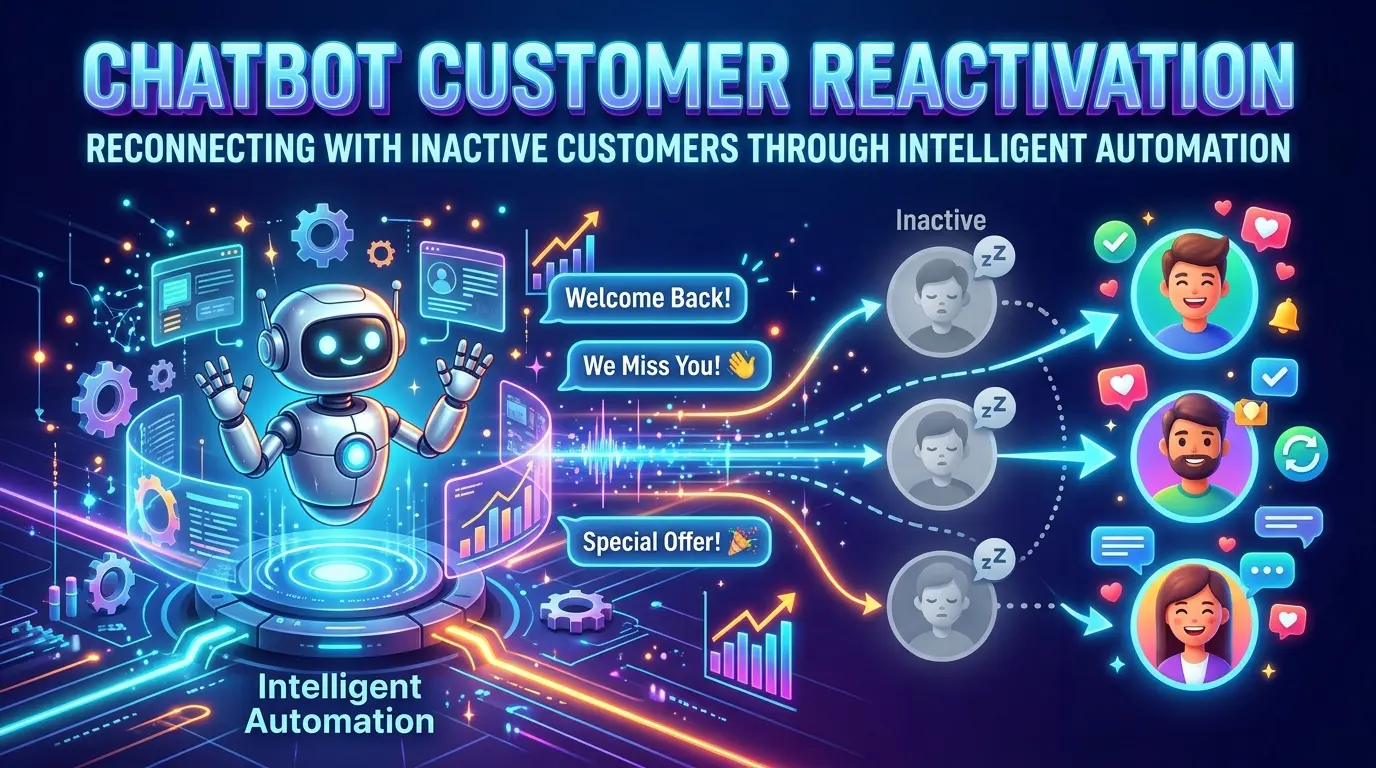
Chatbot customer reactivation helps businesses reconnect with inactive customers through personalized conversations, automated follow-ups, and relevant engagement opportunities. Instead of relying entirely on manual outreach, companies can use chatbots to identify inactive users, understand their previous interactions, deliver timely messages, and encourage customers to return. This article explores how chatbot-driven reactivation improves customer engagement, supports retention, recovers missed opportunities, and creates stronger long-term customer relationships.
Bringing Inactive Customers Back Into the Conversation
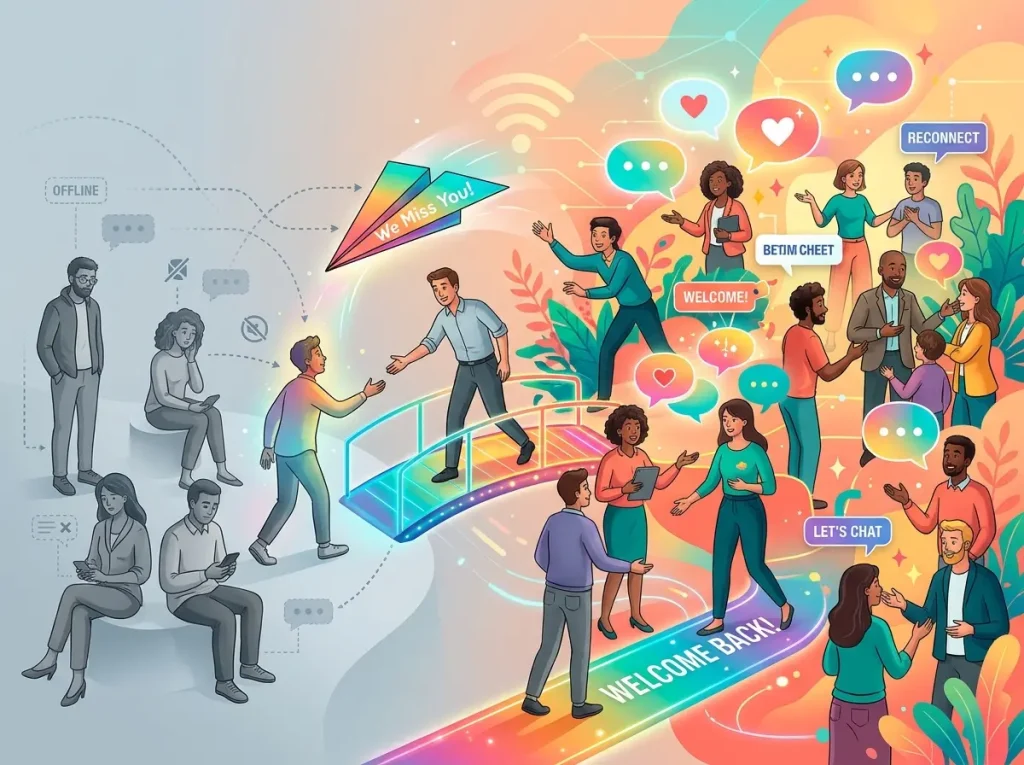
Customer relationships do not always end when someone stops purchasing, visiting a website, or interacting with a business. Sometimes customers become inactive because their needs change, they lose interest, forget about a service, or simply do not receive relevant communication at the right time. Although these customers may appear to have disappeared, many still represent valuable opportunities for businesses.
Reconnecting with them, however, requires more than sending repeated promotional messages. Companies need to understand why customers stopped interacting and provide a meaningful reason for them to return.
This is where Chatbot Customer Reactivation becomes useful. It uses automated conversational technology to reconnect businesses with customers who have become inactive. Through personalized messages, intelligent follow-ups, and relevant recommendations, chatbots can encourage customers to continue conversations and explore products or services again.
Unlike traditional outreach methods that often depend on manually prepared campaigns, chatbots can respond to customer behavior and deliver communication based on specific interaction patterns. A returning customer might receive assistance with a previously explored product, while someone who abandoned a conversation could be invited to continue where they left off.
The purpose is not simply to increase message volume. It is to make customer communication more relevant and useful.
As businesses compete to maintain attention across digital channels, chatbot-driven reactivation offers a way to strengthen existing relationships without treating every inactive customer as a completely new prospect.
Why Customers Become Inactive and What Businesses Often Miss
Customer inactivity can happen for several reasons, and understanding these reasons is important before attempting to reconnect.
Some customers may have completed their initial purchase and have no immediate reason to return. Others may have encountered difficulties during the buying process, received incomplete answers, or found the website experience confusing. In subscription-based businesses, inactivity may result from changing priorities, limited product usage, or dissatisfaction with a service.
There are also customers who simply become distracted. They may browse a website, ask questions through a chatbot, and leave without completing their intended action. Their lack of activity does not necessarily indicate that they have lost interest.
The difficulty is that businesses often treat all inactive customers in the same way. A generic promotional message might reach someone who needs technical assistance, while a discount offer might be sent to someone who only needs information about a previously explored product.
This approach can make communication feel irrelevant.
Chatbot systems provide an opportunity to examine previous customer interactions and distinguish between different inactivity patterns. A person who repeatedly asks about product availability may need a different message from someone who previously requested customer support.
Understanding these differences makes customer re-engagement more meaningful. Instead of assuming why someone stopped interacting, businesses can use available interaction history to create more relevant conversations.
However, customer information should always be handled responsibly, and reactivation messages should respect applicable privacy requirements and communication preferences.
The Role of Chatbots in Customer Re-engagement
Customer re-engagement focuses on rebuilding interaction with people who have previously shown interest in a business but are no longer actively communicating.
Chatbots can support this process by making communication more accessible and responsive. They can recognize certain customer activity patterns, provide useful information, and guide returning visitors toward relevant actions.
For example, an online retailer may notice that a customer previously explored a particular product category but did not complete a purchase. When the customer returns, a chatbot can offer assistance related to that category rather than displaying an unrelated promotional message.
A service business might use a similar approach for customers who previously requested a consultation but did not continue the conversation. The chatbot could offer to answer outstanding questions or explain available service options.
These interactions work because they connect communication with the customer’s earlier interests.
The quality of chatbot re-engagement also depends on the conversation itself. Customers should be able to ask questions, request clarification, and reach human support when necessary. A chatbot that only repeats promotional messages without understanding responses may create frustration instead of renewed interest.
Businesses should therefore view chatbots as conversational support systems rather than automated advertising channels.
When communication is relevant, respectful, and easy to navigate, returning customers have a better opportunity to rebuild their relationship with the brand.
Recovering Inactive Customers Through Previous Conversations
One of the most valuable features of chatbot customer reactivation is the ability to use previous conversations as context for future communication. When a customer returns after several weeks or months, businesses may already have useful information about their interests, questions, and earlier concerns.
This information can help companies create a more natural reactivation experience.
Imagine a customer who contacted an online store to ask about a product but left before making a purchase. A chatbot with access to permitted conversation history could recognize the earlier inquiry and offer relevant assistance when the customer returns. Rather than asking the same questions again, it can help the customer continue the purchasing process.
This approach supports Inactive Customer Recovery by reducing unnecessary repetition and making returning interactions more convenient.
Previous conversations can also reveal where customers experienced difficulties. Someone who repeatedly asked about delivery options might have left because the information was unclear. Another customer may have needed a particular feature that was not available at the time.
Recognizing these situations allows businesses to address the original concern instead of immediately presenting another sales offer.
However, conversation history should only be used when the customer has appropriate privacy permissions and the business has a legitimate reason to process that information. Sensitive details should not be unnecessarily repeated in automated messages.
The most effective recovery experiences make customers feel that the business understands their needs without making the interaction feel intrusive.
Chatbot Follow-Up: Reopening Conversations Without Creating Pressure
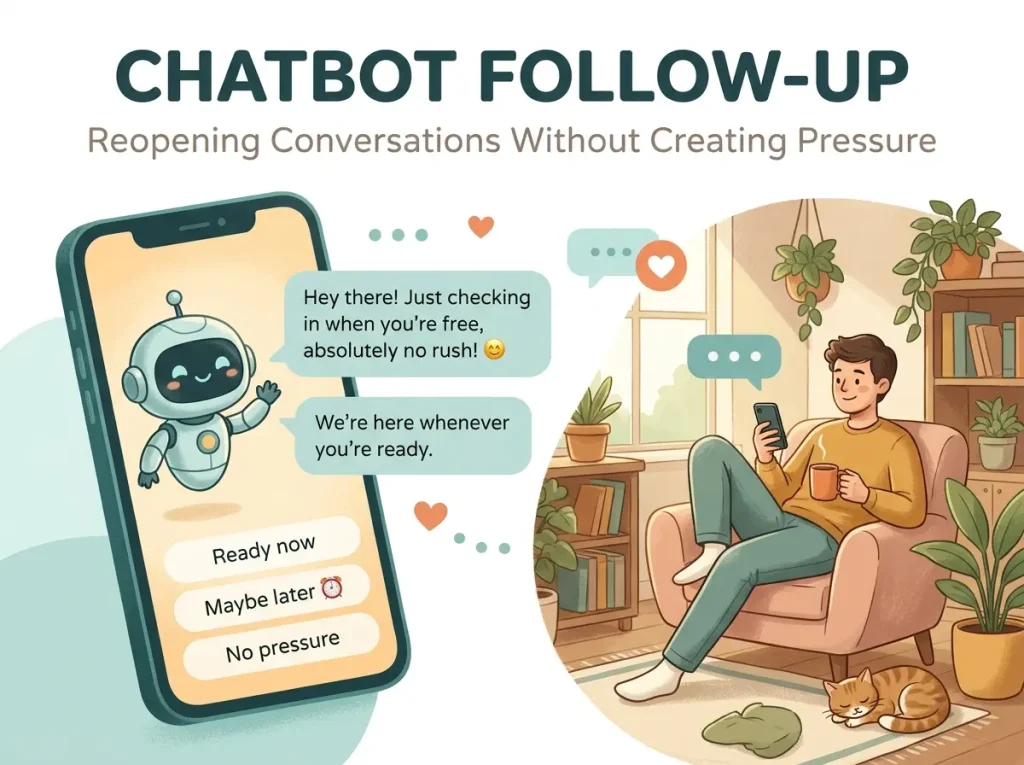
Many potential customers leave conversations without reaching a final decision. They might become busy, need additional time to compare options, or want to discuss a purchase with someone else.
Without a follow-up, these interactions can gradually disappear from the business’s communication process.
A well-designed Chatbot Follow-Up strategy creates opportunities to reopen conversations when there is a relevant reason to do so. Instead of repeatedly asking customers to purchase, businesses can provide useful reminders, answer outstanding questions, or share information connected to an earlier inquiry.
For instance, a customer who previously asked about service packages might receive a message offering further information about the available options. Someone who abandoned a support conversation could be invited to continue receiving assistance.
The timing and frequency of these messages matter. Repeated outreach within short periods can make customers uncomfortable and increase the likelihood of blocked messages or unsubscribes.
Businesses can improve follow-up quality by considering the customer’s previous activity, communication preferences, and the expected value of another interaction.
This is closely connected to Chatbot Message Timing, because even relevant information can become ineffective when delivered at an inconvenient moment.
A thoughtful follow-up should feel like a continuation of a useful conversation rather than an interruption.
Automated Customer Outreach That Feels Personal
Automation makes it possible for businesses to maintain communication with larger customer groups without manually preparing every individual message. However, automation alone does not guarantee meaningful engagement.
Customers respond differently depending on their interests, previous experiences, and current needs. A message that works well for one group may be irrelevant to another.
Automated Customer Outreach becomes more effective when businesses organize inactive customers according to meaningful behavioral differences.
For example, an online service provider might distinguish between customers who stopped using a service, visitors who abandoned registration, and people who previously requested product information. Each group represents a different situation and may require a different conversational approach.
Personalization can involve referring to previously explored products, offering relevant assistance, explaining new features, or providing updates about services that match an established interest.
The wording should remain natural. Customers should not receive messages that expose unnecessary details about their browsing behavior or make assumptions about why they became inactive.
Chatbots can also use conversational responses to determine whether someone wants further information. If a customer is interested, the system can continue the discussion. If the person is not interested, it should respect that decision.
This balance between automation and customer choice is essential. Businesses should use technology to make communication easier, not to create pressure through constant promotional contact.
Customer Retention Messaging and the Value of Relevant Communication
Customer retention messaging plays an important role in bringing inactive users back into a business relationship. The objective is to remind customers of available value while providing a reason to continue interacting.
However, retention communication should not depend entirely on discounts and promotional offers. Although incentives can encourage certain customers to return, they may not address the actual reason behind inactivity.
For example, a customer who stopped using a software platform because they struggled with a particular feature may benefit more from a short explanation or support conversation than a discount. Similarly, someone who previously purchased a product may appreciate information about maintenance, complementary products, or relevant updates.
Chatbots can deliver these messages through conversational formats that allow customers to respond and explore additional information.
The content of retention messages should reflect the relationship between the customer and the business. A long-term customer may require a different communication approach from someone who only interacted with the company once.
Businesses should also avoid making retention messages unnecessarily repetitive. Reusing the same promotional wording across every interaction can make automated communication feel predictable and impersonal.
A stronger approach combines useful information, appropriate timing, and clear customer choices. This makes retention communication more valuable while helping businesses maintain a consistent relationship with their audience.
Designing Chatbot Engagement Campaigns Around Customer Behavior
A successful reactivation campaign begins with understanding what type of interaction the business wants to recover.
Some campaigns focus on returning website visitors, while others target customers who stopped purchasing, abandoned a subscription, or left an earlier chatbot conversation unfinished.
These differences should influence the campaign’s conversational structure.
Chatbot Engagement Campaigns can be developed around specific customer situations rather than broad promotional objectives. A business may create a campaign for previous product inquiries, another for inactive subscribers, and a separate one for customers who need assistance completing an earlier transaction.
This makes campaign messages more relevant and improves the ability to evaluate individual results.
A campaign should also provide a clear conversational path. When a customer responds, the chatbot needs to understand the response and offer an appropriate next step. If the customer asks a question outside the chatbot’s capabilities, the conversation should have a suitable human-support option.
Campaign performance should be evaluated through more than message delivery and response volume. Businesses need to examine whether conversations lead to meaningful outcomes, such as completed purchases, renewed subscriptions, product inquiries, or successful support resolutions.
The quality of engagement matters just as much as the quantity of interactions. A campaign that produces fewer responses but generates stronger customer relationships may provide greater long-term value than one that simply increases message activity.
Dormant Customer Activation Through Personalized Experiences
Dormant customers are people who previously interacted with a business but have not demonstrated meaningful activity for a defined period. They may still recognize the brand, understand its products, and have some level of familiarity with the service.
This makes Dormant Customer Activation different from acquiring completely new customers.
Businesses already have a relationship to build upon, but they need to identify what could make returning worthwhile.
For an ecommerce company, a relevant product update or information about a previously unavailable item may encourage renewed interest. For a subscription platform, an explanation of newly introduced features could remind inactive users of the service’s value.
A chatbot can introduce these opportunities through a conversational experience, allowing customers to request more information before deciding whether to return.
Customer inactivity should also be interpreted carefully. Someone who has not visited a website recently may still be satisfied with the business and simply have no immediate need for its services. Sending frequent reactivation messages to such customers could create unnecessary communication.
Businesses should therefore define inactivity according to their customer journey. A few days without interaction might be significant for a daily-use application but completely normal for a service purchased only once or twice a year.
Understanding these differences helps businesses create reactivation campaigns that are more appropriate to their products and customer relationships.
Automated Re-engagement and the Contribution of Machine Learning
Traditional automated messaging generally follows predefined conditions. For example, a customer might receive a follow-up after abandoning a shopping cart or receive a reminder after a certain period without activity.
These systems can be useful, but more advanced approaches can help businesses understand customer behavior in greater detail.
Machine learning can analyze patterns in previous interactions, identify differences between customer groups, and support predictions about future engagement. This can help businesses recognize which customers may respond to particular types of communication.
Automated Re-engagement can become more adaptive when these insights are incorporated into chatbot systems.
For example, a business might discover that customers who previously explored several product categories respond more positively to personalized recommendations than to general promotional messages. Another group might show stronger interest in assistance related to account usage or service updates.
Machine learning can help identify such patterns, although its predictions should be evaluated against actual customer outcomes.
This is where Machine Learning for Business becomes relevant. Its applications extend beyond customer reactivation, supporting areas such as behavioral analysis, personalization, operational efficiency, and business decision-making.
The relationship between AI and conversational automation also continues to develop. AI Bots for Business demonstrates the wider role intelligent bots can play in business communication, customer assistance, and operational processes.
Nevertheless, businesses should not assume that every inactive customer needs an AI-generated message. Human oversight remains important, particularly when customers raise complaints, discuss sensitive issues, or require more complicated assistance.
The best results come from combining useful behavioral insights with communication that respects individual customer preferences.
Customer Interaction Recovery When Conversations Break Down
Not every chatbot conversation reaches a successful outcome. Some visitors leave because they cannot find the information they need, misunderstand an automated response, or become frustrated with repetitive questions.
These abandoned interactions can reveal important weaknesses in the customer experience.
Customer Interaction Recovery focuses on identifying opportunities to continue conversations that previously ended without resolving the customer’s needs.
Consider a visitor who asks a chatbot about a service’s pricing but receives an incomplete answer. If the system recognizes that the inquiry was not resolved, the business may have an opportunity to offer further assistance when the customer returns.
Similarly, a customer who experiences difficulties during registration might benefit from a simplified explanation of the remaining steps.
However, businesses should understand why conversations end before attempting recovery. This is particularly important because Chatbot Drop-Offs can happen for different reasons, including confusing navigation, slow responses, irrelevant answers, and a lack of suitable support options.
Reviewing these interaction patterns helps businesses improve both reactivation campaigns and the chatbot experience itself.
In some cases, the best solution is not another follow-up message but a better conversation design. Improving response accuracy, simplifying question flows, and making human assistance accessible can prevent future drop-offs.
This creates a more sustainable approach because businesses are not only recovering previous interactions but also reducing the problems that cause customers to leave in the first place.
Measuring the Success of a Chatbot Retention Strategy
A chatbot retention strategy needs measurable outcomes to determine whether reactivation activities are creating meaningful business value.
Message delivery rates and chatbot response counts provide useful information, but they do not explain whether customers are rebuilding their relationship with the business.
A more complete evaluation considers the results that follow each interaction.
Important measurements include:
-
Reactivation rate: The percentage of previously inactive customers who become active again.
-
Response rate: The proportion of customers who respond to reactivation messages.
-
Conversion rate: The percentage of returning customers who complete a desired action.
-
Repeat purchase rate: The proportion of reactivated customers who make additional purchases.
-
Retention rate: The percentage of customers who continue their relationship with the business over a defined period.
-
Unsubscribe rate: The proportion of recipients who opt out of further communication.
-
Customer lifetime value: The estimated financial value of a customer throughout their relationship with the business.
These measurements help organizations distinguish temporary engagement from meaningful retention.
For example, a campaign might generate many chatbot responses but very few returning purchases. This could indicate that the messages attract attention without addressing the reasons customers stopped buying.
Another campaign might generate fewer responses but produce more repeat purchases and stronger customer retention.
Businesses should also compare results across customer groups and campaign types. This makes it easier to understand which communication approaches are effective and where adjustments are needed.
Over time, consistent measurement can help organizations improve their chatbot retention strategy while maintaining a better balance between engagement and customer satisfaction.
Balancing Automation With Human Customer Support
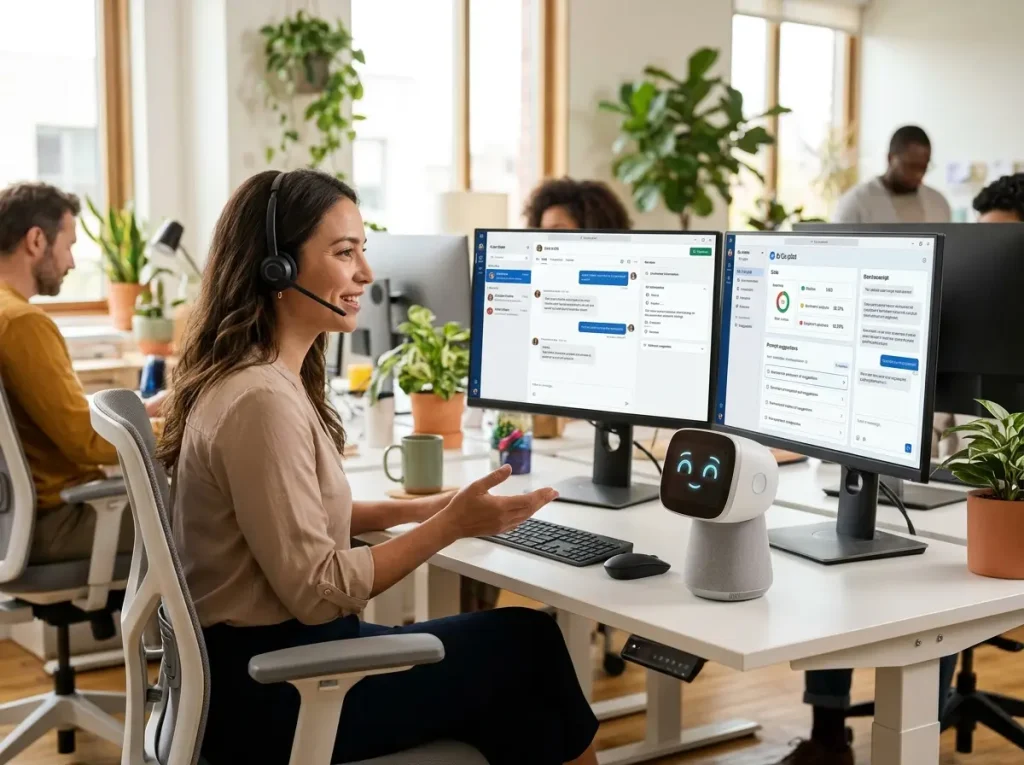
Although chatbots can manage many routine conversations, they cannot replace every form of customer interaction.
Some customers return with complicated questions, billing concerns, complaints, or requests that require personal attention. If an automated system continues presenting predefined responses in these situations, it can damage the relationship the business is trying to rebuild.
A successful reactivation system should recognize when a conversation needs human involvement.
For example, a returning customer who expresses dissatisfaction should have a straightforward way to speak with a support representative. Someone who needs detailed product advice may also benefit from assistance from a knowledgeable employee.
This combination allows chatbots to handle routine communication while human representatives focus on situations that require greater understanding and judgment.
It also improves operational efficiency. Employees do not need to manually manage every reminder or basic inquiry, but they remain available when customer needs become more complicated.
Another important consideration is transparency. Customers should understand when they are communicating with an automated system and should not be misled into believing that a chatbot is a human representative.
Businesses should also make it easy to stop receiving messages or change communication preferences. Respecting these choices helps maintain trust and reduces the risk of turning reactivation into unwanted outreach.
Where Chatbot Customer Reactivation Is Heading
The future of chatbot customer reactivation will likely involve more contextual communication, improved behavioral analysis, and stronger integration between customer service and marketing systems.
Businesses are increasingly interested in understanding customer intent rather than relying only on basic inactivity triggers. This creates opportunities for chatbots to deliver more relevant assistance based on the customer’s previous needs and current interests.
For example, an intelligent chatbot may help a returning customer explore a newly available service, answer questions about a previously considered product, or continue an unfinished support conversation.
Integration with customer relationship management systems can also provide a more connected view of customer interactions. When appropriate permissions are in place, businesses can use this information to coordinate communication across websites, messaging platforms, and support channels.
At the same time, privacy, consent, and responsible automation will remain important considerations. More sophisticated technology does not remove the need to respect customer preferences or maintain appropriate data practices.
Ultimately, the future of reactivation is not about sending more automated messages. It is about making every returning interaction more useful, relevant, and convenient.
Turning Inactive Customers Into Returning Relationships
Chatbot customer reactivation gives businesses an opportunity to reconnect with people who have previously shown interest but gradually stopped interacting. By combining previous conversation insights, personalized follow-ups, automated outreach, and intelligent customer support, companies can recover valuable engagement opportunities.
However, successful reactivation requires more than automation. Businesses must understand customer inactivity, recognize individual needs, provide meaningful communication, and measure whether their efforts produce lasting results.
When chatbots are designed around customer behavior and supported by human assistance, they can become an effective part of a broader retention strategy.
The real value of chatbot customer reactivation lies in rebuilding relationships rather than simply increasing interaction numbers. Businesses that focus on relevance, convenience, and customer trust can create stronger opportunities for long-term engagement and sustainable growth.
Frequently Asked Questions (FAQs)
1. What is chatbot customer reactivation?
Chatbot customer reactivation is the use of automated conversational systems to reconnect with inactive customers through personalized messages, follow-ups, relevant recommendations, and customer support interactions.
2. Why is customer re-engagement important for businesses?
Customer re-engagement helps businesses rebuild relationships with previous customers, recover missed sales opportunities, encourage repeat purchases, and improve long-term customer retention.
3. How do chatbots help recover inactive customers?
Chatbots can use permitted interaction history and customer activity to provide relevant reminders, answer previous questions, recommend suitable products, and encourage customers to continue unfinished conversations.
4. What is chatbot follow-up?
Chatbot follow-up refers to automated communication that continues or reopens a previous customer interaction. It may include reminders, additional information, support offers, or relevant product updates.
5. What causes customers to become inactive?
Customers may become inactive because of changing needs, poor experiences, limited interest, confusing purchasing processes, unavailable products, or a lack of relevant communication from the business.
6. How can businesses improve automated customer outreach?
Businesses can improve automated outreach by segmenting customers, personalizing messages, choosing appropriate communication times, providing relevant information, and respecting customer preferences.
7. What is dormant customer activation?
Dormant customer activation is the process of encouraging previously inactive customers to interact with a business again through relevant offers, product updates, personalized assistance, and targeted communication.
8. Can machine learning improve chatbot reactivation?
Yes. Machine learning can help identify behavioral patterns, analyze customer interactions, support personalization, and identify potential engagement opportunities. Its recommendations should still be monitored and evaluated.
9. Which metrics measure chatbot customer reactivation success?
Important metrics include reactivation rate, response rate, conversion rate, repeat purchase rate, customer retention rate, unsubscribe rate, and customer lifetime value.
10. Can chatbot customer reactivation improve customer retention?
Yes. When chatbots deliver relevant communication and useful assistance, they can encourage customers to return, resolve previous concerns, and maintain stronger relationships with a business.