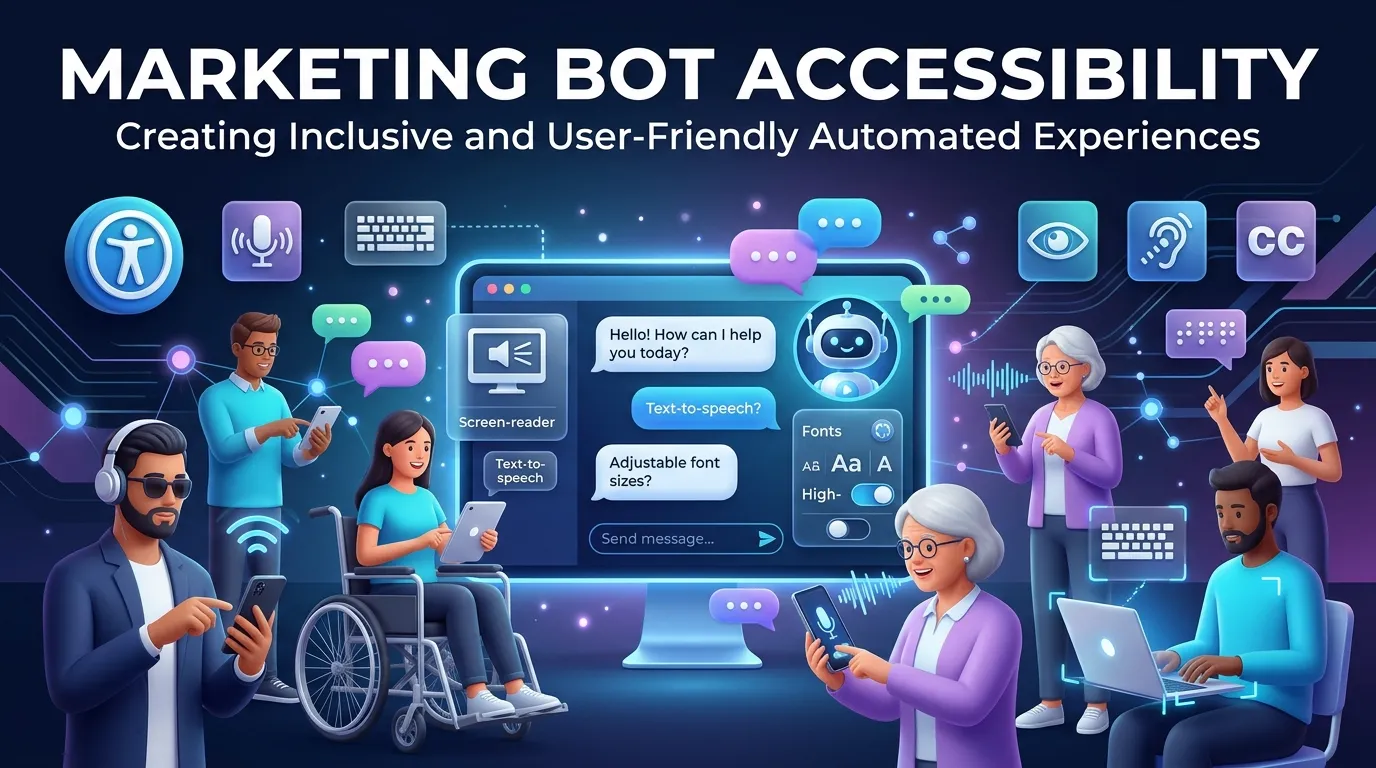
Marketing Bot Accessibility focuses on making automated marketing conversations usable for people with different abilities. By following accessibility standards, supporting screen readers, improving keyboard navigation, simplifying chatbot messages, and providing human assistance, businesses can create more inclusive digital experiences. Accessible marketing automation also supports customer engagement, improves usability, and helps organizations build stronger relationships through more reliable communication.
Marketing automation has changed how businesses communicate with customers, generate leads, and deliver personalized experiences. Chatbots and automated messaging systems now play an important role in answering questions, recommending products, collecting customer information, and supporting marketing campaigns. However, as businesses become more dependent on these technologies, one important consideration often receives less attention: accessibility.
Marketing Bot Accessibility is about making automated marketing experiences usable by people with different abilities, including individuals who rely on screen readers, keyboard navigation, voice commands, captions, or other assistive technologies. An effective marketing bot should not only communicate quickly but also ensure that every visitor can understand its messages, interact with its features, and complete their intended actions.
Accessibility is more than a technical requirement. It influences customer satisfaction, brand perception, engagement, and the overall quality of digital communication. When chatbot experiences are designed without considering accessibility, businesses risk creating unnecessary barriers that prevent potential customers from engaging with their services.
As customer expectations continue to evolve, companies need to rethink how they develop and manage automated communication. By prioritizing inclusive chatbot design, accessible conversational interfaces, and user-friendly marketing automation, businesses can create experiences that welcome a wider audience while maintaining effective marketing performance.
Understanding Marketing Bot Accessibility in Modern Marketing
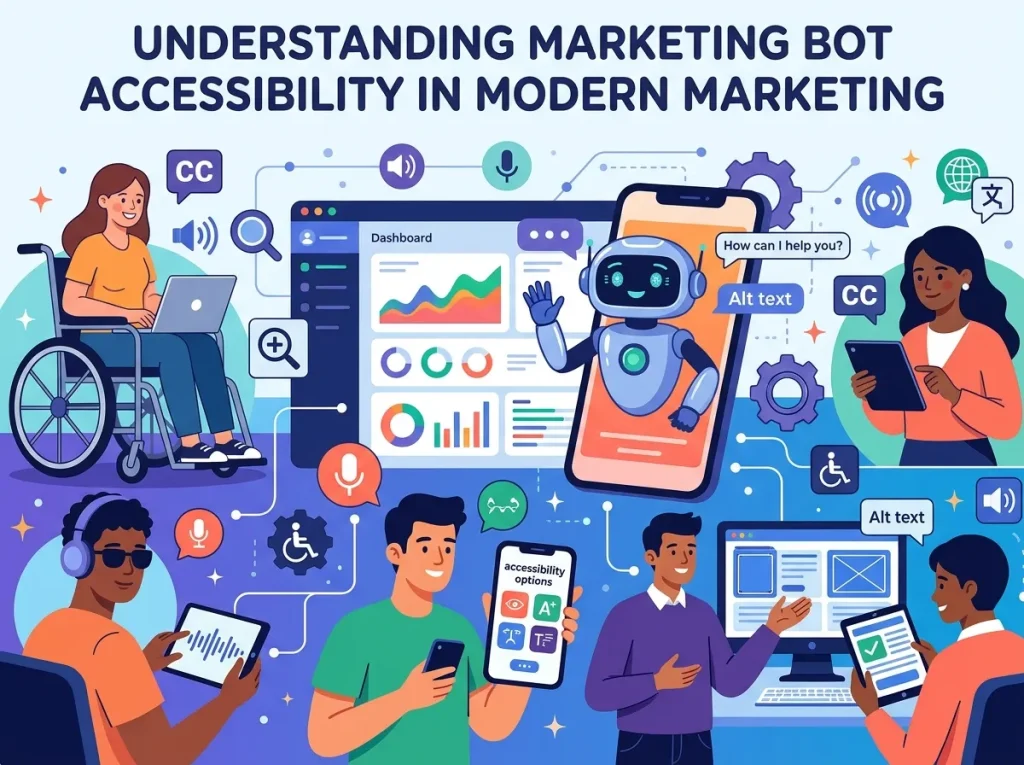
Marketing Bot Accessibility refers to the ability of people with different physical, sensory, and cognitive abilities to interact with marketing chatbots without unnecessary difficulty. It focuses on removing barriers within automated conversations so that users can access information and complete tasks regardless of how they navigate digital platforms.
For example, a visitor with limited mobility may prefer keyboard navigation instead of a mouse. Someone with a visual impairment might depend on a screen reader to understand chatbot messages. Another visitor may have difficulty processing complicated sentences and benefit from short, clearly structured responses.
If a chatbot only works through visual buttons, small interactive elements, or complicated conversational instructions, some users may struggle to use it effectively.
Accessible marketing experiences consider these differences from the beginning. Instead of assuming that every visitor interacts with technology in the same way, businesses create flexible communication systems that support different interaction methods.
This approach also improves the overall quality of automated marketing. Clear messages, logical conversation structures, and predictable interactions make chatbots easier to understand for everyone, not only people with disabilities.
Why Accessibility Matters for Marketing Automation
Marketing automation is designed to reduce communication barriers between businesses and customers. However, an inaccessible chatbot can create the opposite experience.
Imagine a potential customer visiting an online store and asking a chatbot about product availability. The chatbot responds with several interactive options, but those buttons cannot be accessed through a keyboard. Although the business has implemented automation, the customer cannot continue the conversation.
Situations like this demonstrate why accessibility needs to become part of marketing technology decisions.
Businesses that prioritize accessible marketing automation can create more consistent customer experiences across websites, landing pages, and digital communication channels. Visitors can interact with automated services more independently, reducing frustration and making important information easier to access.
Accessibility can also strengthen brand credibility. Customers increasingly evaluate businesses through their digital experiences. A company that considers different user needs demonstrates attention to customer experience and a commitment to inclusive communication.
There is also a practical business advantage. Making chatbot interactions easier to understand and navigate can reduce unnecessary drop-offs, improve customer engagement, and help more visitors complete meaningful actions.
Inclusive Chatbot Design Starts With Understanding Different Users
Inclusive Chatbot Design requires businesses to consider how different people experience digital conversations. Rather than creating a single interaction style and expecting everyone to adapt, developers should build chatbots that accommodate different communication preferences.
A visually impaired visitor may need meaningful descriptions of buttons and interactive elements. A person with hearing difficulties may prefer text-based communication instead of audio instructions. Someone with cognitive disabilities may benefit from straightforward language, fewer choices, and additional time to understand a response.
These differences influence almost every part of a chatbot experience.
For instance, a chatbot that asks five questions simultaneously can overwhelm users who prefer simpler interactions. A more accessible approach is to present one question at a time and explain what information is required.
Conversation design should also avoid unnecessary complexity. Technical terminology, confusing instructions, and unexpected changes in conversation flow can make automated communication difficult to follow.
Inclusive design does not mean removing advanced functionality. It means presenting that functionality in ways that different users can understand and operate.
When businesses take this approach, chatbots become more adaptable communication tools rather than systems designed for only one type of visitor.
Building Accessible Conversational Interfaces
The structure of a conversation has a significant influence on chatbot accessibility. Even when a chatbot includes accessible buttons and readable text, a poorly organized conversation can still create difficulties.
Accessible Conversational Interfaces focus on making interactions predictable, understandable, and easy to navigate.
A well-structured chatbot should clearly communicate when a response is loading, when a message has been delivered, and when the user needs to take action. These small details help visitors understand what is happening during an interaction.
Navigation is another important consideration. Users should be able to move through available options without becoming trapped in a conversation. A visible and understandable method of returning to a previous step or restarting an interaction can make the experience more comfortable.
Businesses should also provide alternatives when automated systems cannot understand a request. Repeatedly asking users to rephrase the same question can create frustration, particularly for people who communicate differently.
A better experience offers alternative responses, relevant suggestions, or a connection to human support.
This is especially important when chatbots are used for customer service, product discovery, and lead qualification. Customers should never feel that automation has removed their ability to communicate with the business.
Marketing Bot Usability and the Importance of Simple Interactions
Marketing Bot Usability describes how easily visitors can understand and operate a chatbot while completing their intended tasks. Accessibility and usability are closely connected because both focus on reducing unnecessary interaction difficulties.
A chatbot may have advanced artificial intelligence, personalized recommendations, and extensive automation capabilities. However, these features have limited value if customers cannot understand how to use them.
Good usability begins with clear communication. Chatbot messages should be concise, relevant, and written in language that matches the audience. Long paragraphs and complicated instructions can make conversations difficult to follow, especially on mobile devices.
The visual presentation also matters. Text should have sufficient contrast against its background, buttons should be easy to identify, and interactive elements should have enough spacing to reduce accidental selections.
Another important factor is interaction timing. Some chatbots display messages too quickly or automatically move users to another conversation stage. This can create problems for visitors who need additional time to read or understand information.
Allowing users to control the pace of a conversation creates a more comfortable experience.
Ultimately, effective usability comes from making the chatbot work around customer needs rather than forcing customers to adjust to the limitations of the technology.
AI Bot Accessibility Features That Improve Customer Experiences
Artificial intelligence has introduced new possibilities for automated communication. Modern marketing bots can interpret questions, recommend relevant content, recognize customer intent, and generate conversational responses.
However, AI capabilities alone do not guarantee accessibility. Businesses must ensure that the technology supports different interaction requirements.
Several AI Bot Accessibility Features can help create more inclusive experiences.
One important capability is flexible communication. Chatbots should understand different ways of expressing similar requests rather than depending on exact keywords or predefined sentences.
For example, customers may ask about pricing using different words, sentence structures, or spelling variations. An intelligent system should be able to recognize the underlying intent and provide an appropriate response.
Another valuable feature is simplified response generation. AI-powered chatbots can present complex information in clearer language, making product details and service explanations easier to understand.
Multilingual support can also improve accessibility by helping customers interact in languages they understand more comfortably. However, translated responses should maintain clear meaning and avoid confusing expressions.
Voice interaction, adjustable text presentation, and compatibility with assistive technologies can further improve the experience.
Businesses should also monitor AI-generated responses carefully. Automated systems can sometimes produce unclear, misleading, or inconsistent information. Accessibility requires accurate communication as much as it requires convenient interaction.
Why Screen Reader Compatible Chatbots Are Essential
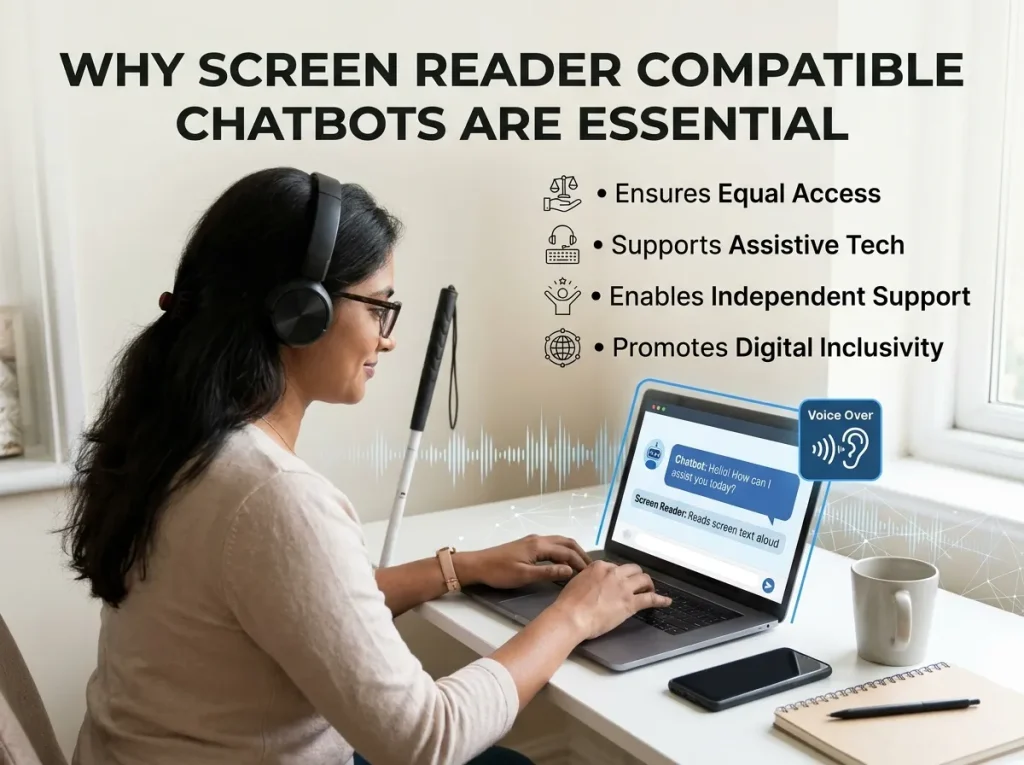
Screen readers allow people with visual impairments to access digital content by converting text and interface information into speech or other accessible formats.
However, not every chatbot communicates its structure correctly to assistive technologies.
Screen Reader Compatible Chatbots need properly labeled interactive elements, meaningful reading order, and clear announcements when new messages appear.
For example, a chatbot button labeled only as “Click Here” does not communicate much information. A more descriptive label, such as “View Product Details,” helps users understand the purpose of the interaction.
The same principle applies to message notifications. When a chatbot generates a new response, the interface should communicate that update in a way that assistive technologies can recognize without unnecessarily interrupting the user.
Developers should also pay attention to keyboard focus. When a new conversation opens or a user selects an option, the focus should behave predictably. Users should not have to navigate through unrelated website elements to find the latest chatbot message.
Proper semantic HTML, accessible labels, logical focus management, and appropriate ARIA attributes can support these requirements.
Testing with actual screen readers is particularly valuable because a chatbot that appears accessible visually may still create problems for users relying on assistive technology.
Inclusive Digital Marketing Tools and Consistent Accessibility
Chatbots rarely operate independently. They are usually connected to websites, landing pages, email platforms, customer relationship management systems, and other marketing technologies.
This makes accessibility a broader digital marketing responsibility.
Inclusive Digital Marketing Tools should work together to provide a consistent experience across customer touchpoints. For example, a customer who receives information through an accessible chatbot should also be able to access the same information through a landing page or follow-up communication.
Consider a business that uses automated bots to collect leads. If the chatbot provides accessible questions but redirects users to an inaccessible form, the overall experience remains incomplete.
The same issue can occur when chatbots share promotional offers, product recommendations, or downloadable resources. Every destination should support accessible navigation and understandable content.
Businesses can strengthen this consistency by considering accessibility when selecting marketing platforms and integrating new automation tools.
The chatbot knowledge system is another important part of this process. A well-organized Chatbot Knowledge Base helps automated systems deliver relevant and consistent information. When the underlying content is clearly structured, chatbots have a stronger foundation for providing understandable responses to different users.
Accessibility should therefore be considered across the entire marketing technology environment, not simply within the chatbot window.
Connecting Accessibility With Lead Qualification and Customer Retention
Marketing chatbots frequently support two important business objectives: identifying potential customers and maintaining relationships with existing ones.
However, these objectives should not come at the expense of accessibility.
During lead qualification, automated bots often ask visitors about their interests, budgets, requirements, and purchasing intentions. If these questions are confusing or difficult to navigate, potential customers may abandon the conversation before completing the process.
A more inclusive experience uses clear questions, understandable answer options, and alternative ways to provide information.
Businesses can also review their Bot Qualification processes to understand how automated interactions influence the quality of collected leads. When qualification conversations are accessible, more visitors have an opportunity to communicate their needs accurately.
Customer retention also depends on consistent communication. Automated bots can help customers find information, receive updates, and access assistance after their initial purchase.
An accessible retention strategy should allow customers to interact with these services without unnecessary barriers. Clear reminders, readable messages, and straightforward support options can make automated communication more useful.
This is where Marketing Bot Customer Retention becomes relevant. Retention is not simply about sending more automated messages. It is about creating communication experiences that customers can comfortably use and trust.
When accessibility becomes part of both lead qualification and retention, marketing automation can support stronger customer relationships throughout the buying journey.
Accessibility Standards and the Role of WCAG
Accessibility should be supported by recognized standards rather than personal assumptions about what users might find convenient.
The Web Content Accessibility Guidelines (WCAG), developed by the World Wide Web Consortium (W3C), provide an established framework for improving digital accessibility.
WCAG is based on four fundamental principles: content should be perceivable, operable, understandable, and robust.
These principles are highly relevant to marketing chatbots.
Perceivable: Users should be able to access chatbot information through appropriate visual, auditory, or assistive formats. Text contrast, meaningful labels, and alternatives for non-text content are important considerations.
Operable: All chatbot functionality should be accessible through supported interaction methods, including keyboard navigation. Users should be able to move through conversations and activate controls without relying exclusively on a mouse.
Understandable: Messages, instructions, and navigation should be clear and predictable. Chatbots should avoid unnecessarily complicated language and confusing interaction patterns.
Robust: Chatbot interfaces should work reliably with different browsers, devices, and assistive technologies. Proper coding and semantic structure help support compatibility.
Businesses should consider WCAG 2.2 as an important reference when evaluating their digital experiences. The appropriate conformance target depends on the organization, applicable regulations, and the specific service being provided.
Following accessibility standards helps create a more reliable foundation for inclusive marketing technology.
The Role of Human Support in Accessible Automation
Even the most advanced chatbot cannot handle every customer situation. Some questions require additional explanation, individual assistance, or human judgment.
For this reason, accessible automation should always include a reasonable path to human support.
A visitor may have difficulty explaining a complicated issue to an automated system. Another customer may prefer speaking with a representative rather than continuing a digital conversation.
When chatbots repeatedly fail to understand these requests, customers can become frustrated.
Providing an understandable human-support option helps prevent this problem. Businesses should make escalation options easy to locate and ensure that customers are not required to repeat unnecessary information when transferring from a bot to a representative.
Human support is particularly important for accessibility-related requests because individual users may have interaction requirements that automated systems cannot fully accommodate.
A balanced approach allows chatbots to manage routine communication while human representatives handle situations that require additional attention.
This combination makes automation more practical and customer-focused.
How Accessibility Is Influencing the Future of Marketing Bots

The future of marketing automation will involve more intelligent, personalized, and interconnected communication systems. As these technologies develop, accessibility will become increasingly important to how businesses evaluate their effectiveness.
AI-powered conversational tools are already making it possible to create more flexible interactions. Future systems may become better at recognizing communication preferences, simplifying explanations, supporting multiple languages, and adapting responses to individual requirements.
However, personalization should not become a replacement for user control. Customers should be able to understand how a chatbot works, choose how they interact with it, and request assistance when necessary.
Businesses will also need to pay closer attention to the accessibility of third-party marketing technologies. A chatbot may operate within a website through an external platform, meaning accessibility depends partly on the tools and integrations being used. Businesses exploring AI Bots for Business should also consider how these solutions support accessible communication, improve customer interactions, and accommodate different user requirements.
Regular evaluation, user feedback, and compatibility testing will remain important as these systems evolve.
Another significant development is the growing relationship between accessibility and brand reputation. Businesses that provide inclusive digital experiences can demonstrate that customer needs are considered throughout their marketing activities.
This creates an opportunity to build trust through practical improvements rather than relying solely on promotional claims.
Conclusion: Making Marketing Bot Accessibility a Business Priority
Marketing Bot Accessibility is an essential part of creating effective and inclusive digital communication. As chatbots become more involved in customer engagement, lead generation, product discovery, and support, businesses must ensure that these systems remain usable for people with different abilities and interaction preferences.
Accessible conversational interfaces, screen reader compatibility, clear messaging, flexible navigation, and reliable human support all contribute to better chatbot experiences.
More importantly, accessibility should not be treated as an isolated technical feature. It should influence how businesses select marketing tools, organize conversational content, develop automation strategies, and evaluate customer experiences.
Companies that prioritize inclusive chatbot design can reduce unnecessary communication barriers while creating more understandable and dependable interactions.
Ultimately, successful marketing automation is not measured only by how quickly a chatbot responds or how many conversations it handles. Its real value also depends on whether people can use it comfortably, access the information they need, and feel included throughout the experience.
Frequently Asked Questions (FAQs)
1. What is Marketing Bot Accessibility?
Marketing Bot Accessibility refers to designing marketing chatbots so people with different abilities can interact with automated conversations, access information, and complete tasks without unnecessary barriers.
2. Why is chatbot accessibility important for businesses?
Chatbot accessibility helps businesses create inclusive customer experiences, improve usability, reduce interaction difficulties, and make automated services available to a wider audience.
3. What are chatbot accessibility standards?
Chatbot accessibility standards are established principles and technical requirements that help make chatbot interfaces usable with different devices and assistive technologies. WCAG provides an important framework for evaluating digital accessibility.
4. How can businesses create inclusive chatbot designs?
Businesses can use clear language, accessible buttons, keyboard navigation, screen reader support, sufficient color contrast, and flexible conversation structures to create more inclusive chatbot experiences.
5. What makes a chatbot compatible with screen readers?
A screen reader-compatible chatbot uses descriptive labels, semantic HTML, logical navigation, appropriate focus management, and accessible notifications to help visually impaired users understand and operate the interface.
6. How does AI improve chatbot accessibility?
AI can support accessibility through flexible language recognition, simplified responses, multilingual communication, and more adaptable conversational interactions. However, these features should be tested to ensure they work reliably.
7. Does chatbot accessibility improve customer experience?
Yes. Accessible chatbots make conversations easier to understand and navigate, helping customers find information, receive assistance, and complete tasks with fewer difficulties.
8. What role does WCAG play in marketing bot accessibility?
WCAG provides internationally recognized accessibility guidelines based on four principles: perceivable, operable, understandable, and robust. Businesses can use these principles to evaluate chatbot interfaces.
9. Should accessible marketing chatbots provide human support?
Yes. Human support gives customers an alternative when automated systems cannot understand their requests or when individual assistance is necessary.
10. What is the future of accessible marketing automation?
The future will likely involve more adaptive AI, improved assistive technology compatibility, multilingual interactions, personalized communication, and stronger accessibility evaluation across digital marketing platforms.