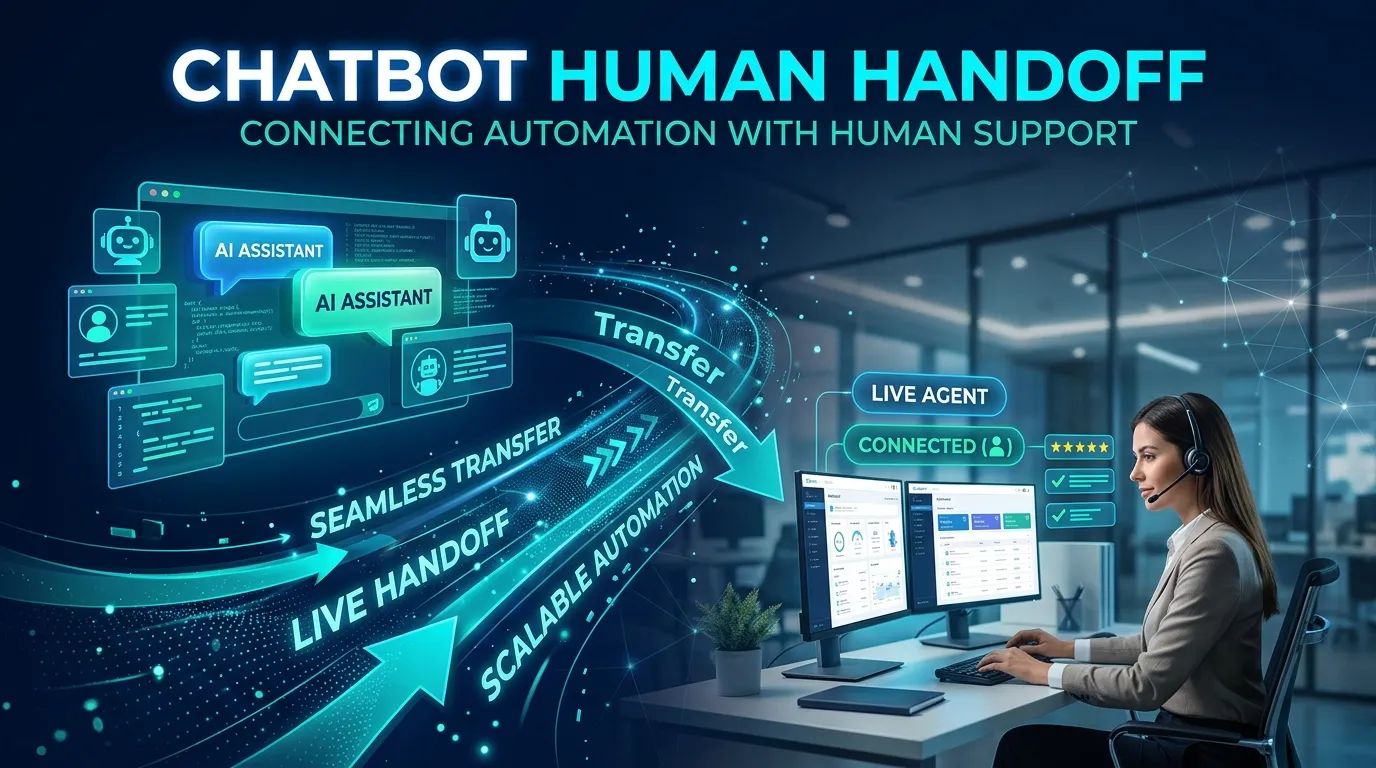
Chatbot Human Handoff enables businesses to transfer conversations from automated chatbots to human representatives when customers need more personalized or complex assistance. With clear escalation rules, conversation history sharing, and reliable live chat integration, businesses can create a smoother support experience while improving efficiency and customer satisfaction.
Chatbots have become an important part of modern customer service. They help businesses answer common questions, provide instant information, guide website visitors, and handle routine requests without requiring a support representative to respond to every conversation. However, automated assistance has its limits. Some customer concerns involve complicated situations, personal preferences, sensitive information, or unexpected problems that require human understanding.
This is where Chatbot Human Handoff becomes essential. It allows a chatbot to transfer a conversation to a live customer service representative when automated support is no longer sufficient. Instead of leaving customers frustrated with repeated automated responses, businesses can connect them with someone who can understand their situation and provide more appropriate assistance.
An effective handoff does more than move a conversation from a chatbot to a person. It creates a continuous support experience in which automation and human expertise work together. Customers receive quick assistance for simple questions while retaining access to personal support when they need it. For businesses, this approach can improve service quality, reduce unnecessary workloads, and make customer communication more efficient.
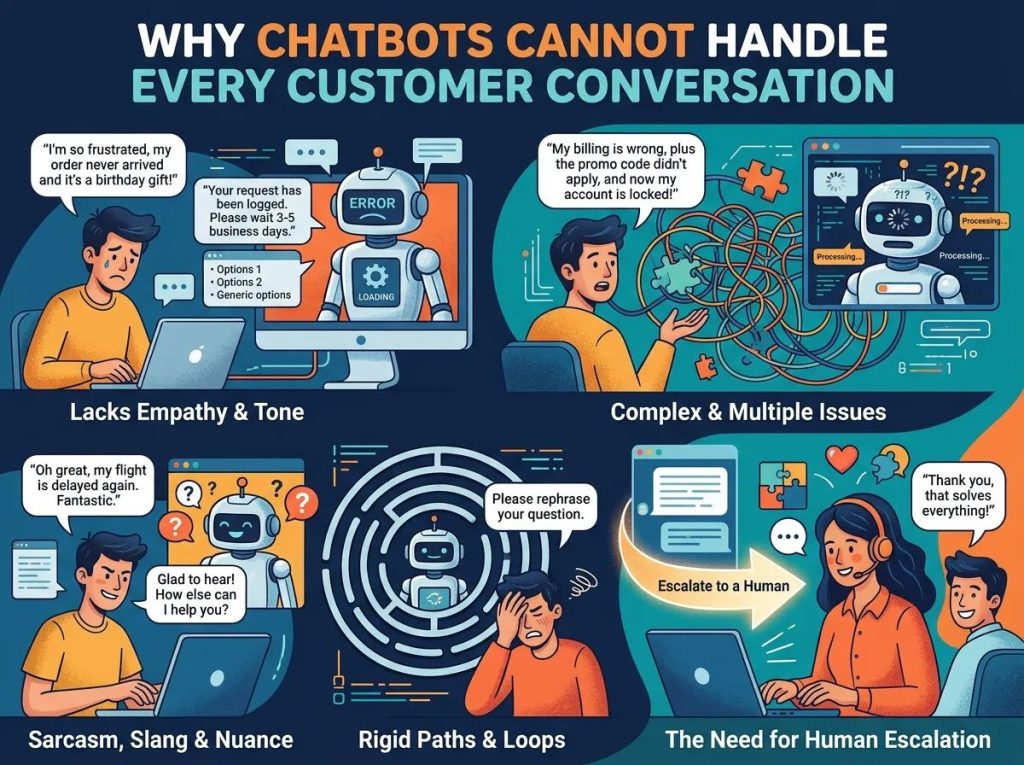
Why Chatbots Cannot Handle Every Customer Conversation
Automation is particularly useful when customer requests follow predictable patterns. A chatbot can explain return policies, share product information, provide order updates, answer frequently asked questions, and guide users through basic processes. These interactions save time for customers and support teams alike.
However, customer conversations are not always predictable. Someone might contact a business because an order has arrived damaged, a payment has failed, an account has been restricted, or a previous support request remains unresolved. Although a chatbot may recognize certain keywords, understanding the complete situation can require judgment and context.
A customer might also become frustrated after receiving several automated answers that do not address the actual problem. Continuing the same automated conversation can make the experience worse. In these circumstances, transferring the interaction to a human representative is often the more effective response.
Businesses should therefore view automation as one part of their customer service operation rather than a complete replacement for human assistance. A well-designed support experience recognizes when automation is useful and when a person should take over.
What Chatbot Human Handoff Actually Means
Chatbot Human Handoff refers to the process of transferring an active chatbot conversation to a human customer service representative. The transition may happen automatically when certain conditions are met or manually when a customer requests personal assistance.
For example, a visitor might begin a conversation by asking about a product’s availability. The chatbot can provide the relevant information immediately. If the visitor then asks about a complicated delivery issue or requests help with a customized order, the system can connect them to a live agent.
This process is sometimes called Chatbot-to-Agent Handoff because the conversation moves from an automated assistant to a human representative without requiring the customer to start again.
The most important part is continuity. The representative should receive the conversation history, the customer’s original question, and any relevant information already collected by the chatbot. Without this context, customers may need to repeat themselves, making the transfer feel inconvenient rather than helpful.
An effective handoff preserves the progress of the conversation and allows the human representative to continue from where the chatbot stopped.
Recognizing the Right Moment for Human Assistance
One of the biggest challenges in automated customer support is identifying when a conversation should be transferred. If a chatbot escalates every question, it creates unnecessary work for support teams. If it refuses to escalate complicated requests, customers may become dissatisfied.
A reliable system needs to recognize different conversation patterns and respond accordingly.
Customer requests involving account access, billing disputes, payment problems, complaints, refunds, and unusual technical issues may require human attention. These situations often involve details that cannot be resolved through a standard automated response.
Repeated misunderstandings are another important signal. If a chatbot fails to understand a question after several attempts, it should consider transferring the conversation instead of asking the customer to rephrase the same request indefinitely.
Customer sentiment can also provide useful context. Repeated expressions of frustration, dissatisfaction, or urgency may indicate that the customer needs a more personal response. Sentiment detection should not be treated as perfect, but it can help identify conversations that deserve closer attention.
A well-designed escalation process also makes it easy for customers to request a person directly. Even when a chatbot believes it can answer a question, customers should not have to struggle through multiple automated menus to reach human support.
How Live Agent Chatbot Transfer Works
A Live Agent Chatbot Transfer usually begins when the chatbot identifies a situation that requires additional assistance. The transfer can be initiated through predefined escalation conditions, customer requests, or signals detected during the conversation.
Once the transfer is triggered, the chatbot checks whether an appropriate support representative is available. Depending on the business’s support structure, the conversation may be assigned to a general support team or directed to a specialist who handles billing, technical issues, sales, or account management.
Before the representative takes over, the system should package the relevant conversation details. This can include the customer’s question, previous chatbot responses, selected options, order references, and information already provided during the interaction.
The representative then receives the conversation through a live chat interface or another supported communication channel. They can review the available context and continue assisting the customer.
If no agent is immediately available, the chatbot should explain what happens next. It might offer a waiting queue, request permission to arrange a callback, or collect contact details for a follow-up. Customers should not be left wondering whether their request has been received.
The quality of this process depends on the technology behind it, but equally important is how clearly the business communicates during the transition.
Human Agent Escalation and the Importance of Context
Human Agent Escalation is not simply about connecting a customer with another person. It is about ensuring that the person receiving the conversation has enough information to solve the problem.
Imagine a customer contacting an online retailer about a missing delivery. The chatbot asks for an order number, checks the delivery status, and provides an update. However, the customer explains that the tracking information is incorrect and the package has not arrived.
If the conversation is transferred without its history, the customer may have to explain the issue again. The representative might repeat questions that the chatbot has already asked, creating unnecessary delays.
A better system transfers the complete interaction, including the order reference and the steps already attempted. The representative can immediately investigate the delivery problem rather than restarting the conversation.
This is an important part of Human-in-the-Loop Customer Support. Automation handles predictable tasks, while human representatives provide judgment, empathy, and decision-making when the situation requires more than a standard response.
Businesses can also use the information collected during escalations to improve their automated support. If customers repeatedly request human assistance for the same issue, that may indicate missing information, confusing chatbot responses, or an outdated support process.
Designing Effective Chatbot Escalation Rules
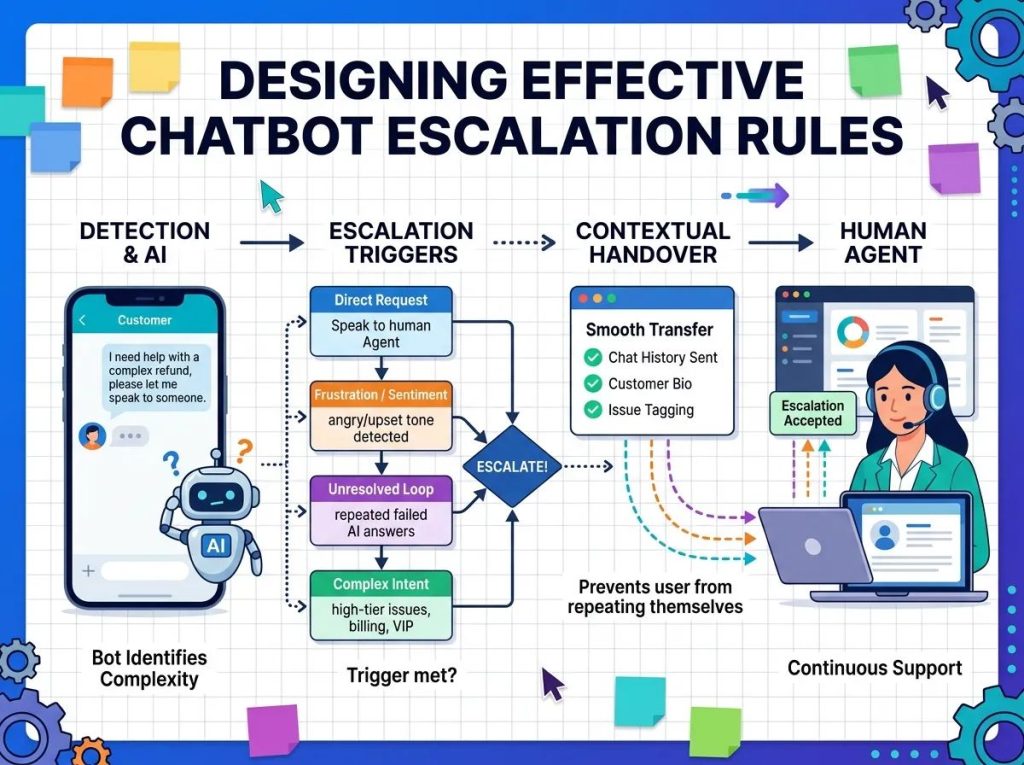
Every chatbot needs a clear understanding of when to continue an automated conversation and when to transfer it. These decisions are controlled through Chatbot Escalation Rules.
The rules should reflect the actual needs of the business and its customers. For instance, a company may automatically escalate billing disputes, account security concerns, and complex technical problems. Routine questions about business hours or product specifications can usually remain within the automated support process.
It is also important to define how many unsuccessful attempts a chatbot should make before offering human assistance. Too many repeated questions can make the system feel unhelpful. A reasonable escalation threshold gives customers an alternative before frustration increases.
Businesses should consider the type of service they provide when setting these conditions. An online store, financial service, healthcare platform, and software company may all require different escalation priorities. A problem that is relatively simple in one industry could be highly sensitive in another.
Escalation rules should also account for business hours and agent availability. If live support is unavailable, the chatbot needs a clear alternative rather than promising an immediate transfer that cannot happen.
The objective is not to send every difficult conversation to a person. It is to make sure customers reach the appropriate level of assistance without unnecessary delays.
Building a Seamless Chatbot Transition
A Seamless Chatbot Transition makes the movement between automated and human support feel like a natural continuation of the same conversation.
Customers should understand when the transfer is happening, why it is necessary, and what they should expect. A simple message explaining that the chatbot is connecting them with a support representative can prevent confusion.
The conversation history should remain available throughout the process. Customers should not need to repeat information, reselect options, or explain the same problem to a new representative.
The language used during the transition also matters. A chatbot should avoid making customers feel that they have failed to communicate properly. Instead of repeatedly saying that it does not understand, it can acknowledge the request and explain that a representative may be better equipped to help.
For example, a chatbot might respond:
“I understand that you’re experiencing a problem with your recent payment. This may require additional assistance, so I’ll connect you with a support representative who can review the issue.”
This type of response is direct, respectful, and informative. It also sets a realistic expectation about what will happen next.
Businesses should pay attention to the entire customer journey, not just the transfer itself. The interaction should remain consistent in tone, information, and service quality, regardless of whether the customer is speaking with a chatbot or a human representative.
Connecting Chatbots With Live Chat Systems
Successful handoffs depend on effective communication between chatbot software and the business’s customer support infrastructure. This is where Live Chat Integration becomes particularly important.
When chatbot platforms are connected to live chat tools, support teams can receive transferred conversations through their existing communication interface. Depending on the technology, the integration may also connect customer relationship management systems, ticketing platforms, order databases, and other business applications.
These connections help representatives access useful customer information without switching between multiple systems. They can review previous interactions, understand the current request, and identify the next appropriate action.
A connected support environment also improves visibility for managers. They can monitor transferred conversations, evaluate response times, identify common escalation reasons, and understand where automated support may need improvement.
The broader value of this approach becomes clearer when businesses consider how automation connects with their other operations. Effective chatbot integration can support smoother communication across departments, as explained in How Chatbot Integration Improves Business Efficiency. When systems share relevant information, employees spend less time searching for details and more time resolving customer concerns.
However, integration should be planned carefully. Businesses need to consider data accuracy, access permissions, privacy requirements, and system reliability. A technically connected platform will not automatically create a good customer experience unless the information it transfers is relevant and dependable.
The Role of a Chatbot Knowledge Base in Better Handoffs
A chatbot’s ability to resolve routine questions has a direct impact on the number and quality of conversations transferred to human representatives.
A well-maintained knowledge base gives the chatbot access to accurate answers about products, services, policies, and common customer problems. This helps automation resolve more straightforward requests before escalation becomes necessary.
For example, if a customer asks about a return policy, the chatbot should be able to explain the relevant conditions clearly. If the customer then describes an unusual situation that falls outside the standard policy, the system can transfer the conversation with the relevant details.
The quality of the information available to the chatbot is therefore important. Outdated policies, incomplete answers, and conflicting information can create unnecessary escalations or cause customers to lose confidence in automated support.
Businesses can improve this foundation by developing a structured Chatbot Knowledge Base. Organizing information around common questions and customer needs makes it easier for automated systems to provide useful answers while recognizing when a request requires further attention.
The knowledge base should also evolve based on actual customer interactions. If representatives repeatedly answer questions that the chatbot cannot resolve, those conversations may reveal useful opportunities to add new information or improve existing responses.
Why Message Timing Matters During Escalation
Even when a chatbot correctly identifies the need for human assistance, poor communication timing can affect the experience.
Customers may become uncertain if the chatbot announces a transfer and then remains silent. They may leave the conversation if they do not know whether an agent is coming or how long they might need to wait.
This makes communication timing an important part of the handoff process. Customers should receive clear updates when a transfer begins, when they enter a waiting queue, and when a representative becomes available.
The chatbot should also avoid sending repeated notifications that add no meaningful information. Too many messages can make the experience feel automated and intrusive, particularly when customers are already waiting for help.
Businesses can improve these interactions by considering the principles discussed in Chatbot Message Timing. Appropriate timing helps customers understand what is happening and reduces uncertainty during important moments in the conversation.
A useful approach is to make every status message serve a purpose. If an agent is unavailable, explain the situation and provide a practical alternative. If the transfer is successful, confirm that the representative has joined. Clear communication is more valuable than frequent but unnecessary notifications.
How Human Handoff Supports Better Conversion Experiences
Customer support and business growth are closely connected. A visitor who receives useful assistance at the right moment may feel more confident about completing a purchase, booking a service, or requesting additional information.
Consider someone browsing a software company’s website. The chatbot can explain available subscription plans and answer general questions. However, the visitor may need advice about selecting a package for a large team or integrating the software with existing systems.
A live representative can discuss those requirements in greater detail and recommend an appropriate option. In this situation, transferring the conversation creates an opportunity to provide personalized assistance that a standard automated response might not deliver.
The same principle applies to online stores, service providers, and other businesses where purchasing decisions involve specific requirements.
However, human handoff should not become a sales tactic that interrupts customers unnecessarily. Its purpose is to provide the right level of assistance, whether that means answering a product question, resolving a concern, or helping someone complete an important action.
Businesses looking to connect support interactions with stronger customer journeys can also explore Chatbot Conversion Optimization. Improving how chatbots guide visitors, recognize their needs, and involve human representatives can make the overall experience more relevant and useful.
Hybrid Customer Support Systems: Combining Automation With Human Expertise
A Hybrid Customer Support System combines automated assistance with human customer service. Rather than relying entirely on chatbots or expecting employees to handle every request, it assigns each interaction to the most appropriate support method.
In this model, chatbots can manage repetitive questions, collect initial information, provide instant updates, and guide customers through basic processes. Human agents can focus on complex problems, sensitive conversations, complaints, and situations that require judgment.
This division of responsibility can help businesses manage support demand more effectively. Representatives spend less time answering repetitive questions and have more capacity to handle cases that genuinely require personal attention.
It can also create a more flexible support environment. During busy periods, automation can continue handling routine inquiries while agents concentrate on escalated conversations. Outside business hours, the chatbot can provide basic assistance and collect information for later follow-up.
Nevertheless, a hybrid system requires coordination. Teams need consistent information, clear responsibilities, and a shared understanding of how conversations move between automated and human support.
It is also important to ensure that customers can reach a person when necessary. A hybrid approach should make support more accessible, not create additional barriers between customers and representatives.
Measuring the Quality of Chatbot Human Handoff
Businesses need to evaluate more than the number of conversations transferred to human agents. A high transfer rate does not automatically mean the system is working well. It could indicate that the chatbot is struggling to answer basic questions or that customers cannot find the information they need.
A more meaningful evaluation considers the complete support experience.
Handoff response time is one useful measure because it shows how long customers wait after requesting human assistance. First-contact resolution can indicate whether representatives successfully solve transferred problems without requiring repeated interactions.
Customer satisfaction scores can reveal how people feel about the transition and the support they receive afterward. Businesses can also examine conversation abandonment rates to understand whether customers leave while waiting for a representative.
Another valuable measurement is escalation accuracy. This considers whether the chatbot transfers conversations when human assistance is genuinely necessary. Too many unnecessary transfers can increase workloads, while too few can leave customers struggling with automated support.
Businesses should also review the reasons behind escalations. If a particular question repeatedly leads to human assistance, the chatbot may need better information, improved recognition, or a clearer response process.
Regular analysis turns customer support conversations into useful operational insights. Instead of treating every escalation as an isolated event, businesses can identify patterns and improve the overall service experience.
Common Challenges Businesses Should Consider
Implementing chatbot-to-agent handoff can introduce several operational challenges. One common problem is incomplete conversation history. If important details are missing during transfer, representatives may struggle to understand the customer’s situation.
Agent availability is another concern. A chatbot may recognize the need for escalation correctly, but the customer experience can still suffer if no representative is available and no alternative is offered.
Poor routing can create similar difficulties. Sending technical problems to a sales representative or billing disputes to a general support queue can increase resolution time. Businesses should connect escalation conditions with appropriate teams and expertise.
Privacy also deserves attention. Customer information transferred between systems should be handled according to relevant data protection requirements. Businesses should collect only the information needed for support and ensure that access is appropriately controlled.
Finally, employees need to understand how the chatbot works. Representatives should know what information the system collects, how conversations are assigned, and how to continue interactions without making customers repeat themselves.
These challenges do not mean that human handoff is difficult to implement. They highlight why the process needs to be designed around real customer needs rather than treated as a simple software feature.
The Future of Connected Customer Support

Customer expectations continue to change as businesses introduce more advanced automation. Chatbots are becoming better at understanding natural language, recognizing intent, retrieving information, and managing multi-step conversations.
However, greater automation does not remove the need for human assistance. In many situations, the ability to connect customers with a knowledgeable representative will remain an important part of delivering reliable service.
Future support systems are likely to make handoffs more context-aware. They may identify the customer’s intent more accurately, summarize conversations for representatives, and recommend relevant information before an agent joins. These capabilities can help reduce the time required to understand and resolve a problem.
Businesses may also use insights from previous conversations to identify which requests are suitable for automation and which consistently require human involvement. This can support more thoughtful improvements to chatbot design and customer service operations.
The strongest systems will not necessarily be those that automate the greatest number of conversations. They will be the systems that recognize what customers need and provide the right kind of assistance at the right moment.
Conclusion
Chatbot Human Handoff creates a practical connection between automated communication and human customer service. It allows businesses to resolve routine questions efficiently while ensuring that customers can receive personal assistance when a situation becomes too complex for automation.
Successful handoffs depend on more than transferring a conversation. They require clear escalation rules, reliable live chat integration, accessible conversation history, appropriate agent routing, and transparent communication throughout the process.
When these elements work together, chatbots and human representatives can support one another rather than operate as separate service channels. Businesses can reduce repetitive workloads, improve the quality of customer interactions, and create a more consistent support experience.
Ultimately, effective automation is not about removing people from customer service. It is about allowing technology and human expertise to work together to deliver better assistance.
Frequently Asked Questions
1. What is Chatbot Human Handoff?
Chatbot Human Handoff is the process of transferring a conversation from an automated chatbot to a human customer service representative when a request requires personal attention, specialized knowledge, or additional problem-solving.
2. Why is human handoff important in chatbot support?
Human handoff ensures that customers can receive assistance when automated responses are insufficient. It helps resolve complicated issues, reduces frustration, and creates a more balanced customer service experience.
3. When should a chatbot transfer a conversation to a human agent?
A chatbot should consider transferring conversations involving billing disputes, complaints, account problems, complex technical issues, repeated misunderstandings, or direct requests to speak with a representative.
4. How does chatbot-to-agent handoff work?
The chatbot identifies a need for human assistance, checks agent availability, and transfers the conversation with relevant customer information and interaction history. A representative then continues the discussion.
5. What are chatbot escalation rules?
Chatbot escalation rules are predefined conditions that determine when an automated conversation should be transferred to a human representative. They may consider customer requests, conversation complexity, repeated failures, or specific support categories.
6. How can businesses make chatbot transitions seamless?
Businesses can preserve conversation history, explain the transfer clearly, route requests to the appropriate team, and provide waiting-time updates or alternative contact options when agents are unavailable.
7. What is the role of live chat integration in human handoff?
Live chat integration connects chatbot software with human support platforms. It allows representatives to receive transferred conversations, review customer information, and continue assisting users through a connected interface.
8. Can chatbots reduce the workload of human support agents?
Yes. Chatbots can handle routine questions, provide basic information, and collect initial details. This allows human representatives to focus more on complex requests and interactions that require personal attention.
9. What is a hybrid customer support system?
A hybrid customer support system combines automated chatbot assistance with human representatives. Chatbots manage predictable interactions, while employees handle complex, sensitive, or personalized customer requests.
10. How can businesses measure chatbot handoff performance?
Businesses can evaluate handoff response time, first-contact resolution, customer satisfaction, conversation abandonment, escalation accuracy, and the reasons customers are transferred to human agents.