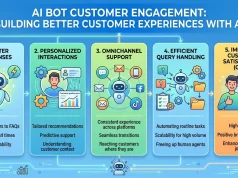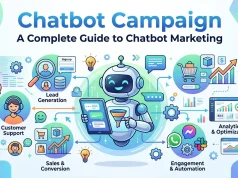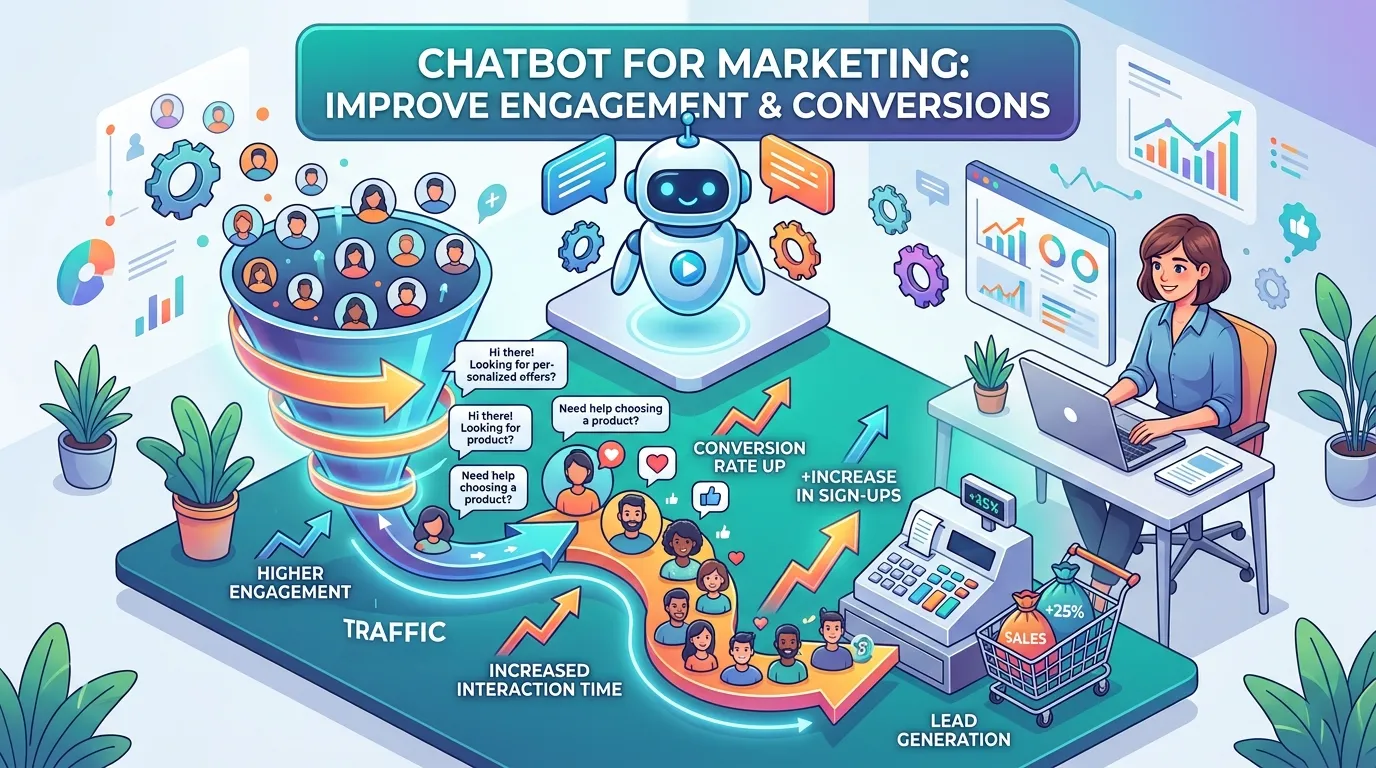
A chatbot for marketing can help businesses automate conversations, engage visitors, generate and qualify leads, recommend content, support digital campaigns, and improve conversions. By combining AI, automation, conversational marketing, and human support, businesses can create more responsive customer experiences while connecting chatbot interactions with measurable marketing outcomes.
A chatbot for marketing can help businesses communicate with website visitors, answer questions, capture leads, recommend products, and support customers throughout the buying journey. Instead of relying entirely on manual communication, businesses can use chatbots to provide immediate responses while collecting useful information about visitor needs and interests.
Modern marketing chatbots can do more than answer basic questions. With artificial intelligence, natural language processing, customer data, and automation, they can participate in personalized conversations and guide users toward relevant content, products, services, or conversion opportunities.
As businesses look for more responsive ways to engage audiences, chatbots are becoming part of broader marketing strategies. Their value depends on how well they are connected to customer needs, marketing objectives, content, lead-generation processes, and conversion journeys.
What Is a Chatbot for Marketing?

A chatbot for marketing is an automated conversational system designed to support marketing activities through direct interactions with users. It can appear on websites, landing pages, messaging platforms, social channels, or other digital experiences.
A chatbot may welcome visitors, answer frequently asked questions, recommend resources, collect contact information, identify customer interests, schedule appointments, or direct users toward specific products and services.
An AI chatbot for marketing can provide more flexible interactions because it can interpret natural language and respond to a wider range of questions. Instead of forcing every visitor through a fixed menu, an AI-powered system can understand conversational requests and provide contextually relevant responses.
The chatbot should not operate independently from the rest of the marketing system. When connected with a website, CRM, analytics platform, email marketing system, or other tools, it can become part of a broader customer journey.
Why Businesses Use Chatbots in Marketing
Traditional marketing often relies on forms, emails, landing pages, advertisements, and static website content to move visitors toward a desired action. These channels remain useful, but they may not provide immediate two-way communication.
A chatbot can add an interactive layer to the experience. Visitors can ask questions and receive responses without waiting for a salesperson or customer service representative.
This can be particularly useful when a visitor needs clarification before completing an action. For example, someone considering a software product may ask about pricing, integrations, features, or implementation. A chatbot can provide relevant information and guide the visitor toward additional resources.
Chatbots can also support marketing teams by handling repetitive conversations. This allows human teams to focus on interactions that require more detailed attention or personal involvement.
Building a Chatbot Marketing Strategy
A chatbot marketing strategy should begin with a clear understanding of what the chatbot is expected to accomplish. Businesses may use chatbots for lead generation, customer engagement, product discovery, content distribution, appointment scheduling, or conversion support.
The strategy should also consider the audience. A chatbot serving existing customers may need to provide a different experience from one designed to engage first-time website visitors.
Conversation design is another important consideration. The chatbot should use language that matches the brand while keeping interactions simple and understandable. Visitors should not have to navigate unnecessary questions before reaching useful information.
Businesses can also define specific points where the chatbot should transfer conversations to human representatives. A clear handoff process can help maintain the quality of the customer experience when questions become too complex for automation.
Marketing Automation Chatbot and Customer Journeys
A marketing automation chatbot can connect conversational interactions with broader automated marketing processes. For example, a chatbot may collect a visitor’s email address and interests before sending that information to a CRM or marketing automation platform.
The information can then be used to personalize future communication. A visitor interested in a specific product category could receive relevant content rather than a generic marketing message.
Automation can also help businesses follow up with visitors who interact with particular campaigns. For example, someone who requests a product guide through a chatbot could receive related educational content through an email sequence.
The goal is not simply to automate every interaction. Instead, automation should make the customer journey more responsive while preserving relevant human involvement where needed.
Using a Chatbot for Lead Generation

A chatbot for lead generation can help businesses turn website conversations into potential customer opportunities. Instead of requiring every visitor to complete a traditional form, the chatbot can collect information conversationally.
For example, it might ask what type of service the visitor needs, the size of their organization, their preferred timeline, or the problem they are trying to solve. These responses can help businesses understand whether the visitor may be a relevant prospect.
Chatbots can also make lead capture more interactive. Rather than presenting a long form immediately, the system can ask a small number of questions and progressively collect useful information.
The quality of leads remains important. Generating a large number of contacts does not necessarily create business value if those contacts are poorly matched to the company’s products or services. Chatbot conversations should therefore be designed around meaningful qualification criteria.
Conversational Marketing Chatbot
A conversational marketing chatbot allows businesses to communicate with visitors through a more interactive experience. Instead of presenting information only through static pages, the business can respond to questions and guide users based on their interests.
This approach can be especially useful for visitors who are still researching their options. The chatbot can direct them toward educational articles, comparison resources, product pages, demonstrations, or other relevant information.
Conversation can also reveal what customers care about. The questions people ask may identify common concerns, product gaps, confusing website sections, or opportunities for new content.
Businesses can use these insights to improve both chatbot conversations and broader marketing activities.
Chatbot Customer Engagement
Chatbot customer engagement focuses on creating useful interactions before, during, and after a purchase. Chatbots can welcome visitors, provide information, recommend content, and help customers find relevant resources.
Engagement should not be measured only by the number of conversations. The quality and usefulness of those conversations are also important.
For example, a chatbot that receives thousands of interactions but regularly fails to answer questions may not be creating a valuable experience. Businesses should examine completion rates, user feedback, conversation outcomes, and successful handoffs to understand whether the chatbot is actually helping visitors.
Interactive marketing can extend beyond basic chatbot functionality. Businesses interested in broader AI-powered communication can explore AI-Driven Interactive Marketing Communication Strategies to understand how interactive technologies can support marketing communication.
Chatbot for Digital Marketing
A chatbot for digital marketing can support multiple stages of the online customer journey. It can engage visitors arriving from search engines, social media, paid advertising, email campaigns, or other digital channels.
The chatbot experience can also be customized according to the visitor’s entry point. Someone arriving from a product advertisement may receive a different conversation from someone arriving through an educational blog article.
This creates opportunities for greater relevance. A visitor coming from a specific campaign can be presented with information related to the campaign message instead of starting with a generic conversation.
Chatbots can also support content distribution by recommending relevant blog posts, reports, videos, webinars, case studies, or product resources based on user questions.
Chatbot Lead Qualification
Chatbot lead qualification helps businesses determine whether a potential prospect meets predefined criteria. The chatbot can ask questions that help identify the visitor’s needs, industry, company size, budget range, purchase timeline, or other relevant characteristics.
Qualification can reduce the amount of manual work required from sales teams. Instead of receiving unstructured inquiries, sales representatives may receive more useful information about the prospect and their needs.
However, qualification questions should be kept reasonable. Asking too many questions at the beginning of a conversation can create friction and cause visitors to abandon the interaction.
The best approach is to collect information that genuinely helps determine the next step. Qualified visitors can then be directed toward sales representatives, demos, consultations, or other conversion opportunities.
Automated Marketing Chatbot
An automated marketing chatbot can operate continuously and respond to visitors outside normal business hours. This can be valuable for businesses that receive visitors from different time zones or have audiences that browse websites outside traditional working hours.
Automation can also support repetitive marketing tasks. A chatbot can distribute resources, answer common questions, collect information, recommend products, and direct visitors to appropriate pages.
However, automation should include appropriate boundaries. If a visitor asks a question the chatbot cannot confidently answer, the system should provide a useful alternative or offer a human handoff rather than repeatedly giving irrelevant responses.
Businesses can also monitor unanswered questions to identify where the chatbot needs additional training, content, or conversation logic.
Chatbot Conversion Optimization
Chatbot conversion optimization focuses on improving the chatbot experience so that more qualified visitors complete meaningful actions.
Conversion optimization can involve testing conversation openings, calls to action, question sequences, recommendations, lead forms, and handoff points. Small changes in the conversation flow can affect whether visitors continue interacting or leave the experience.
For example, a chatbot may perform better when it immediately communicates its purpose rather than beginning with several unnecessary questions. Similarly, a clear call to action can make the next step easier for the visitor to understand.
Businesses can learn more about this process through Chatbot Conversion Optimization, which focuses on improving chatbot conversations and connecting them with customer actions.
Connecting Chatbots With Broader Marketing Automation
Chatbots can become more valuable when they work together with other marketing technologies. A conversation can trigger actions in a CRM, email marketing platform, analytics system, customer database, or automation workflow.
For example, a visitor could ask for information about a particular service. The chatbot can provide the relevant resource, record the interaction, and trigger a follow-up sequence based on the visitor’s stated interest.
This creates a connected customer journey rather than treating the chatbot as an isolated website feature.
Businesses exploring broader automated approaches can also consider Bot-Based Marketing to understand how AI bots can support different marketing activities.
Chatbots and Conversational Commerce
For ecommerce businesses, chatbots can support product discovery and purchasing decisions. Customers may ask about product specifications, availability, pricing, shipping, compatibility, or recommendations.
An AI-powered chatbot can use these questions to guide customers toward relevant products. It can also provide additional information when a customer is uncertain about which option to choose.
This creates a connection between conversation and commerce. Businesses interested in this area can explore AI Conversational Commerce to learn how conversational systems can support shopping experiences and sales interactions.
Measuring Chatbot Marketing Performance

Businesses need clear metrics to understand whether a chatbot is contributing to marketing objectives. Useful measurements can include the number of conversations, engagement rate, conversation completion rate, lead capture rate, qualified lead rate, conversion rate, and successful human handoffs.
The appropriate metrics depend on the chatbot’s purpose. A customer-support chatbot may focus on resolution and successful self-service, while a lead-generation chatbot may focus more heavily on qualified leads and conversion rates.
Businesses should also monitor unsuccessful conversations. High abandonment rates or repeated unanswered questions can indicate problems with the conversation design or underlying information.
Comparing chatbot performance over time can help marketing teams identify opportunities for improvement and determine whether changes to the experience produce better outcomes.
Common Challenges With Marketing Chatbots
Chatbots can create problems when they are introduced without a clear purpose. A chatbot that interrupts visitors unnecessarily or provides irrelevant responses can make the user experience less effective.
Another challenge is maintaining accurate information. Marketing offers, pricing, product details, policies, and other business information can change. The chatbot needs access to current information to avoid providing outdated responses.
Privacy and data handling should also be considered. Businesses should understand what information the chatbot collects, how that information is stored, and how it is used.
Finally, businesses should avoid assuming that automation can replace every human interaction. Some conversations require empathy, detailed explanation, negotiation, or specialized knowledge. A well-designed chatbot should make it easy to move those conversations to an appropriate human representative.
The Future Role of Chatbots in Marketing
As artificial intelligence and conversational technologies continue to develop, chatbots are likely to become more integrated with broader marketing systems. They can increasingly combine conversational data with customer information, content, product catalogs, and automation workflows.
This creates opportunities for more personalized digital experiences. Instead of simply answering questions, future chatbot systems can help visitors discover relevant information, receive recommendations, complete actions, and move between different stages of the customer journey.
The underlying principle remains the same: technology should support useful customer experiences. Businesses that connect chatbot functionality with clear marketing objectives, relevant content, accurate information, and measurable outcomes can make conversations a meaningful part of their marketing strategy.
Frequently Asked Questions
1. What is a chatbot for marketing?
A chatbot for marketing is an automated conversational system that helps businesses interact with potential and existing customers. It can answer questions, recommend content or products, collect leads, qualify prospects, and support conversion activities.
2. How can an AI chatbot help marketing teams?
An AI chatbot can provide automated responses, personalize conversations, capture customer information, recommend relevant resources, qualify leads, and support visitors throughout different stages of the buying journey.
3. Can a chatbot generate leads?
Yes. A chatbot can ask visitors relevant questions, collect contact information, identify their interests, and direct qualified prospects toward actions such as booking a consultation, requesting a demo, or contacting sales.
4. What is a chatbot marketing strategy?
A chatbot marketing strategy defines how a business will use conversational technology to achieve specific marketing objectives. It can include lead generation, customer engagement, content distribution, qualification, personalization, and conversion support.
5. How does chatbot lead qualification work?
Chatbot lead qualification uses predefined questions and criteria to understand whether a visitor may be a suitable prospect. The chatbot can collect information about needs, company characteristics, budget, timeline, or other relevant factors.
6. Can chatbots improve customer engagement?
Chatbots can support customer engagement by providing immediate responses, personalized recommendations, useful resources, and interactive conversations. Their effectiveness depends on the relevance and quality of the experience they provide.
7. What is chatbot conversion optimization?
Chatbot conversion optimization involves improving conversation flows, calls to action, questions, recommendations, and handoff processes to encourage more qualified users to complete desired actions.
8. Can chatbots be integrated with marketing automation?
Yes. Chatbots can often connect with CRM systems, email platforms, analytics tools, and other marketing technologies. This allows conversations to trigger follow-up activities and contribute information to broader customer journeys.
9. Are automated marketing chatbots available 24/7?
Many automated chatbots can operate continuously, allowing businesses to respond to visitors outside normal business hours. Businesses should still provide a clear process for transferring complex conversations to human representatives.
10. How should businesses measure chatbot marketing performance?
Businesses can measure chatbot performance using metrics such as conversations, engagement, completion rates, lead captures, qualified leads, conversion rates, customer feedback, and successful human handoffs. The most useful metrics depend on the chatbot’s specific marketing objective.