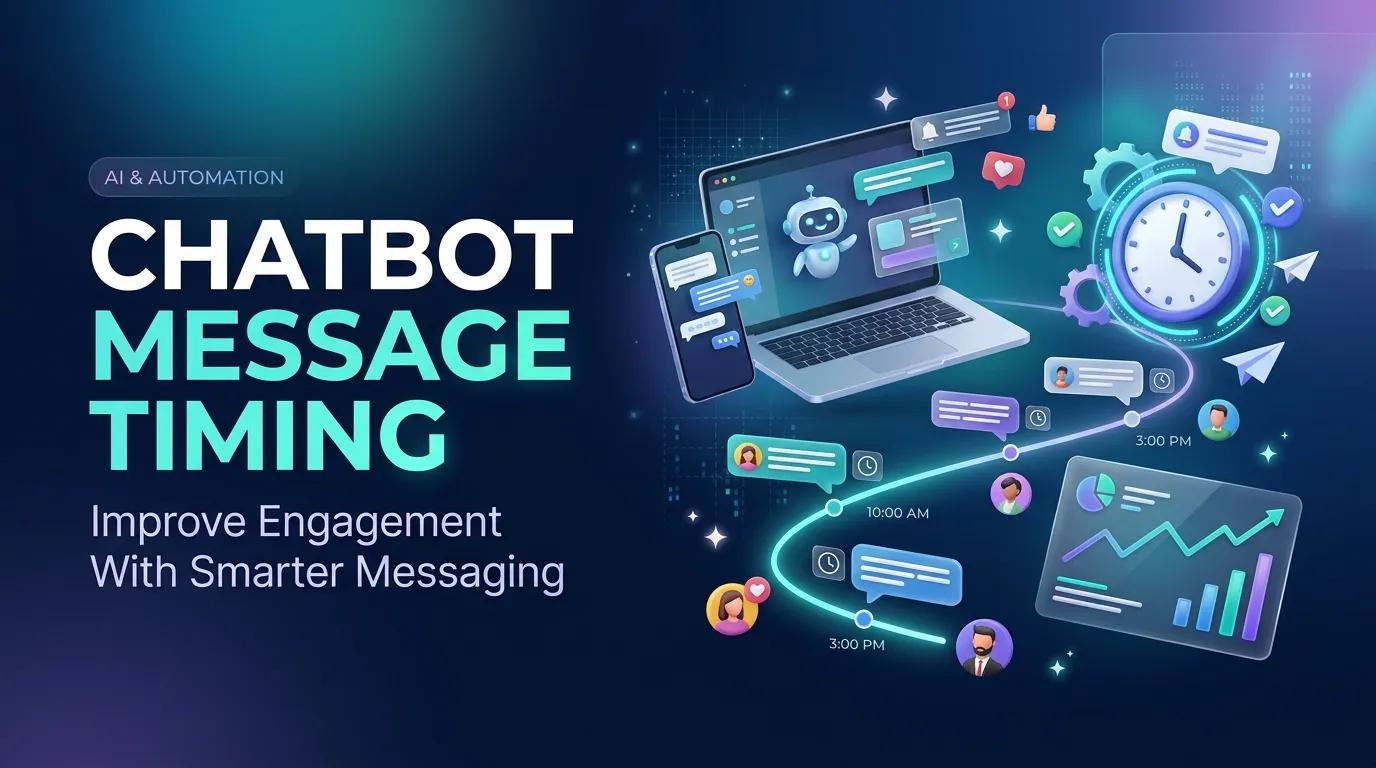
Chatbot message timing helps businesses deliver automated messages when customers are most likely to find them useful. By improving response speed, scheduling notifications appropriately, personalizing conversations, and respecting customer preferences, businesses can create more natural interactions. A well-planned messaging approach reduces unnecessary interruptions, supports customer service, and improves the overall effectiveness of chatbot communication.
Chatbots have become an important part of digital communication, helping businesses answer questions, guide customers, share information, and provide support across multiple channels. However, the effectiveness of these interactions depends on more than the quality of the message itself. When a chatbot sends a message can be just as important as what it says.
Chatbot message timing refers to the way businesses determine when automated messages should appear during customer interactions. Appropriate timing helps conversations feel natural, reduces unnecessary interruptions, and ensures that customers receive information when it is most useful. Poorly timed messages, on the other hand, can frustrate visitors, interrupt their activities, and make automated communication feel intrusive.
A well-planned messaging approach considers customer behavior, conversation context, time zones, response delays, and individual preferences. By combining these factors, businesses can create chatbot experiences that are helpful rather than disruptive.
Whether a company uses chatbots for customer support, sales assistance, lead generation, or marketing communication, understanding message timing can improve the overall customer experience and make automated conversations more effective.
Understanding Chatbot Message Timing
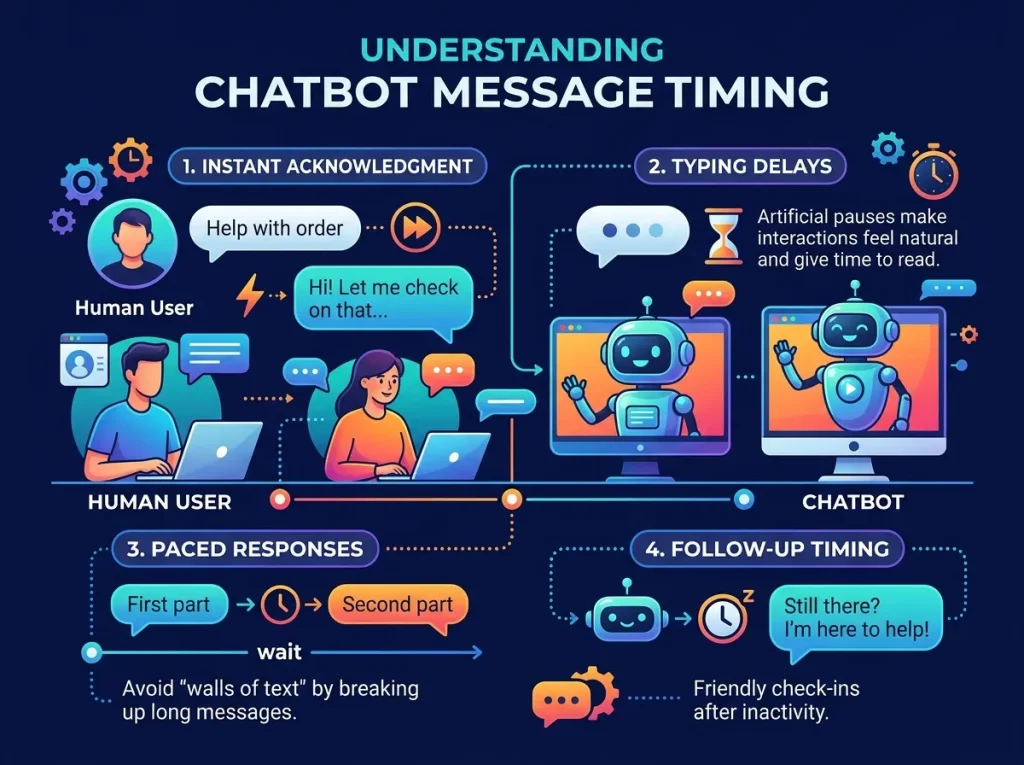
Chatbot message timing describes the scheduling and delivery of automated messages in response to customer actions, questions, or predefined conditions. These messages may appear immediately when a visitor asks a question, after a short delay when someone explores a webpage, or at a later time when a customer requests a reminder.
The appropriate timing depends on the purpose of the interaction. A customer asking about an order usually expects a prompt response, while someone browsing a product page may prefer time to explore before receiving assistance.
This distinction makes timing an important part of conversational design. Chatbots should respond quickly when customers need direct assistance but avoid sending unnecessary messages when there is no clear reason to interrupt.
A business may also use different timing strategies for different communication channels. Website chat often depends on real-time visitor activity, while messaging applications may support reminders, follow-ups, and scheduled notifications.
Understanding these differences allows businesses to develop a more flexible approach to automated communication. Instead of delivering every message according to a fixed schedule, a chatbot can use context to determine when an interaction is appropriate.
Why Chatbot Messaging Schedule Matters
A well-designed chatbot messaging schedule helps businesses communicate consistently without overwhelming customers. When messages arrive at relevant moments, customers are more likely to understand their purpose and engage with the information being provided.
Timing also influences how customers perceive a brand. A helpful message that appears when someone needs assistance can make a business seem responsive and attentive. An unexpected message that interrupts browsing or arrives repeatedly may create the opposite impression.
For customer support, prompt communication reduces uncertainty. Customers often want immediate acknowledgment when reporting an issue or asking a straightforward question. A chatbot that responds quickly can confirm that the request has been received and explain what happens next.
In marketing, timing helps businesses connect messages with customer interests. A relevant product suggestion may be useful after a visitor explores a particular category, while a promotional reminder may be more appropriate when a customer has explicitly requested updates.
Businesses developing chatbot automation for business growth can use these timing decisions to improve communication efficiency and create more consistent customer experiences.
The objective is not to send more messages. It is to deliver the right information at a moment when it provides genuine value.
Automated Message Timing and Customer Behavior
Automated message timing becomes more effective when it reflects customer behavior rather than relying entirely on predetermined intervals. Different actions can indicate different needs, and a chatbot should respond according to the meaning of those actions.
For example, a visitor who opens a pricing page may be comparing options, while someone who asks about delivery costs has expressed a more specific information need. Both interactions can justify assistance, but the messages should serve different purposes.
Browsing duration can also provide useful context, although it should not be treated as a definitive sign of interest. A visitor may leave a page open while doing something else, and repeatedly sending messages based on elapsed time can create a poor experience.
Other behavioral signals include questions submitted through chat, repeated visits to a particular section, requests for human assistance, and interactions with earlier messages. These signals can help determine whether a message should be delivered immediately, delayed, or withheld.
Businesses should also recognize that not every customer action requires an automated response. Sometimes the most appropriate decision is to wait until the customer asks a question or performs an action that clearly indicates a need for help.
This approach makes automated communication more relevant and reduces unnecessary interruptions.
Finding the Optimal Chatbot Response Time
Optimal chatbot response time depends on the type of interaction, customer expectations, and the complexity of the requested information. There is no single response delay that works equally well for every conversation.
For straightforward questions, such as checking business hours or locating a basic policy, customers generally benefit from an immediate response. Delays in these situations may make the chatbot appear unreliable or unnecessarily slow.
More complicated requests require a different approach. If a chatbot needs to retrieve account information, search a knowledge base, or process a request through another system, it should acknowledge the customer promptly and communicate when additional information is needed.
A short acknowledgment can prevent confusion while the system completes its work. The chatbot should then provide an update if processing takes longer than expected, rather than leaving the customer uncertain about whether the request is being handled.
Response timing should also reflect conversational flow. A chatbot that sends several messages before a customer has time to read the first can make an interaction feel rushed. Allowing enough time for customers to understand the information and respond creates a more natural experience.
Businesses can evaluate response timing through customer feedback, conversation completion rates, abandonment patterns, and support resolution data. These measurements help identify where delays cause problems and where additional messages may be unnecessary.
Conversational Message Scheduling for Natural Interactions
Conversational message scheduling helps automated interactions feel more like a thoughtful exchange rather than a sequence of disconnected notifications. It considers the order, spacing, and relevance of messages throughout a conversation.
When a customer asks a question, the chatbot should first address that request instead of immediately introducing unrelated promotions. Additional information can be offered after the original need has been satisfied, provided it is relevant to the discussion.
Message spacing is especially important when a chatbot delivers information in several parts. Sending a lengthy explanation as a series of rapid messages may overwhelm the customer. Grouping related information into a clear response is often easier to understand.
For more interactive experiences, a chatbot can pause at meaningful decision points. After presenting a choice, it should allow the customer to select an option before continuing. This creates a responsive conversation in which the customer’s input determines what happens next.
The same principle applies to storytelling and guided product experiences. Businesses experimenting with interactive storytelling with AI chatbots can use conversational pacing to introduce information gradually and give customers opportunities to participate.
Effective scheduling makes the conversation easier to follow while ensuring that each message contributes to the customer’s immediate objective.
Chatbot Engagement Timing Across the Customer Journey
Chatbot engagement timing should reflect where customers are in their relationship with a business. A first-time visitor may need introductory information, while an existing customer may prefer direct access to support, account details, or order updates.
During the awareness stage, a chatbot can offer assistance when a visitor is exploring relevant information or searching for an answer. The message should be brief and useful, giving the visitor the option to engage without forcing an interaction.
During consideration, customers may need product comparisons, pricing details, feature explanations, or answers to common objections. A chatbot can provide these resources when the customer requests them or when a clear interaction indicates that additional information would be helpful.
After a purchase, communication may focus on confirmation messages, delivery updates, onboarding, and support. These messages should follow the customer’s transaction or preferences rather than an unrelated marketing schedule.
Long-term customer engagement requires a similar balance. Reminders, educational content, and personalized recommendations can be valuable when they match customer interests. Repeated follow-ups without a clear purpose can quickly become irritating.
Understanding how chatbot interactions support different stages of the customer journey helps businesses coordinate messaging with broader marketing activities. Chatbots can also support brand marketing through conversational engagement by delivering relevant information in a way that reflects the brand’s communication style.
Automated Chat Message Delivery Across Time Zones
Automated chat message delivery becomes more complicated when businesses communicate with customers across different regions. A message scheduled according to the company’s local time may arrive during the customer’s sleeping hours or outside their preferred communication window.
Time-zone awareness is therefore important for scheduled reminders, promotional messages, and non-urgent follow-ups. When possible, systems should use the recipient’s known local time rather than applying one schedule to every customer.
Businesses should also consider the difference between real-time support and outbound messaging. A customer who initiates a conversation may expect assistance regardless of the local hour, depending on the service’s stated availability. A promotional notification, however, generally has less urgency and can often wait until a more appropriate time.
Customer preferences should take priority over generalized assumptions about when people are available. If a customer chooses a preferred contact time, the system should respect that preference whenever the communication channel and technical setup allow it.
For businesses serving international audiences, localized scheduling can reduce unnecessary interruptions and improve the relevance of automated communication.
It is also important to account for daylight saving time where applicable and to ensure that scheduled messages do not become misaligned when local clock settings change.
Chatbot Notification Timing and Customer Expectations
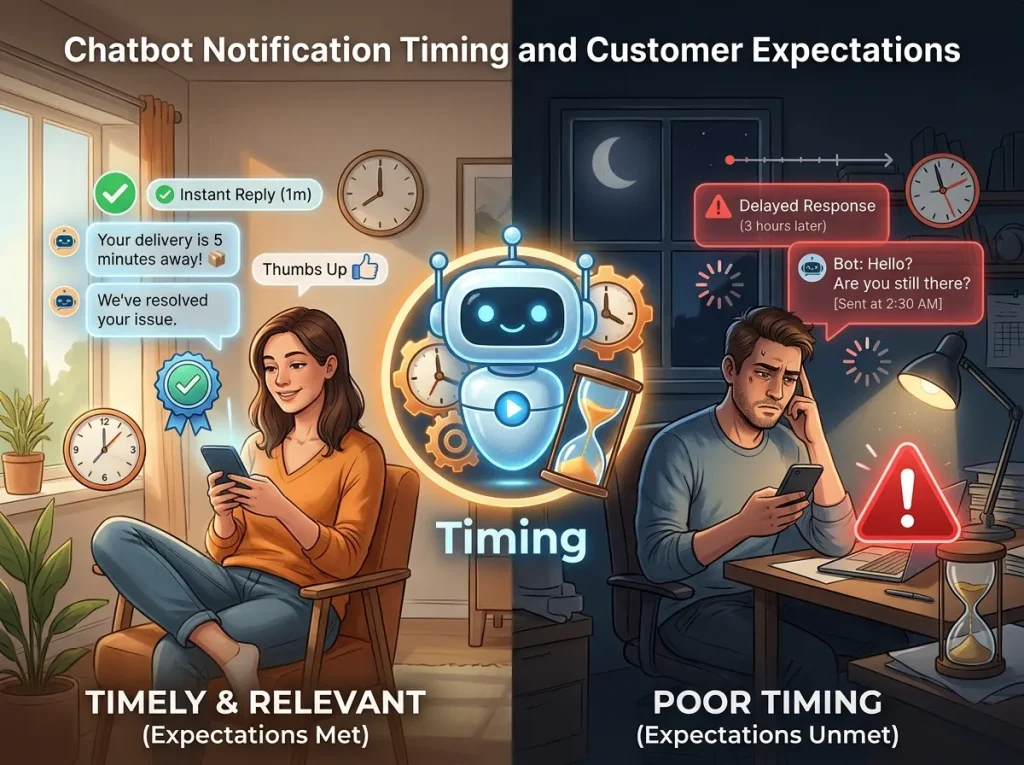
Chatbot notification timing determines when alerts, reminders, and other automated updates are delivered. These notifications may relate to order status, appointment confirmations, unfinished tasks, product availability, or requested follow-ups.
The value of a notification depends heavily on its relevance and urgency. An important account or transaction update may need to be delivered immediately, while a general promotional message may be more suitable for a later time.
Frequency matters as well. Even useful notifications can become disruptive when they arrive too often or repeat information the customer already knows. Businesses should coordinate their messaging systems to prevent multiple automated tools from sending similar alerts.
Notification timing should also reflect what the customer has agreed to receive. Consent, communication preferences, unsubscribe requests, and channel-specific rules should be considered before promotional messages are scheduled.
A useful notification explains why the information matters and provides a clear next step when one is needed. For example, an appointment reminder should make the relevant details easy to understand, while a delivery update should communicate the current status without unnecessary promotional content.
By prioritizing usefulness and appropriate frequency, businesses can make notifications more valuable and preserve customer confidence in automated communication.
Personalized Chatbot Messaging and Timing
Personalized chatbot messaging adapts communication to a customer’s interests, previous interactions, preferences, or current needs. When timing is considered alongside personalization, messages can become more relevant without requiring customers to repeat information unnecessarily.
For example, a returning customer who previously asked about a particular service may benefit from a relevant update when they initiate another conversation. A user who requests a reminder can receive it at the agreed time, while someone who prefers fewer notifications should receive less frequent communication.
Personalization should rely on information that is appropriate to collect and use. Businesses should respect privacy requirements, consent, and customer expectations when using interaction history or account information to determine when messages are sent.
It is also important not to interpret every behavior as a definite expression of intent. Visiting a product page does not necessarily mean someone wants to purchase, and an unanswered message does not automatically justify repeated follow-ups.
A considerate chatbot uses available information to improve relevance while leaving customers in control of their interactions. It should provide clear options to stop a conversation, change notification preferences, or request assistance from a human when necessary.
When personalization is handled carefully, message timing can support more useful communication and a more comfortable customer experience.
Customer Interaction Timing and Human Handoffs
Customer interaction timing also affects how effectively chatbots transfer conversations to human support teams. Automated systems can handle routine questions, but some requests require judgment, empathy, or access to specialized assistance.
When a customer requests a human representative, the chatbot should communicate the available options clearly and avoid repeatedly forcing the customer through automated responses. If a transfer is possible, the system should explain what will happen next.
Timing is equally important when a chatbot cannot resolve a question. It should acknowledge the limitation, gather only the necessary information, and provide a realistic next step rather than leaving the customer in an endless loop.
If human support is unavailable, the chatbot can explain operating hours, offer a callback or ticket option when available, and provide relevant self-service resources. It should not promise an immediate response if the business cannot deliver one.
The system should also preserve useful conversation context during a handoff. Requiring customers to repeat their questions can create frustration and undermine the convenience that automated support is meant to provide.
A well-timed handoff demonstrates that the chatbot recognizes the limits of automation and prioritizes the customer’s needs over keeping every interaction within the automated system.
Improving Chatbot Message Timing Through Performance Analysis
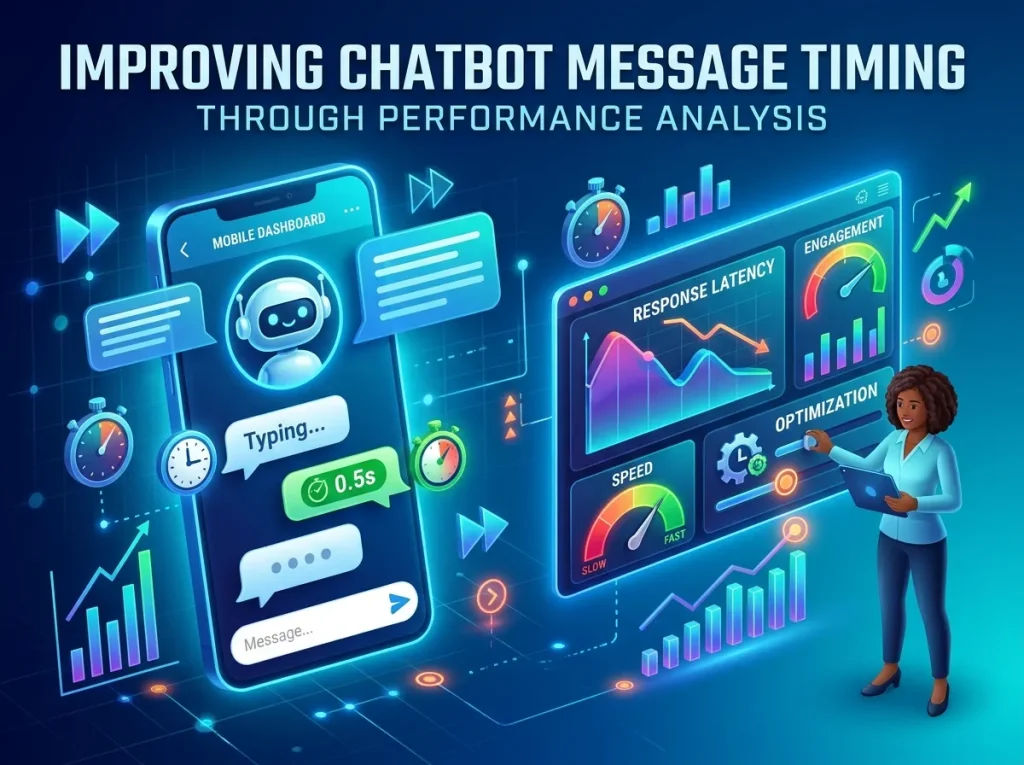
Businesses can improve chatbot message timing by reviewing how customers respond to different messaging patterns. Performance analysis helps identify whether messages are arriving too early, too late, too frequently, or without sufficient relevance.
Useful measurements include response rates, conversation completion, time to resolution, abandonment rates, notification engagement, and the number of customers who opt out of communications. The most appropriate metrics depend on the chatbot’s purpose.
For example, a support chatbot should be evaluated partly on whether it helps customers resolve their issues efficiently. A marketing chatbot may focus more on qualified interactions, useful content engagement, or completed customer actions.
Testing different timing approaches can reveal meaningful differences. A business might compare an immediate greeting with a context-triggered message that appears only after a visitor requests assistance or demonstrates a relevant need. The results should be assessed alongside customer feedback and the quality of resulting interactions.
Teams should avoid optimizing for engagement alone. A message that generates clicks but frustrates customers or interrupts their tasks may not provide long-term value.
Performance reviews should also consider differences between customer groups, communication channels, and time zones. An approach that works well for one audience may be less effective for another.
Regular evaluation allows businesses to adjust messaging schedules as customer expectations, products, and communication patterns evolve.
Conclusion
Chatbot message timing is an essential part of creating useful and reliable automated conversations. By considering customer behavior, response expectations, conversational flow, time zones, and communication preferences, businesses can deliver messages when they are most relevant.
Effective timing is not simply about responding quickly or sending notifications at predetermined intervals. It requires understanding the purpose of each interaction and deciding whether a message will genuinely help the customer.
Businesses that combine thoughtful scheduling with personalization, clear communication, and ongoing performance analysis can create more natural chatbot experiences. The result is a messaging approach that supports customer satisfaction, improves communication efficiency, and strengthens long-term engagement without overwhelming users.
Frequently Asked Questions
1. What is chatbot message timing?
Chatbot message timing refers to when automated messages are delivered during customer interactions. It includes real-time responses, scheduled notifications, follow-ups, and messages triggered by customer actions.
2. Why is chatbot message timing important?
It helps businesses communicate at relevant moments, reduce unnecessary interruptions, improve customer experiences, and make automated conversations more effective.
3. What is an optimal chatbot response time?
The optimal response time depends on the interaction. Straightforward questions generally benefit from immediate responses, while complex requests may require additional processing time and clear progress updates.
4. How does a chatbot messaging schedule work?
A chatbot messaging schedule determines when messages are sent based on predefined times, customer actions, conversation context, preferences, or specific conditions within an automated workflow.
5. How can businesses improve chatbot engagement timing?
Businesses can analyze customer behavior, provide messages when assistance is relevant, avoid excessive follow-ups, and test different timing approaches to understand what works best for their audiences.
6. What is personalized chatbot messaging?
Personalized chatbot messaging adapts communication to relevant customer information, such as stated preferences, previous interactions, or current requests, while respecting privacy and consent requirements.
7. How often should a chatbot send notifications?
Notification frequency depends on the message’s purpose, urgency, and customer preferences. Important service updates may require immediate delivery, while promotional messages should be limited to appropriate, consent-based communication.
8. How does time-zone awareness improve chatbot messaging?
Time-zone awareness helps businesses deliver scheduled messages according to recipients’ local times, reducing the likelihood of sending non-urgent notifications during inconvenient hours.
9. Can chatbot message timing improve customer support?
Yes. Prompt acknowledgments, timely updates, and appropriate human handoffs help reduce uncertainty and make it easier for customers to receive assistance.
10. How can businesses measure chatbot message timing performance?
Businesses can evaluate response times, conversation completion rates, resolution times, engagement, abandonment, and notification opt-outs. These metrics help identify opportunities to improve messaging relevance and timing.