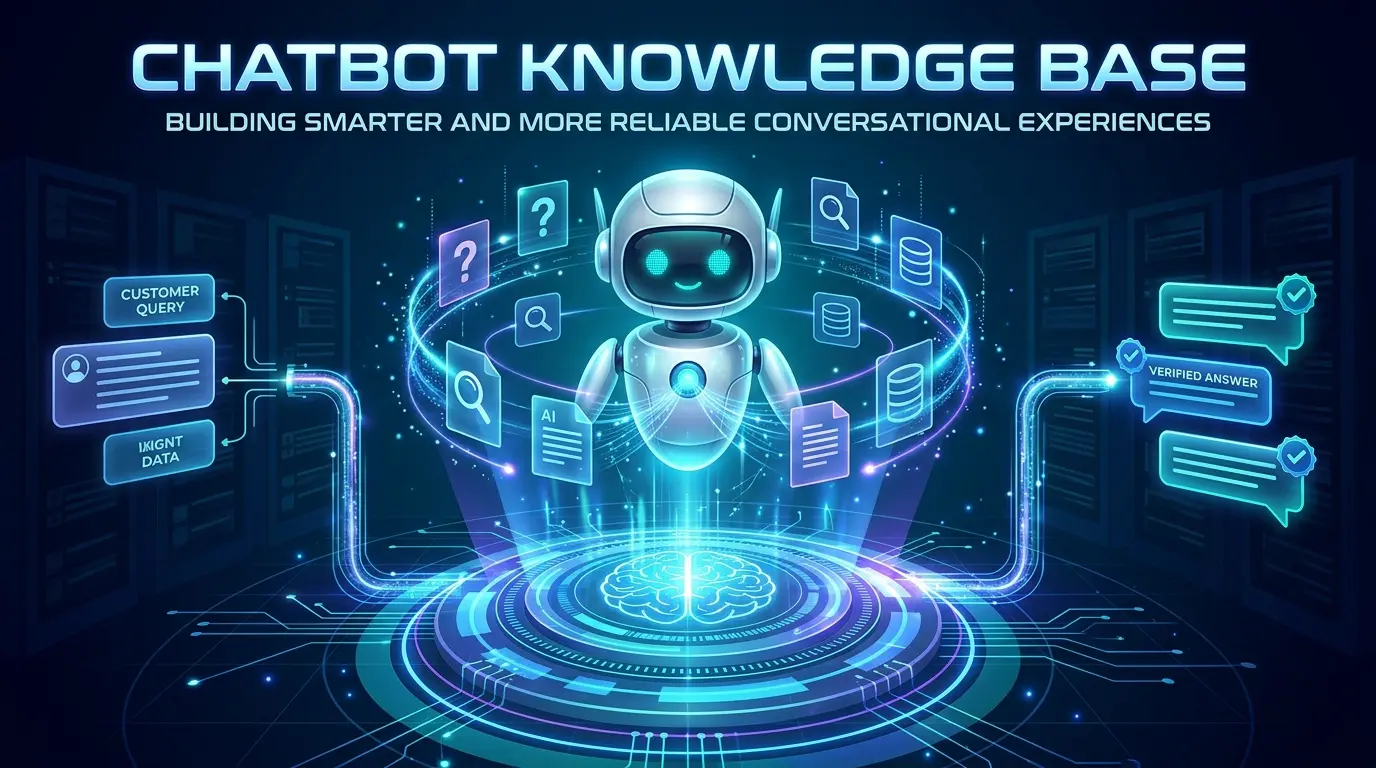
A Chatbot Knowledge Base is the organized collection of information that a chatbot uses to understand questions and provide useful responses. It may contain frequently asked questions, product details, service information, troubleshooting instructions, company policies, and other customer support resources. A well-maintained knowledge base helps chatbots deliver accurate answers, maintain consistent communication, and resolve common inquiries more efficiently. By connecting reliable content with suitable knowledge retrieval systems, businesses can improve customer experiences while reducing repetitive support work.
A chatbot can respond within seconds, handle multiple conversations, and remain available beyond normal business hours. However, fast responses do not automatically make it useful. When a chatbot provides outdated information, misunderstands a question, or repeatedly gives irrelevant answers, customers quickly lose confidence in the experience.
The quality of a chatbot depends heavily on the information available to it. This is where a Chatbot Knowledge Base becomes essential. It provides the organized information a chatbot needs to answer questions, explain services, guide users, and support customer interactions.
Rather than relying on random text or disconnected documents, businesses can create a structured information environment that connects approved content with conversational systems. This makes it easier for chatbots to retrieve relevant details and respond consistently.
A knowledge base is not simply a collection of answers. It is an important part of how a chatbot understands a business, communicates its offerings, and supports users throughout their interactions. As conversational automation becomes more common, maintaining accurate and useful knowledge has become a central requirement for successful chatbot operations.
The Information Behind Every Useful Chatbot Response
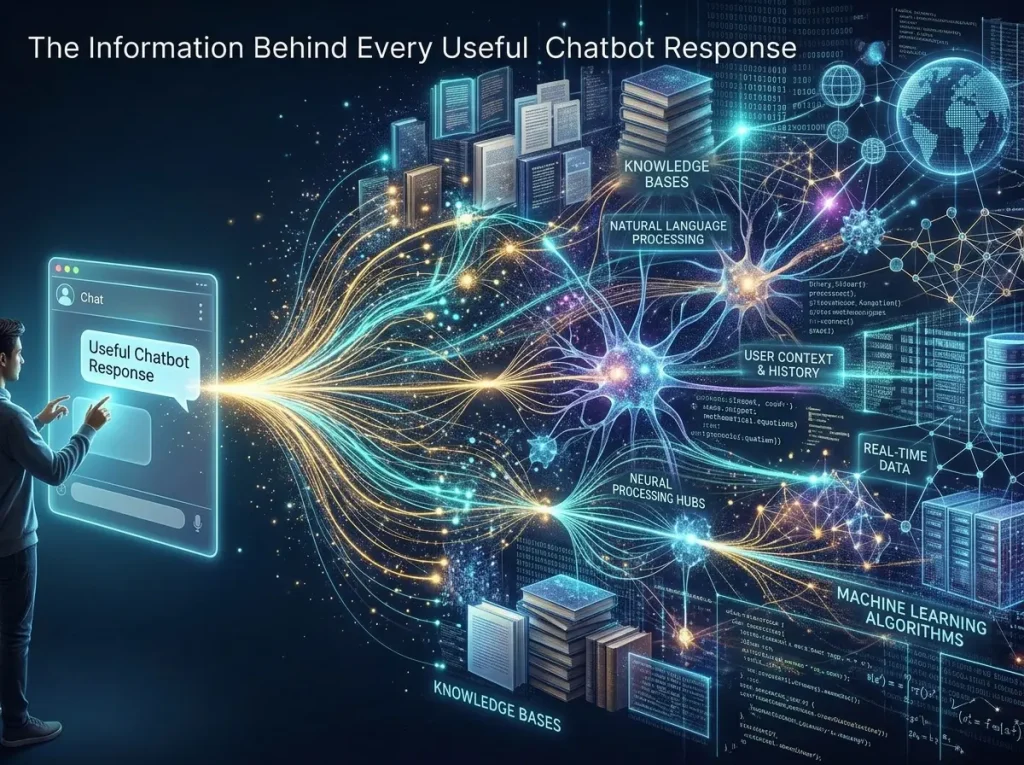
When someone asks a chatbot about delivery times, product features, account access, or service availability, the system needs reliable information to respond. If that information is missing or poorly organized, even an advanced conversational model may struggle to provide a helpful answer.
A Chatbot Information Database brings important business information together in a format that can be searched and used during conversations. It may include product descriptions, service explanations, company policies, pricing information, support procedures, troubleshooting steps, and answers to common questions.
The structure of this information matters. A business might store hundreds of documents, but a chatbot cannot provide consistently useful answers if the content is duplicated, contradictory, or difficult to retrieve. Information should be organized around clear topics, with relevant details grouped together.
For example, an online store may maintain separate knowledge sections for order tracking, returns, payment methods, shipping policies, and product specifications. When a customer asks about returning an item, the chatbot should be able to identify the relevant policy instead of searching through unrelated information.
The value of the database comes from its usefulness during real conversations. It should help the chatbot find the right information quickly and present it in language that customers can understand.
Conversational Knowledge Management and the Customer Experience
Customer questions rarely follow the exact wording used in company documents. A business may describe a policy as a refund procedure, while a customer asks, “How can I get my money back?” Someone looking for account assistance might ask, “I can’t log in. What should I do?”
This difference makes Conversational Knowledge Management important. It connects formal business information with the way people naturally communicate. Instead of treating every question as an exact keyword match, conversational systems need to recognize different expressions of similar intent.
Well-managed knowledge content should explain concepts clearly and include enough context to support different types of questions. A single policy may need to address eligibility, time limits, required information, and possible exceptions. When these details are available, the chatbot has a better chance of producing a complete response.
Knowledge management also influences the overall customer experience. A chatbot that provides consistent information across different conversations can reduce confusion and help customers complete tasks more confidently.
The experience begins before the first question is asked. During Chatbot Onboarding, users learn what the chatbot can help them accomplish and how to interact with it. A strong knowledge foundation supports that first impression by ensuring the information provided during onboarding matches the answers customers receive later.
Why AI Chatbot Training Data Needs Reliable Sources
Artificial intelligence chatbots can process natural language and generate responses based on patterns learned from data. However, general language knowledge is not the same as accurate knowledge about a particular company.
A chatbot may understand how online shopping works, but that does not mean it knows a merchant’s actual return policy. It may recognize common banking terms without knowing a specific institution’s account requirements. Business-specific information must come from reliable sources.
AI Chatbot Training Data can include examples of questions, suitable responses, business documents, product information, and other approved resources. Depending on the chatbot architecture, information may be used during model training, supplied through retrieval systems, or connected through other data integrations.
These approaches serve different purposes. Training examples can help a system understand conversational patterns and response expectations, while retrieval-based methods allow a chatbot to access current information from an external knowledge source.
For many businesses, connecting a chatbot to an updated knowledge repository is particularly useful because company information changes. Product availability, service conditions, operating procedures, and policies may need frequent revisions. A system that retrieves approved information can reduce the need to retrain an entire model whenever a document changes.
The most important requirement is source quality. Outdated documents, conflicting policies, and unverified claims can create inaccurate responses regardless of how sophisticated the chatbot technology may be.
Creating a Chatbot FAQ Database That Reflects Real Questions
Frequently asked questions provide a practical starting point for building chatbot knowledge. They reveal the subjects customers regularly need help with and give businesses an opportunity to make support information easier to access.
A Chatbot FAQ Database should reflect actual customer language rather than only internal terminology. Support tickets, email inquiries, website searches, and previous chatbot conversations can reveal the questions people commonly ask.
For example, a company may discover that customers frequently ask whether an order can be changed after payment. Instead of providing a general link to the order policy, the knowledge base can include a clear explanation of when changes are possible, what information is required, and when customers need to contact support.
FAQs should also account for different ways of expressing the same concern. Questions such as “Where is my package?”, “Can I track my delivery?”, and “When will my order arrive?” may relate to the same information category.
However, an FAQ database should not become an unstructured collection of short answers. Some topics require context, conditions, or explanations that cannot be covered in one sentence. Organizing related questions around broader subjects makes it easier for the chatbot to retrieve information accurately.
As customer behavior changes, the FAQ collection should evolve. New questions may appear after a product launch, policy update, seasonal campaign, or change in customer expectations.
Knowledge Base Integration With Business Systems
A knowledge base becomes more valuable when it connects with the systems that already manage business information. Without integration, teams may need to update several separate platforms whenever a product detail, policy, or service condition changes.
Knowledge Base Integration can connect chatbot platforms with help desk software, customer relationship management systems, product databases, documentation platforms, and other approved information sources.
Consider a company that manages customer inquiries through a support platform. If its chatbot can access the relevant support documentation, it may answer common questions before a human agent becomes involved. When the issue requires personal assistance, the conversation can be transferred with useful context.
Integration can also support more specific interactions. A chatbot connected to an authorized order management system may be able to retrieve order status after verifying the customer’s identity. A product database may provide current specifications, while a service management system may supply relevant appointment information.
These integrations need appropriate access controls. A chatbot should only retrieve information that is necessary and authorized for the task. Sensitive customer records should not become freely accessible simply because a system is connected to a knowledge source.
When implemented carefully, integration reduces disconnected information and helps chatbots provide answers that reflect current business operations.
Automated Customer Support Content Should Be More Than Scripts
Many early chatbot systems relied on fixed scripts. Users selected predefined options, and the chatbot responded with prepared messages. Although this approach can work for simple tasks, it becomes limiting when customers ask questions in unexpected ways.
Modern Automated Customer Support Content needs to support more flexible conversations. Instead of depending entirely on a fixed sequence, chatbots can use organized knowledge resources to retrieve information based on the user’s question.
This does not mean every response should be generated freely. Important information, especially policies, payment conditions, account procedures, and legal requirements, should come from approved sources. The chatbot can present the information conversationally while preserving the meaning of the original content.
For example, a delivery policy may contain several conditions about location, shipping method, and processing time. A useful chatbot response should explain the relevant condition rather than provide a vague statement that all deliveries take the same amount of time.
The quality of support content also depends on readability. Long technical explanations may be appropriate for internal documentation but difficult for customers to understand. Breaking complex information into clear sections helps the chatbot retrieve relevant details and communicate them naturally.
Businesses should also define how the chatbot responds when information is unavailable. A clear explanation and a suitable route to human support are often more helpful than an uncertain or invented answer.
Chatbot Response Accuracy and the Importance of Content Quality
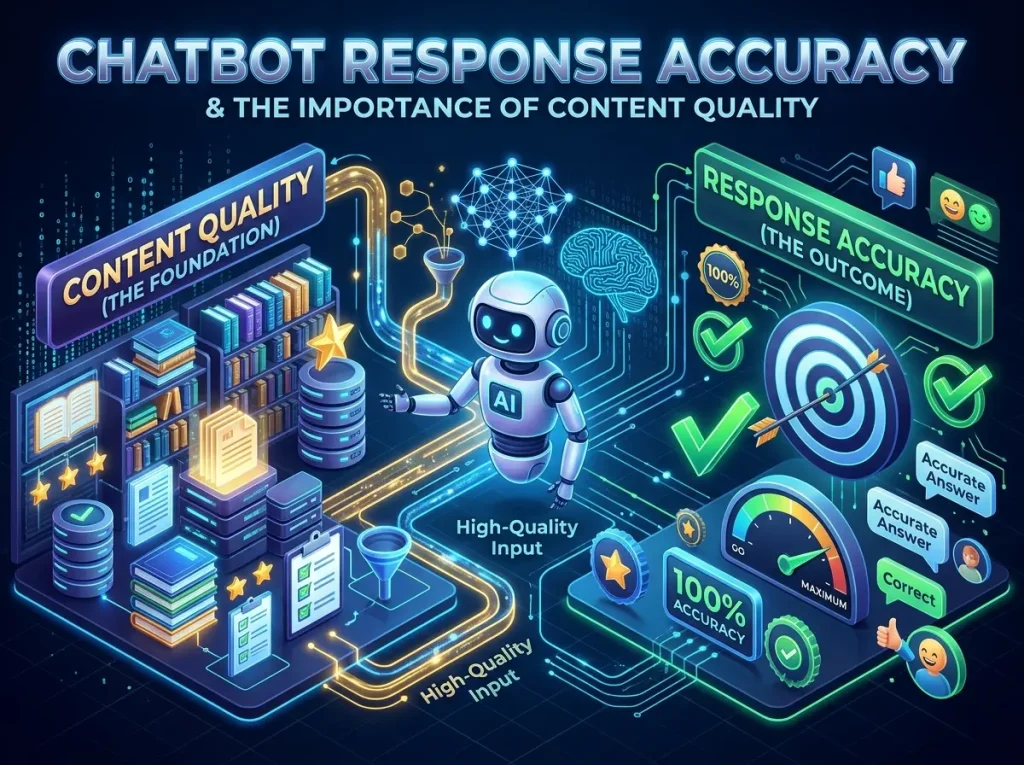
A chatbot’s response is only as dependable as the information and retrieval process behind it. Even when the correct answer exists in a knowledge base, poor organization or ambiguous wording may prevent the system from finding it.
Chatbot Response Accuracy depends on several connected elements: source reliability, content clarity, retrieval quality, conversational understanding, and the way responses are generated.
Imagine that a company has two documents describing its cancellation policy. One is an older version that allows cancellation within seven days, while the updated policy allows cancellation within five days. If both documents remain available without clear version control, the chatbot may retrieve the wrong information.
This is why content maintenance is just as important as initial setup. Businesses need a reliable process for reviewing documents, removing outdated material, resolving conflicting statements, and identifying the correct source of truth.
Accuracy should also be evaluated through real conversations. Teams can examine unanswered questions, incorrect responses, repeated clarification requests, and customer feedback. These patterns help identify gaps that may not be obvious when testing only a small collection of prepared questions.
For more complex interactions, the chatbot should recognize when it lacks enough information to answer confidently. Asking a relevant follow-up question or transferring the conversation to a support agent is better than presenting an unsupported response.
Self-Service Knowledge Systems and the Value of Faster Support
Customers often prefer to find answers independently, especially when their questions are straightforward. They may want to check a return condition, understand a product feature, reset a password, or learn how to use a service without waiting for a support representative.
Self-Service Knowledge Systems make this possible by giving users access to useful information through websites, help centers, searchable documentation, and conversational interfaces.
A chatbot can make these resources easier to access because users can describe their problems in natural language rather than navigate several menus. Instead of searching through a long support page, someone can ask a direct question and receive an answer based on the relevant documentation.
Self-service systems can also reduce repetitive support requests. When common questions are handled through reliable information, human agents have more time to focus on complicated cases that require investigation, judgment, or personal attention.
However, self-service should not become a barrier to human assistance. Customers dealing with billing disputes, unusual account problems, or sensitive issues may need direct support. An effective system recognizes these situations and provides a clear way to continue the conversation with a person.
This balance helps businesses improve support accessibility without removing the human element from customer service.
Chatbot Content Management as an Ongoing Business Process
A knowledge base is not a one-time project. Products change, services expand, policies are revised, and customers develop new expectations. Without regular maintenance, even a well-designed chatbot can gradually become less useful.
Chatbot Content Management involves creating, reviewing, updating, organizing, and retiring the information used by conversational systems. It also requires clear responsibility for approving changes and ensuring that the chatbot uses the correct version of important content.
A business may assign different teams to maintain different knowledge areas. Product teams can review specifications, support teams can update troubleshooting information, and marketing teams can maintain approved service descriptions. A central process should ensure that these updates remain consistent.
Content management also benefits from version control. When a policy changes, teams should be able to identify which version is current and prevent older information from being retrieved accidentally.
Performance data can guide these improvements. If customers repeatedly ask questions that the chatbot cannot answer, the knowledge base may need additional content. If users abandon conversations after receiving a particular response, the wording or relevance of that information may require review.
In this way, content management becomes a continuous improvement process rather than a simple documentation task.
Knowledge Retrieval Systems Behind Intelligent Conversations
Storing information is only one part of building a useful chatbot. The system must also identify which information is relevant to each question and make it available when a response is generated.
Knowledge Retrieval Systems perform this important role. They search available information sources and return content that is relevant to the user’s request. Depending on the technology, retrieval may use keyword search, semantic search, structured databases, or a combination of methods.
Semantic retrieval is particularly useful when customers use different words from those found in official documentation. A person asking about “getting my money back” may need information stored under a heading called “refund policy.” A retrieval system that recognizes the relationship between these expressions can find the relevant content more effectively.
Some AI chatbot platforms use retrieval-augmented generation, commonly known as RAG. This approach retrieves relevant information from an external knowledge source and provides it to a language model as context for generating a response.
The advantage is that the chatbot can use business-specific information without relying entirely on what the model learned during its original training. However, retrieval quality still matters. If the wrong document is selected or the source contains incomplete information, the final answer may also be inaccurate.
A reliable retrieval process therefore combines suitable search technology with well-organized, trustworthy content.
Industry Applications: From Customer Service to Supply Chain Operations
Chatbot knowledge systems can support many types of business activity. In retail, they can answer questions about products, delivery, returns, and order management. In financial services, they may provide general information about account procedures and service conditions, subject to appropriate security controls. In healthcare administration, they can help users locate approved information about appointments, facilities, and administrative processes.
The same concept applies to more specialized operations. For example, Supply Chain Chatbots can help users access logistics information, delivery updates, inventory-related details, and operational documentation.
In these environments, the knowledge base may contain information for several user groups, including customers, suppliers, logistics teams, and internal employees. Organizing access according to user roles is important because different people may require different information.
Chatbots can also support marketing and lead qualification. When a visitor asks about a product or service, the system can provide relevant details and identify whether the person needs additional assistance. Effective Bot Qualification can help distinguish general inquiries from more specific business opportunities while keeping the conversation relevant.
After a customer becomes familiar with a brand, reliable information continues to matter. Consistent answers about services, account support, and product usage can contribute to Marketing Bot Customer Retention by making ongoing interactions easier and more dependable.
Measuring Whether a Chatbot Knowledge Base Is Working
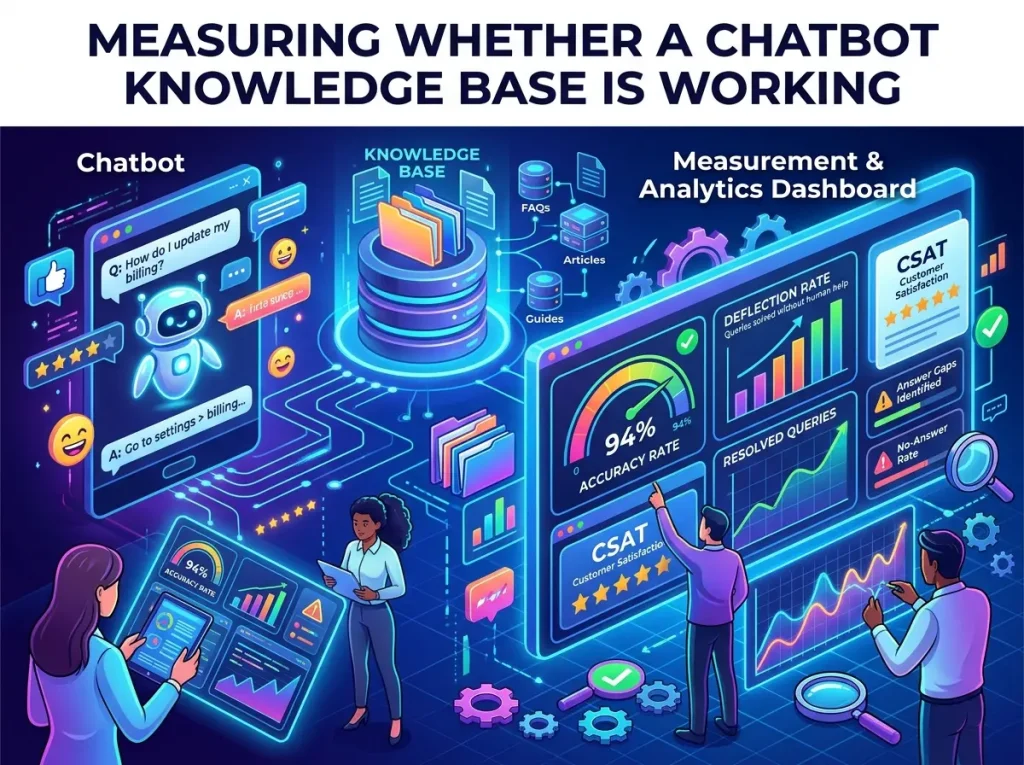
A knowledge base should be evaluated through the results it produces, not simply by the number of documents it contains. A large collection of information may look comprehensive but still fail to answer the questions customers actually ask.
Businesses can examine several performance indicators to understand its effectiveness. These include the percentage of questions answered successfully, unresolved inquiries, repeated questions, response relevance, escalation rates, and customer satisfaction.
Conversation reviews provide additional insight. If users frequently rephrase the same question, the chatbot may not be recognizing their intent. If support agents repeatedly correct chatbot answers, the underlying content may be outdated or incomplete.
It is also useful to examine whether the knowledge base supports business outcomes. A customer support chatbot may be evaluated through resolution rates and reduced repetitive inquiries, while a marketing chatbot may be assessed through relevant engagement and qualified leads.
Performance should be reviewed regularly because a chatbot’s knowledge needs change alongside the business. Continuous evaluation helps organizations identify weaknesses, improve content, and maintain a dependable conversational experience.
Conclusion
A Chatbot Knowledge Base provides the information foundation that allows conversational systems to deliver useful, consistent, and relevant responses. Its effectiveness depends on more than storing frequently asked questions. Reliable source material, organized content, appropriate integrations, accurate retrieval, and regular maintenance all contribute to a successful system.
As businesses adopt more advanced conversational automation, the quality of their knowledge resources becomes increasingly important. Chatbots need access to current information and a clear way to recognize when they cannot answer a question confidently.
By treating knowledge management as an ongoing business process, organizations can create more effective self-service experiences, reduce repetitive support work, and strengthen customer relationships. A well-maintained knowledge base ultimately helps transform a chatbot from a simple automated responder into a more dependable source of business information.
Frequently Asked Questions
1. What is a Chatbot Knowledge Base?
A Chatbot Knowledge Base is an organized collection of information that a chatbot uses to answer questions and support conversations. It can include FAQs, product details, service information, company policies, troubleshooting instructions, and other approved resources.
2. Why does a chatbot need a knowledge base?
A knowledge base gives chatbots access to reliable business-specific information. It helps them answer customer questions more accurately, maintain consistent communication, and handle common inquiries without requiring human assistance every time.
3. What information should a chatbot knowledge base contain?
It can contain frequently asked questions, product descriptions, pricing details, service policies, troubleshooting content, delivery information, account procedures, and other information relevant to customer needs.
4. How is a chatbot knowledge base different from training data?
Training data helps a chatbot learn language patterns, examples, and response behavior. A knowledge base provides organized information that the chatbot can use when answering questions. Some systems use both approaches to support better conversations.
5. What is a chatbot FAQ database?
A chatbot FAQ database is a collection of common customer questions and their approved answers. It helps conversational systems recognize recurring inquiries and retrieve relevant information during support interactions.
6. How does knowledge base integration work?
Knowledge base integration connects chatbot platforms with information sources such as help desk systems, product databases, CRM platforms, and documentation tools. This allows chatbots to retrieve relevant information from connected systems.
7. How can businesses improve chatbot response accuracy?
Businesses can improve accuracy by using reliable information, removing outdated documents, organizing content clearly, testing real conversations, improving retrieval quality, and providing human support when a question cannot be answered confidently.
8. What are knowledge retrieval systems?
Knowledge retrieval systems search available information sources and identify content relevant to a user’s question. They may use keyword search, semantic search, structured databases, or AI-powered retrieval techniques.
9. How often should a chatbot knowledge base be updated?
It should be reviewed regularly and updated whenever important business information changes. Product details, pricing, policies, service conditions, and troubleshooting procedures should remain consistent with current approved information.
10. Can a chatbot knowledge base reduce customer support workload?
Yes. By answering common questions and helping customers find information independently, a well-maintained knowledge base can reduce repetitive support requests. It also allows human agents to focus on more complex inquiries that require personal attention.