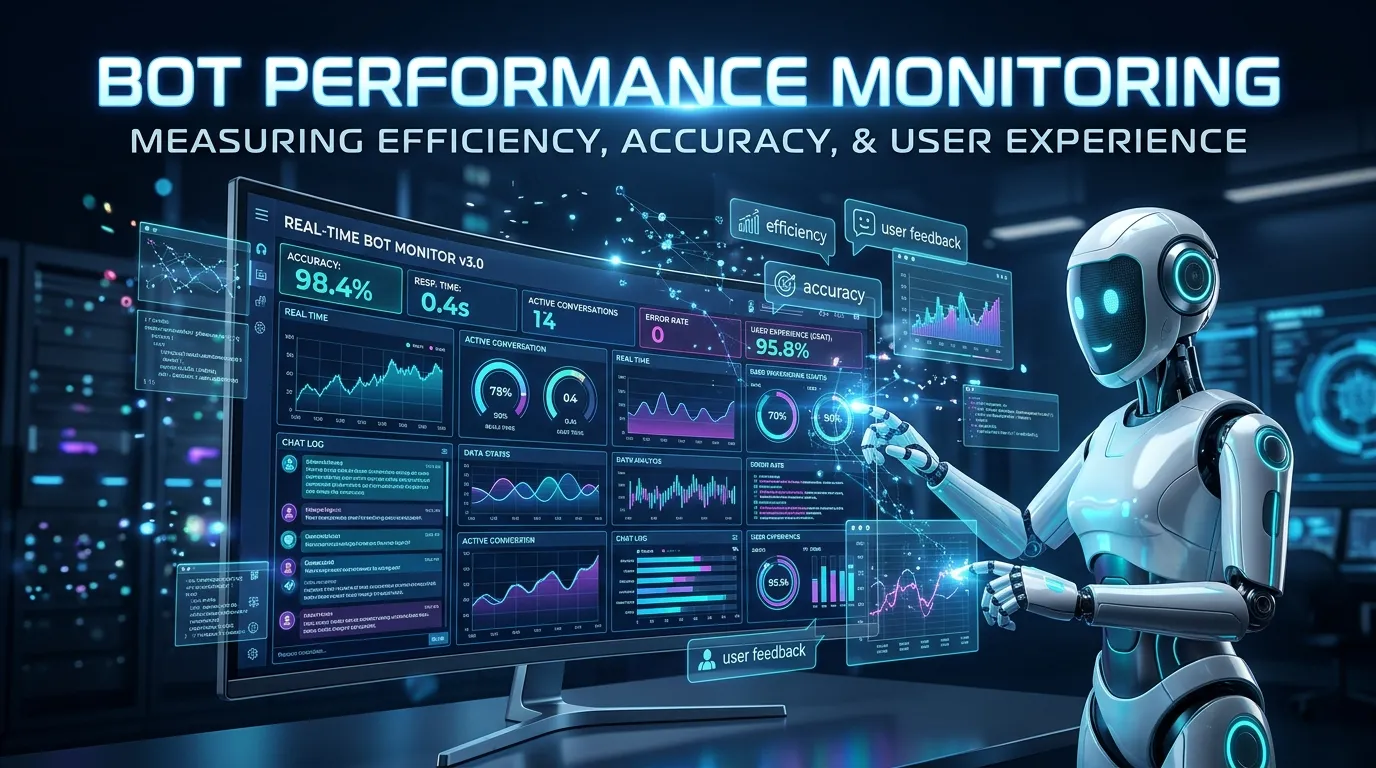
Bot Performance Monitoring helps businesses evaluate chatbot efficiency, response speed, accuracy, engagement, and operational reliability. By using chatbot analytics tools, activity tracking, error monitoring, and automated reporting, organizations can identify performance problems and improve conversational experiences. Effective monitoring connects technical measurements with customer satisfaction and business outcomes.
A chatbot can answer thousands of questions, handle customer requests around the clock, and reduce the workload of support teams. Yet high activity does not necessarily mean that a bot is performing well. It may respond quickly but provide inaccurate information, attract users but fail to resolve their requests, or complete simple conversations while struggling with more complex questions.
This is why Bot Performance Monitoring is essential for businesses that depend on automated conversations. It provides a way to understand how bots operate, how users interact with them, and whether automation is delivering meaningful results.
Effective monitoring goes beyond counting conversations. It examines response quality, resolution rates, error frequency, user engagement, system availability, and the efficiency of automated workflows. These insights help businesses identify weaknesses before they affect customer satisfaction or operational performance.
A well-monitored bot is not simply one that stays online. It is one that consistently provides useful responses, handles requests accurately, and supports the purpose for which it was developed.
What Bot Performance Monitoring Really Reveals
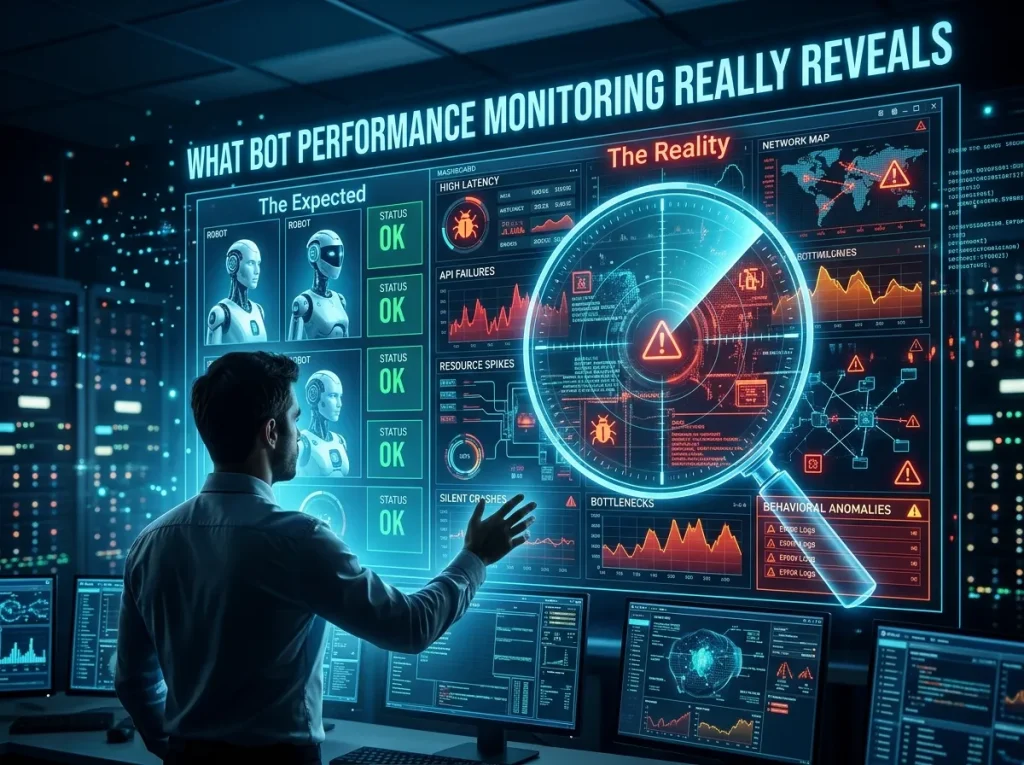
Bot performance monitoring is the continuous process of collecting and evaluating information about a bot’s technical operation and conversational behavior.
For a customer support chatbot, this might include how many conversations it handles, how long users wait for responses, how frequently it transfers conversations to human agents, and how often it resolves requests successfully.
For a marketing bot, the focus may include lead qualification, user engagement, completed actions, and the quality of information collected during conversations.
These differences matter because performance should always be measured against the bot’s intended purpose. A bot designed to answer frequently asked questions should not be evaluated in exactly the same way as one designed to qualify sales prospects.
Monitoring also creates a connection between technical performance and business outcomes. A system may appear healthy from an infrastructure perspective while providing a poor conversational experience. Combining both perspectives gives businesses a more realistic understanding of automation quality.
The Metrics That Explain Chatbot Performance
Chatbot performance metrics help businesses understand whether automated conversations are meeting user expectations. The most useful measurements combine operational indicators with the quality of the interactions themselves.
Response time is one of the easiest metrics to observe. It measures how quickly a bot responds after receiving a user message. Long delays can interrupt conversations, particularly when customers expect immediate assistance.
Resolution rate provides a different perspective. It measures the proportion of conversations in which the bot successfully completes the user’s intended task without unnecessary escalation. A high response speed means little if users repeatedly need human assistance to solve simple problems.
Conversation completion rate can reveal where users abandon interactions. If many people leave after the bot asks a particular question, the wording or process may be confusing.
Accuracy is another important measure. A bot that responds confidently but provides incorrect information can damage trust and create additional work for support teams.
Customer satisfaction scores, feedback ratings, and repeat interaction patterns can help show whether users find the experience helpful.
No single metric tells the complete story. A bot may have a high completion rate but low satisfaction if it completes tasks through an unnecessarily complicated process. Combining several measurements makes performance reports more meaningful.
Bot Activity Tracking: Understanding What Happens During Conversations
Bot activity tracking records how users and automated systems interact over time. Instead of looking only at the final outcome, it provides a view of the actions that occur throughout a conversation.
A business might track when users start conversations, which options they select, how often they request clarification, and where they leave the interaction.
These patterns can reveal problems that are difficult to identify through occasional manual testing.
For example, a chatbot may receive a large number of product questions but frequently fail when users ask about delivery conditions. Activity tracking can highlight this recurring issue and help the team identify a missing knowledge source or an ineffective response flow.
It can also show which features customers use most frequently. If users repeatedly request order information, account assistance, or appointment details, the business can prioritize improvements around those functions.
However, activity tracking should be designed responsibly. Businesses need to collect information that supports legitimate operational purposes while respecting user privacy and applicable data protection requirements.
The principles discussed in Bot Data Privacy are particularly relevant here. Monitoring should not become an excuse to collect unnecessary personal information. Clear data policies, appropriate access controls, and sensible retention practices help maintain trust while supporting performance analysis.
Automated Bot Performance Analysis: Finding Patterns Behind the Numbers
Raw performance data becomes valuable when it explains what is happening and why. Automated bot performance analysis helps businesses identify recurring patterns without requiring teams to inspect every conversation manually.
For example, an analytics system may detect that a bot’s resolution rate drops after a particular software update. It may also reveal that certain questions produce repeated fallback responses or that conversations become longer during specific periods.
These patterns can point toward different causes. A sudden increase in response time might indicate higher traffic, a slow external API, or an infrastructure issue. A growing number of unanswered questions may suggest that the bot’s knowledge base needs updating.
Automated analysis can also compare performance across conversation categories. A customer service bot may handle account questions successfully but struggle with refund requests. Rather than treating the entire system as ineffective, the team can focus improvements on the weaker category.
The real advantage is prioritization. Instead of reacting to isolated complaints, businesses can use recurring data patterns to identify which problems affect the greatest number of users.
Chatbot Efficiency Monitoring and Operational Performance
Efficiency is not simply about making a chatbot respond faster. It is about completing useful work with an appropriate level of time, resources, and human involvement.
A bot that answers a question in one message may be more efficient than one that requires five clarification steps. Similarly, an automated system that resolves routine requests can free support agents to handle complex cases that require judgment and personal attention.
Chatbot efficiency monitoring examines how effectively the system uses its capabilities. Conversation length, successful task completion, escalation frequency, and the amount of agent assistance required can all provide useful information.
Consider an ecommerce chatbot that helps customers check order status. If it consistently retrieves accurate information in a short interaction, it is likely supporting the business efficiently. If customers repeatedly need to provide the same order details or contact an agent afterward, the process may need improvement.
Efficiency should also be considered alongside user experience. Reducing conversation length is not automatically beneficial if the bot becomes less helpful. A slightly longer interaction may be appropriate when it ensures that the customer receives accurate instructions.
The strongest efficiency improvements remove unnecessary friction without sacrificing clarity or service quality.
Bot Response Time Analysis: Identifying Delays Before Users Leave
Response time has a direct influence on conversational flow. When a bot takes too long to answer, users may assume that the system has stopped working or that their request has not been received.
Bot response time analysis examines the delay between a user message and the bot’s reply. More detailed monitoring can separate the different stages involved in generating a response.
For example, the system may need to receive a message, interpret its intent, retrieve information from a database, communicate with an external service, and generate an answer. A delay in any of these stages can affect the final response time.
Average response time provides a general overview, but it can hide occasional severe delays. Measuring higher-percentile response times, such as the 95th percentile, helps teams understand the experience of users who encounter slower responses.
Traffic patterns are also relevant. A chatbot may operate smoothly during normal business hours but experience delays when large numbers of users interact with it simultaneously.
Businesses can investigate these issues by examining server capacity, API performance, database queries, network conditions, and the complexity of bot workflows.
Improving response time should not involve removing necessary verification or accuracy checks. A quick but unreliable answer creates more problems than a slightly slower response that correctly addresses the request.
Conversational AI Performance Tracking and Response Quality
Traditional rule-based bots generally follow predefined paths, while conversational AI systems can interpret more varied language and generate responses dynamically. This flexibility creates additional monitoring requirements.
Conversational AI performance tracking needs to evaluate not only whether a response was delivered but also whether it understood the user’s intent and provided relevant information.
A system may respond fluently while misunderstanding the actual question. It may also produce an answer that sounds convincing but includes unsupported or outdated information.
For that reason, businesses should examine intent recognition, answer relevance, factual accuracy, context retention, and the system’s ability to handle follow-up questions.
Human review remains valuable. A sample of conversations can be examined to identify incorrect answers, confusing wording, inappropriate responses, and situations where the bot should have transferred the user to an agent.
Monitoring should also include the bot’s behavior when it does not know an answer. A responsible system should be able to acknowledge uncertainty, ask for clarification, or direct the user to an appropriate support channel rather than inventing information.
This is particularly important when bots support financial, medical, legal, or other sensitive customer interactions.
Bot Error Rate Monitoring: Understanding Where Automation Fails
Errors can occur at several stages of a chatbot interaction. The bot may fail to recognize an intent, retrieve the correct information, connect to an external system, or complete a requested action.
Bot error rate monitoring helps teams understand how frequently these failures occur and which parts of the system are responsible.
A useful monitoring system distinguishes between different error categories rather than treating every failed conversation as the same problem.
For example:
-
Intent recognition errors: The bot misunderstands what the user is asking.
-
Knowledge errors: The system provides missing, outdated, or incorrect information.
-
Integration errors: An external API, database, or connected service fails.
-
Workflow errors: The bot cannot complete a process because a required step is missing or unsuccessful.
-
User experience errors: Confusing questions or repetitive responses prevent users from progressing.
Separating these categories makes troubleshooting more effective. A high number of integration failures requires a different response from frequent misunderstandings caused by unclear training examples.
Teams should also track how errors affect users. A technical failure that occurs occasionally during a low-priority interaction may have limited impact, while repeated failures during payment or account access can create serious frustration.
Error monitoring is most effective when it leads to corrective action. Once a problem is identified, developers and bot managers can update the relevant workflow, improve the knowledge source, adjust integrations, and test the revised behavior.
Chatbot Analytics Tools: Turning Data Into Useful Decisions
The right chatbot analytics tools make monitoring easier by bringing operational and conversational information into a shared reporting environment.
Depending on the platform, these tools may provide conversation histories, response-time reports, user engagement data, error alerts, and integration monitoring. Some also support sentiment analysis, intent recognition reports, and automated identification of frequently asked questions.
A business should choose analytics capabilities according to the bot’s complexity and purpose. A small FAQ chatbot may only require basic conversation reporting and error tracking. A customer service system connected to order databases and CRM software may need more advanced monitoring across several services.
Integration is particularly important. When chatbot analytics connect with customer relationship management systems, businesses can examine whether automated conversations contribute to qualified leads, customer retention, or successful support outcomes.
The broader role of automation is also worth considering. AI Bots for Business explores how businesses use AI-powered bots across different operations. As these systems become more closely connected with business processes, analytics must provide visibility into both conversational behavior and operational results.
Rather than selecting tools based only on the number of available charts, businesses should focus on whether the platform helps them identify problems, understand their causes, and measure improvements.
Bot Engagement Measurement: Are Users Finding the Experience Helpful?
A chatbot can receive thousands of interactions without creating meaningful engagement. Users may open a conversation, ask one question, and leave because the response is irrelevant or the process is confusing.
Bot engagement measurement examines how people participate in conversations and whether they continue interacting toward a useful outcome.
Conversation initiation is one basic indicator. It shows how many users begin interacting with the bot. However, initiation alone does not demonstrate satisfaction or successful assistance.
Follow-up questions can reveal whether users are exploring the information provided. Repeat interactions may indicate that customers find the bot useful, although repeated contact about the same unresolved problem could point to a weakness.
Completion rates, interaction depth, and feedback responses offer additional context. When users regularly finish tasks and provide positive feedback, the bot may be delivering a valuable experience.
Engagement should also be interpreted according to the purpose of the system. A simple appointment confirmation bot may complete its job in two messages. A product recommendation assistant may require a longer conversation to understand preferences and provide suitable options.
This is why engagement measurement should not reward longer conversations automatically. The goal is to help users accomplish what they came to do, not to keep them interacting unnecessarily.
Businesses can also connect engagement findings with their wider customer communication efforts. The approaches discussed in Bots for Customer Engagement provide useful context for understanding how automated conversations can support ongoing customer relationships.
Automated Bot Performance Reporting: Making Monitoring Consistent
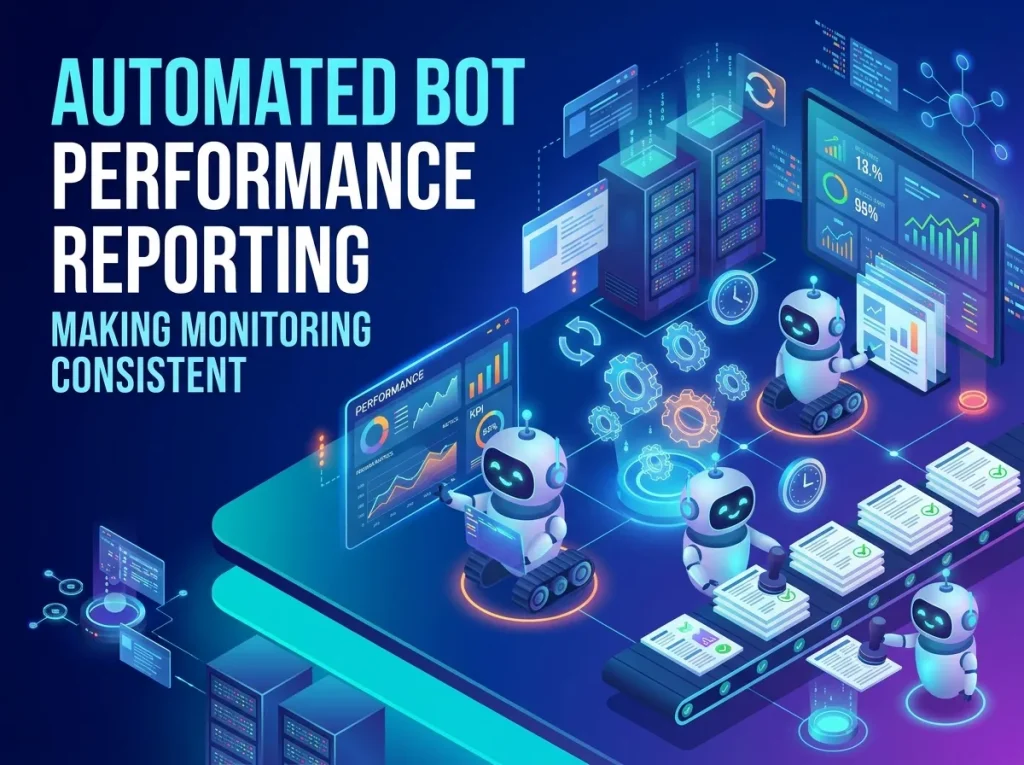
When bot performance reports are prepared manually, important changes can go unnoticed. Automated bot performance reporting helps teams review results at regular intervals and identify unusual patterns more quickly.
A useful report should present a manageable set of indicators. It might include conversation volume, successful resolution rate, response time, escalation frequency, error rate, and user feedback.
Reports should also compare current results with previous periods. If resolution rates decline after a new feature is introduced, the team can investigate whether the change affected conversational quality.
Different teams may need different reporting views. Developers may focus on system availability, latency, integration failures, and technical errors. Customer service managers may prioritize resolution rates, escalations, and satisfaction. Marketing teams may be more interested in lead qualification, engagement, and conversion activity.
The reporting process should make these differences visible without creating disconnected versions of the truth. Shared metric definitions help teams understand the same results consistently.
Alerts can provide another layer of protection. A sudden increase in errors, a major rise in response time, or an unexpected drop in successful conversations can trigger a notification for the responsible team.
However, excessive alerts can become distracting. Thresholds should reflect meaningful operational risks rather than every small fluctuation.
Turning Monitoring Insights Into Better Bot Experiences
Monitoring becomes valuable when it changes how a bot is managed.
Suppose a company discovers that customers frequently abandon a conversation after being asked to select from a long list of options. The issue may not be the bot’s technical performance. It may be the way the conversation is designed.
The business could simplify the choices, introduce more natural language input, or ask a smaller number of questions at a time. After making the change, the team can compare abandonment and completion rates to determine whether the experience improved.
A different situation may involve repeated questions that the bot cannot answer. This could indicate gaps in the knowledge base, outdated content, or unclear information architecture. Updating the relevant resources and testing common questions may improve response quality.
Lead-focused bots require another type of review. If the system attracts many conversations but collects incomplete or irrelevant information, the business may need to improve its qualification questions. The related topic of Bot Qualification helps explain why the quality of information collected during automated conversations matters.
These examples show that performance improvements do not always require replacing the entire chatbot. Small, evidence-based changes to conversation design, information sources, or system integrations can produce meaningful results.
Common Challenges in Bot Performance Monitoring
One challenge is measuring performance without considering context. A chatbot may experience a temporary increase in response time during a major promotional campaign because conversation volume has increased. Looking at response time alone could make the system appear unreliable when the actual issue is temporary demand.
Another challenge is incomplete data. If conversations are not consistently recorded or integrations fail to capture important events, reports may not represent the full user experience.
There is also the risk of focusing too heavily on technical indicators. A system can have excellent uptime and fast responses while consistently misunderstanding customer requests. Operational health and conversational quality need to be evaluated together.
Privacy is equally important. Monitoring systems should avoid exposing sensitive conversation details to unauthorized employees. Businesses should establish appropriate permissions, protect stored information, and follow relevant privacy requirements.
Finally, monitoring needs clear ownership. Teams should know who reviews reports, who investigates alerts, and who is responsible for implementing improvements. Without accountability, even accurate analytics may fail to produce practical results.
The Future of Bot Performance Monitoring
As conversational AI becomes more capable, monitoring is likely to become more focused on context, accuracy, and business impact.
Advanced analytics can help identify unusual conversation patterns, detect changes in response quality, and highlight areas where users repeatedly struggle. Automated evaluations may also help teams review larger volumes of interactions without manually examining every conversation.
However, automated evaluation should not replace human judgment entirely. People remain important for assessing whether a response is appropriate, whether a customer received a genuinely helpful answer, and whether the bot handled an unusual situation responsibly.
Businesses will also need to monitor how bots behave across connected services. A chatbot that depends on payment systems, customer databases, scheduling software, and external APIs requires visibility into the reliability of those integrations.
The most useful monitoring systems will connect technical performance with customer outcomes. They will help businesses understand not only whether a bot is functioning but also whether it is making everyday operations easier.
Building a More Reliable Approach to Bot Performance
A successful chatbot is the result of continuous improvement rather than a one-time development project. User expectations change, business information gets updated, and technical systems evolve. Monitoring helps organizations keep their automated experiences relevant and dependable.
Bot Performance Monitoring provides the information needed to evaluate response quality, activity, efficiency, engagement, and system reliability. By combining these measurements, businesses can identify weaknesses, improve conversation flows, and understand how automation contributes to operational goals.
The most effective approach balances technical indicators with real user experiences. Fast responses matter, but so do accurate answers, successful task completion, responsible data handling, and clear escalation options.
Ultimately, monitoring should help businesses create bots that are not just active but genuinely useful. When performance data leads to thoughtful improvements, automated conversations can become a more reliable part of customer service, marketing, and everyday business operations.
10 Frequently Asked Questions
1. What is Bot Performance Monitoring?
Bot Performance Monitoring is the process of tracking and evaluating a bot’s technical operation, response quality, user engagement, and ability to complete assigned tasks.
2. Which chatbot performance metrics are most important?
Important metrics include response time, resolution rate, conversation completion, error rate, escalation frequency, accuracy, and customer satisfaction.
3. Why is bot activity tracking necessary?
Bot activity tracking helps businesses understand how users interact with automated systems, identify common requests, and discover where conversations become unsuccessful or confusing.
4. How does automated bot performance analysis work?
It uses collected interaction and system data to identify patterns, detect unusual changes, evaluate performance, and highlight areas that may require improvement.
5. What is chatbot efficiency monitoring?
Chatbot efficiency monitoring evaluates how effectively a bot completes tasks while minimizing unnecessary conversation steps, delays, and human intervention.
6. How can businesses improve bot response time?
They can optimize server resources, reduce unnecessary processing, improve database queries, monitor external API performance, and simplify inefficient workflows.
7. What is bot error rate monitoring?
It measures how frequently a bot encounters problems such as incorrect responses, failed integrations, misunderstood requests, and unsuccessful workflows.
8. Which chatbot analytics tools should businesses use?
Businesses should select tools that support conversation reporting, response-time tracking, error monitoring, engagement analysis, and integration with their existing systems.
9. How can bot engagement be measured?
Engagement can be evaluated through conversation starts, follow-up interactions, completion rates, repeat usage, user feedback, and successful task outcomes.
10. How often should chatbot performance be monitored?
Important metrics should be monitored continuously where possible, with regular reports and periodic reviews to identify trends, investigate problems, and evaluate improvements.