
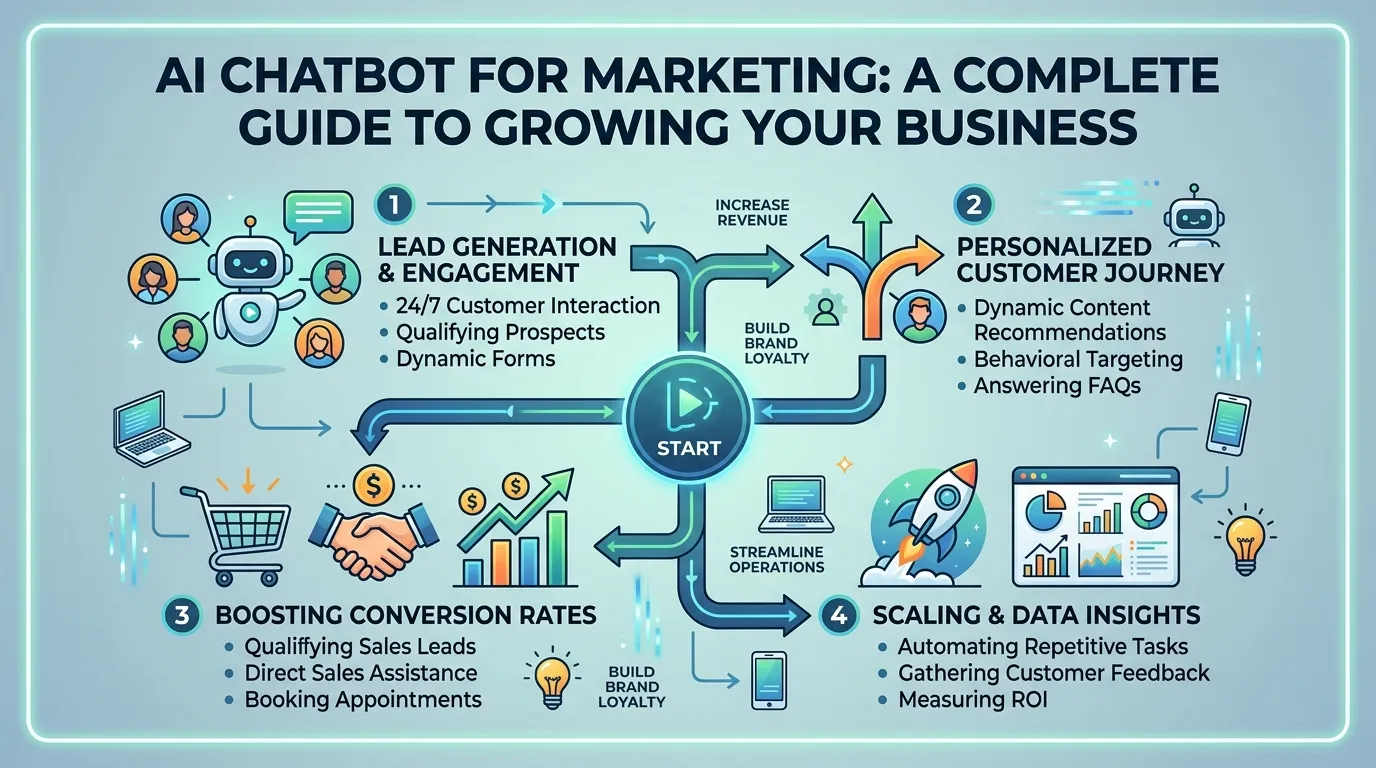
AI chatbots for marketing help businesses automate conversations, engage customers, generate leads, and support sales while improving customer experiences and growth.
An AI chatbot for marketing can help businesses communicate with customers, capture leads, answer questions, and automate repetitive marketing tasks around the clock. As customers increasingly expect quick and personalized responses, businesses are using artificial intelligence to improve engagement while reducing the amount of manual work required from marketing and sales teams.
Modern AI chatbots can do much more than respond to simple customer questions. They can understand natural language, recommend products or services, qualify prospects, collect contact information, schedule appointments, provide personalized recommendations, and connect users with the right resources.
When implemented correctly, an AI chatbot can become an important part of a company’s digital marketing strategy. It can support visitors throughout the customer journey, from their first interaction with a brand to lead generation and conversion.
This guide explains what an AI chatbot for marketing is, how it works, its benefits, common use cases, and how businesses can develop an effective chatbot marketing strategy.
What Is an AI Chatbot for Marketing?
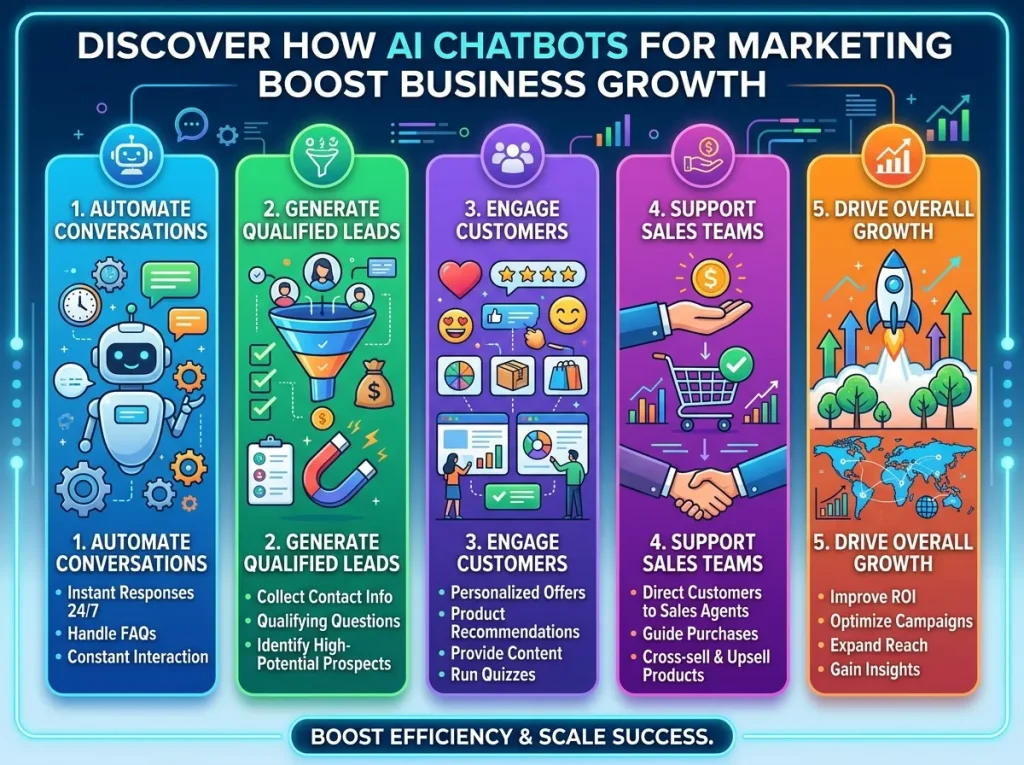
An AI chatbot for marketing is an artificial intelligence-powered software tool that communicates with website visitors or customers through automated conversations. Unlike traditional chatbots that rely heavily on predefined rules and buttons, AI-powered chatbots can understand natural-language questions and generate relevant responses. Businesses can use an AI marketing chatbot to answer frequently asked questions, recommend products, collect leads, provide information, and guide visitors toward specific actions.
Businesses can use these chatbots on websites, messaging platforms, social channels, and other digital touchpoints. They can answer frequently asked questions, recommend products, collect leads, provide information, and guide visitors toward specific actions. When combined with a broader AI chatbot for digital marketing approach, these tools can help businesses create more personalized interactions across multiple marketing channels.
For example, a visitor may arrive on a company’s website and ask, “Which marketing service is best for a small business?” Instead of searching through multiple pages, the visitor can interact with the chatbot and receive an immediate response based on the company’s available services.
The chatbot can then ask additional questions about the visitor’s needs and potentially recommend an appropriate service or encourage the visitor to schedule a consultation.
How Does an AI Marketing Chatbot Work?
An AI marketing chatbot combines artificial intelligence, natural-language processing, machine learning, and business data to understand and respond to user messages.
When a visitor sends a message, the chatbot analyzes the intent behind the question. It then uses its available knowledge and configured instructions to generate an appropriate response.
More advanced systems can use information from product catalogs, FAQs, knowledge bases, customer relationship management platforms, and other business systems. This allows the chatbot to provide more relevant answers and perform useful actions.
For marketing purposes, the chatbot can also collect information during conversations. For example, it may ask about a visitor’s company size, industry, marketing goals, budget, or preferred service. This information can help marketers determine whether the visitor is a qualified prospect.
The chatbot can then send the collected information to a CRM or marketing automation platform, allowing the sales or marketing team to follow up.
Benefits of Using an AI Chatbot for Marketing
An AI chatbot can provide several advantages for businesses when it is properly implemented.
24/7 Customer Communication
One of the biggest advantages of AI chatbots is their ability to operate continuously. Customers can ask questions outside normal business hours and receive an immediate response.
This is especially useful for companies that serve customers across different time zones. Instead of waiting for a representative to become available, visitors can receive basic information immediately.
Continuous availability can also prevent potential leads from leaving a website simply because they cannot get an answer to an important question.
Faster Responses
Customers generally prefer quick communication. Waiting several hours for an email response can cause prospects to lose interest or search for another provider.
An AI chatbot can respond to many common questions instantly. It can explain services, provide basic product information, share relevant resources, and guide visitors to the next step.
This faster communication can improve the overall customer experience while reducing pressure on customer-facing teams.
Personalized Customer Experiences
AI chatbots can use information provided during a conversation to personalize responses.
For example, if a visitor explains that they operate an ecommerce business, the chatbot can provide information relevant to ecommerce marketing rather than presenting generic recommendations.
Personalization can make conversations more useful and help customers find the information they need more quickly. Businesses can also use conversational experiences as part of their broader customer-engagement efforts, including strategies such as gamifying a chatbot to boost engagement.
AI Chatbot Marketing Strategy
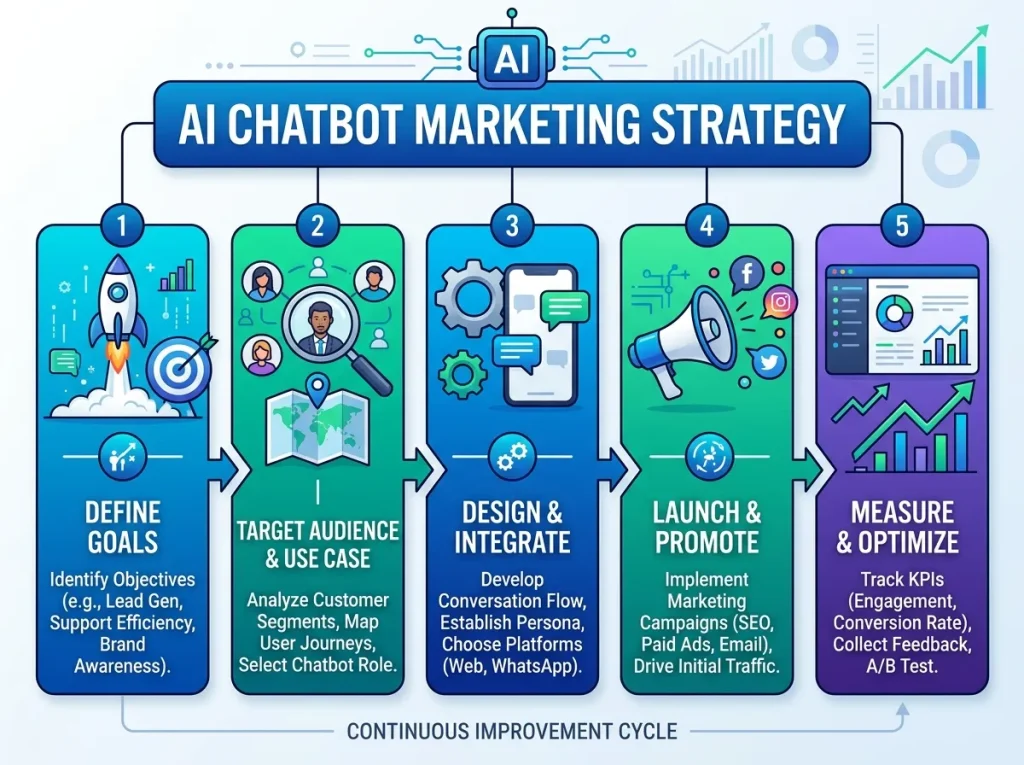
An effective AI chatbot marketing strategy begins with clearly defining what the chatbot should accomplish.
Businesses should identify the most valuable customer interactions that can be automated. These may include answering frequently asked questions, collecting leads, qualifying prospects, recommending products, booking appointments, or directing customers toward specific content.
The chatbot should also have a clearly defined target audience. A B2B software company, for example, may want to qualify website visitors based on company size, job role, industry, and business requirements.
The conversation should feel natural rather than forcing users through a complicated sequence of buttons. Businesses should provide opportunities for users to ask questions in their own words while ensuring the chatbot knows when to transfer the conversation to a human representative.
Another important part of the strategy is measuring performance. Businesses should track conversations, engagement, leads generated, conversion rates, qualified leads, and customer satisfaction to determine whether the chatbot is achieving its objectives.
AI Chatbots for Lead Generation
One of the most valuable applications is using AI chatbots for lead generation. Instead of relying entirely on static forms, businesses can use conversational interactions to collect information from potential customers.
A chatbot can start by asking visitors what they are looking for. It can then ask relevant follow-up questions based on their responses.
For example, a digital marketing agency might ask whether a visitor needs SEO, paid advertising, content marketing, or social media services. It could then ask about the company’s website, industry, marketing goals, and approximate requirements.
Once enough information has been collected, the chatbot can ask for an email address or phone number and offer to connect the visitor with a specialist.
This conversational approach can make lead capture feel more interactive and less like filling out a traditional form.
AI Chatbot for Customer Engagement
An AI chatbot for customer engagement can help businesses maintain conversations with website visitors and existing customers.
Instead of waiting for customers to initiate contact through email or phone, businesses can use chatbots to provide helpful prompts and recommendations.
For example, an ecommerce website might use a chatbot to ask whether a visitor needs help finding a product. A SaaS company could offer assistance with choosing the right plan. A service provider could help visitors determine which service is appropriate for their needs.
Chatbots can also direct customers toward useful blog posts, guides, product documentation, webinars, and other resources. Businesses can extend this approach across multiple communication channels by using an omnichannel chatbot to maintain consistent conversations.
This creates additional opportunities for businesses to educate their audiences while keeping visitors engaged with their websites.
AI Chatbot for Digital Marketing
An AI chatbot for digital marketing can support several stages of the marketing funnel. At the awareness stage, it can answer questions and recommend educational resources. During consideration, it can provide product comparisons, explain services, and share case studies. At the decision stage, it can help visitors request a quote, schedule a demo, or contact sales. Businesses looking to strengthen their overall digital marketing knowledge can also explore how to make money from digital marketing and discover different opportunities within the industry.
Chatbots can also work alongside other digital marketing channels. For example, an email campaign can direct recipients to a landing page where a chatbot helps them learn more about an offer.
Similarly, paid advertising campaigns can send visitors to chatbot-enabled landing pages that immediately answer questions and help qualify prospects.
AI Chatbot for Sales and Marketing
An AI chatbot for sales and marketing can help bridge the gap between marketing-generated leads and sales teams.
Marketing teams can use the chatbot to attract and qualify visitors, while sales teams can receive information about prospects who demonstrate buying intent.
For example, if a visitor asks about pricing, implementation, and product features, the chatbot can recognize that the visitor may be further along in the buying process. It can collect relevant information and offer to arrange a sales conversation.
This can help sales representatives spend more time with qualified prospects rather than manually responding to every initial inquiry.
The chatbot does not necessarily replace sales representatives. Instead, it can handle repetitive early-stage interactions and make the transition to human sales assistance more efficient.
AI Chatbot for Marketing Automation
An AI chatbot for marketing automation can automate repetitive interactions that would otherwise require manual effort.
For example, when a visitor downloads a resource, the chatbot can provide the download link and ask whether the visitor wants additional information. It can then recommend another relevant resource or invite the visitor to schedule a consultation.
Chatbots can also be integrated with CRM and marketing automation systems. Depending on the technology being used, conversations can trigger workflows such as lead scoring, email nurturing, notifications, or sales follow-ups.
This allows businesses to connect conversational marketing with their broader automation strategy.
AI Chatbot for Customer Support
Although chatbots are often associated with marketing, an AI chatbot for customer support can also provide significant value.
Customers frequently ask repetitive questions about pricing, account processes, product features, availability, delivery, or basic troubleshooting. An AI chatbot can answer many of these questions without requiring a customer service representative.
For more complicated issues, the chatbot can collect information about the problem and transfer the conversation to a human agent.
This creates a hybrid support model in which AI handles simple requests while human employees focus on complex or sensitive issues.
AI Chatbot for Business Marketing
An AI chatbot for business marketing can be particularly valuable for companies that receive a high volume of website traffic or inquiries.
Instead of treating every visitor the same way, businesses can use conversational AI to understand what visitors need and guide them toward relevant solutions. Chatbots can also work alongside other marketing channels, including push notification marketing, to reach customers with timely messages and encourage them to return to a website or engage with an offer.
For example, a professional services company can use a chatbot to identify whether a visitor is looking for consulting, training, implementation, or support services. The chatbot can then recommend the relevant service page and provide an appropriate call to action.
This can improve navigation, increase engagement, and create more opportunities for conversion.
How to Implement an AI Chatbot for Marketing

Successful implementation starts with identifying the chatbot’s primary purpose. Businesses should avoid trying to automate every possible interaction immediately.
Start with a small number of high-value use cases, such as answering common questions, collecting leads, or scheduling consultations. Once the chatbot performs reliably, additional capabilities can be introduced.
The chatbot should also be trained or configured using accurate business information. Outdated or incorrect information can damage customer trust.
Businesses should create clear escalation rules as well. When a question is too complex, sensitive, or outside the chatbot’s knowledge, the conversation should be transferred to a human representative.
Testing is another important step. Teams should review real conversations, identify common misunderstandings, improve responses, and regularly update the chatbot’s knowledge.
Measuring AI Chatbot Lead Generation
AI chatbot lead generation should be measured using meaningful business metrics rather than conversation volume alone.
Businesses can track how many visitors interact with the chatbot, how many complete a conversation, how many provide contact information, and how many become qualified leads.
Conversion rate is another important metric. If thousands of people interact with the chatbot but very few take a desired action, the conversation flow may need improvement.
Businesses can also measure the quality of chatbot-generated leads. A smaller number of highly qualified prospects may be more valuable than a large number of unqualified contacts.
Over time, businesses should analyze conversation data to identify common customer questions, objections, and areas where the chatbot needs improvement.
Common AI Chatbot Marketing Mistakes
One common mistake is making the chatbot too aggressive. Constantly interrupting visitors with sales messages can create a poor user experience.
Another mistake is providing generic or inaccurate responses. Customers expect useful information, so businesses need to ensure that the chatbot has access to reliable and up-to-date knowledge.
Businesses should also avoid hiding the option to speak with a human. AI should make customer communication easier, not create frustration when a user needs human assistance.
Finally, companies should not launch a chatbot and forget about it. Customer questions, products, services, and business policies change over time. Regular monitoring and optimization are necessary to maintain quality.
Conclusion
An AI chatbot for marketing can help businesses improve customer engagement, automate communication, generate leads, support sales, and provide faster customer service. When connected with a broader digital marketing and automation strategy, it can become a valuable part of the customer journey.
The most effective approach is to start with clear objectives, understand customer needs, provide accurate information, and create natural conversations. Businesses should also combine automation with human support and continuously analyze chatbot performance.
As AI technology continues to develop, businesses that use conversational experiences thoughtfully can create faster, more personalized, and more efficient ways to connect with customers.
Frequently Asked Questions
What is an AI chatbot for marketing?
An AI chatbot for marketing is an AI-powered tool that communicates with customers, answers questions, generates leads, and guides visitors toward relevant marketing or sales actions.
How can AI chatbots help with marketing?
AI chatbots can engage website visitors, answer questions, recommend resources, capture leads, qualify prospects, and support marketing automation.
Can AI chatbots generate leads?
Yes. AI chatbots can ask qualifying questions, collect contact information, identify buying intent, and send qualified prospects to sales teams.
What is an AI chatbot marketing strategy?
An AI chatbot marketing strategy defines how a business will use conversational AI to engage customers, generate leads, support sales, and achieve specific marketing goals.
Can AI chatbots improve customer engagement?
Yes. Chatbots provide fast, personalized interactions and can help customers find information, products, services, and resources more easily.
Can AI chatbots replace human sales teams?
AI chatbots generally work best as a support tool rather than a complete replacement. They can handle repetitive interactions while human representatives manage complex sales conversations.
How can chatbots support digital marketing?
Chatbots can support digital marketing by engaging website visitors, qualifying leads, recommending content, supporting campaigns, and connecting visitors with sales or marketing teams.
Are AI chatbots useful for customer support?
Yes. They can answer common questions, provide basic troubleshooting, and transfer complex issues to human support agents.
How do you measure chatbot marketing performance?
Important metrics include chatbot engagement, conversations, lead conversion rate, qualified leads, appointments, customer satisfaction, and revenue generated.
What should businesses consider before using an AI chatbot?
Businesses should define clear goals, provide accurate information, choose relevant use cases, protect customer data, offer human support, and regularly monitor chatbot performance.





[…] can also combine AI chatbots with AI Chatbot for Marketing to automate marketing conversations, support lead generation, answer customer questions, and guide […]
[…] exploring AI chatbots for marketing can consider how conversational tools support lead capture, customer questions, and relevant […]