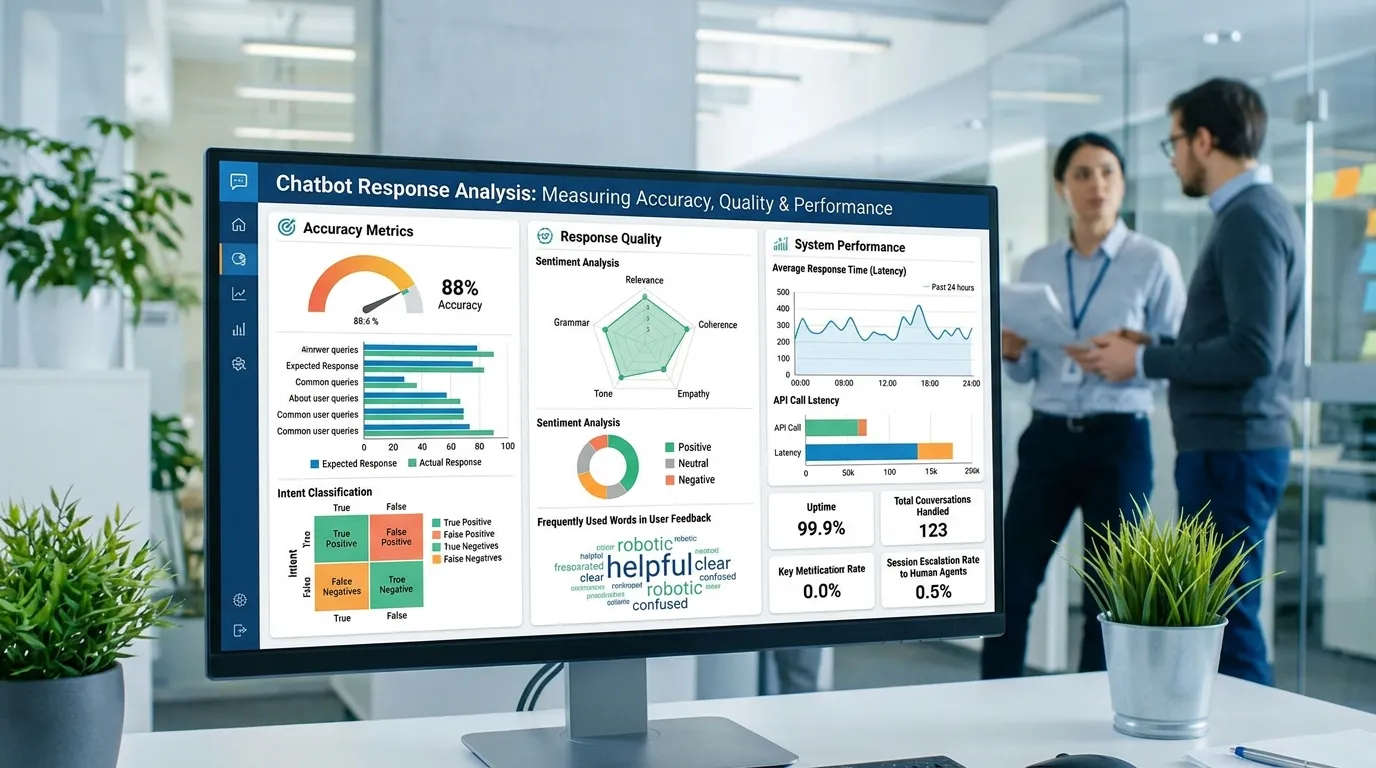
Chatbot Response Analysis helps businesses understand how effectively their chatbots communicate with users. By examining response accuracy, conversation quality, engagement, interaction patterns, and performance metrics, businesses can identify where automated conversations work well and where improvements may be needed. Effective analysis can also reveal user preferences, recurring questions, response gaps, and opportunities to improve customer experiences. When combined with AI chatbot analytics and response optimization, response analysis can support more useful, consistent, and efficient chatbot interactions.
Understanding Chatbot Response Analysis
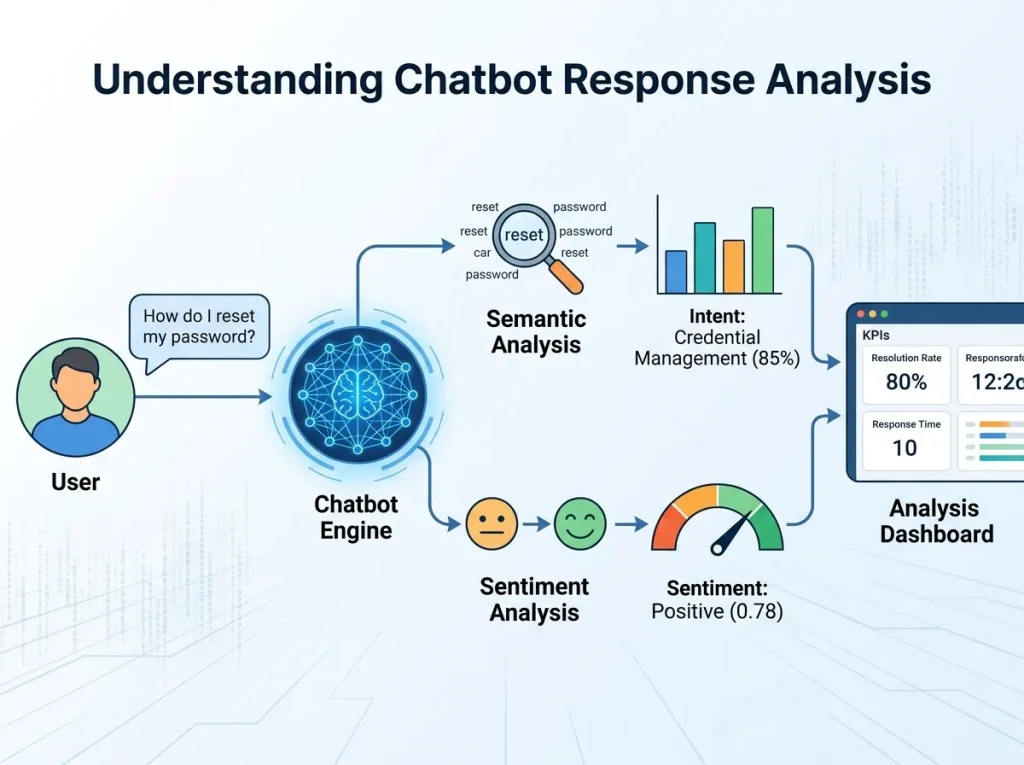
Chatbots have become an important part of digital communication. Businesses use them to answer questions, provide product information, support customers, collect leads, recommend resources, and assist users at different stages of the customer journey. As chatbot adoption increases, simply having an automated conversation system is no longer enough. Businesses also need to understand how effectively that system responds to users.
Chatbot Response Analysis provides a way to evaluate chatbot conversations and determine whether responses are accurate, relevant, timely, useful, and aligned with user expectations. It looks beyond the number of conversations a chatbot handles and examines what happens inside those interactions.
A chatbot may receive thousands of messages but still provide limited value if users frequently repeat questions, abandon conversations, request human assistance, or receive irrelevant responses. Response analysis can identify these patterns and provide a clearer picture of chatbot effectiveness.
The analysis can cover individual responses, complete conversations, user engagement, conversion behavior, response accuracy, and overall chatbot performance. Together, these insights help businesses understand how their automated communication contributes to customer experience and marketing performance.
Chatbot Response Performance
Chatbot Response Performance refers to how effectively a chatbot handles user requests and produces useful responses. Performance can involve several factors, including response speed, relevance, accuracy, completion rate, and the chatbot’s ability to understand different types of user questions.
Speed is particularly important in digital communication. Users typically expect automated systems to respond quickly, but speed alone does not create a successful interaction. A fast response that fails to answer the user’s question may create frustration rather than satisfaction.
Response performance should therefore be considered as a combination of efficiency and usefulness. Businesses can examine whether users receive appropriate answers, continue conversations, complete desired actions, or transfer to human support when necessary.
Analyzing these patterns can also help distinguish between simple requests that automation handles effectively and more complex situations that require human involvement.
Chatbot Response Accuracy
Chatbot Response Accuracy measures how closely chatbot responses match the user’s actual question or intent. Accuracy is one of the most important elements of chatbot quality because incorrect information can negatively affect customer trust and the overall experience.
A chatbot may technically respond to every message while still misunderstanding what the user wants. For example, a customer asking about delivery times may receive information about product availability. The chatbot has responded, but the response does not address the actual request.
Accuracy analysis can identify frequently misunderstood questions, ambiguous language, missing knowledge, and areas where chatbot training or content needs improvement.
Businesses can also examine whether the chatbot correctly recognizes different ways users phrase similar questions. This is particularly important because customers rarely communicate using perfectly standardized language.
Chatbot Conversation Analysis
Chatbot Conversation Analysis examines complete interactions rather than individual messages. Looking at the entire conversation can reveal patterns that are difficult to identify from isolated responses.
A conversation may begin with a simple product question and progress toward pricing, availability, comparisons, and purchase-related information. Analyzing the sequence can show where users engage successfully and where conversations tend to break down.
Conversation analysis can also reveal repeated questions, unexpected topic changes, frequent requests for human support, and points where users abandon the interaction.
These patterns can help businesses understand user intent and improve the structure of automated conversations. Instead of evaluating only whether individual answers are correct, organizations can examine whether the chatbot successfully supports the user’s broader objective.
Chatbot Performance Metrics
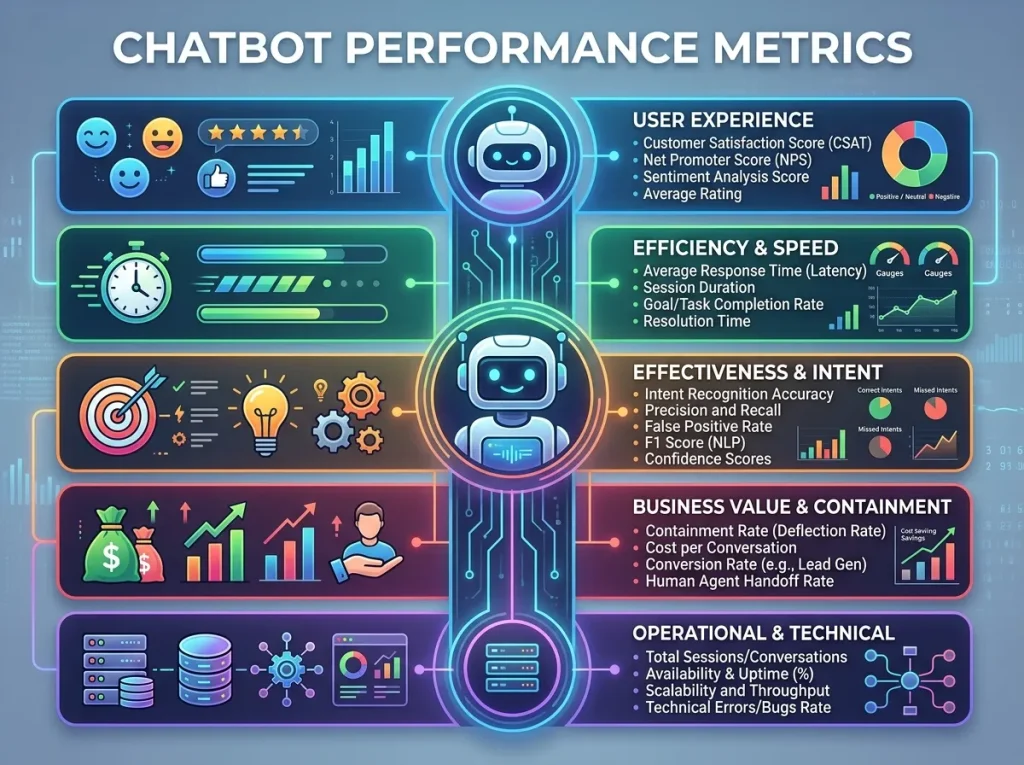
Chatbot Performance Metrics provide measurable information about how an automated conversational system operates. Different businesses may prioritize different metrics depending on whether the chatbot is designed for customer support, lead generation, sales, marketing, or another purpose.
Common metrics can include conversation volume, response time, completion rate, fallback rate, human handoff rate, engagement, conversion rate, and user satisfaction.
For marketing chatbots, conversion-related metrics may be particularly relevant. A chatbot might collect contact information, recommend a product, encourage a visitor to book a consultation, or move a prospect toward another marketing interaction.
For customer service chatbots, resolution rates, response accuracy, and successful self-service interactions may receive greater attention.
The most useful measurement framework therefore depends on what the chatbot is expected to accomplish.
Chatbot Response Quality
Chatbot Response Quality goes beyond factual correctness. A response can contain accurate information but still be difficult for users to understand or act upon.
Quality can involve relevance, clarity, tone, completeness, consistency, and contextual understanding. A high-quality response should address the user’s request in a way that makes sense within the conversation.
For example, a user who asks a simple question may not need a long explanation. Conversely, a complex request may require additional context. Response quality analysis can help businesses identify whether chatbot communication matches the user’s needs.
Consistency is another important consideration. A chatbot should ideally provide reliable information across similar conversations rather than producing significantly different answers to essentially identical questions.
AI Chatbot Analytics
AI Chatbot Analytics combines conversational data with analytical capabilities to identify patterns in user interactions. Modern chatbot systems can collect substantial amounts of information about conversations, allowing businesses to examine trends across large numbers of interactions.
AI-powered analysis can help identify common questions, frequently misunderstood requests, sentiment patterns, conversation drop-off points, and recurring topics. These insights can support improvements to chatbot content and conversational logic.
Analytics can also connect chatbot interactions with broader customer journeys. For example, businesses may examine whether users who interact with a chatbot are more likely to complete a form, request information, make a purchase, or return to the website.
This broader perspective helps organizations understand the role of chatbot conversations within their overall marketing and customer experience strategies.
Chatbot User Interaction Analysis
Chatbot User Interaction Analysis focuses on how people interact with automated conversational systems. It examines the actions users take during conversations and how those actions change as the interaction progresses.
User interaction can include message frequency, response patterns, button selections, content requests, form submissions, product inquiries, and human handoffs.
These behaviors can reveal important information about user expectations. If many users ask the same question immediately after receiving a particular response, the original answer may not provide enough information.
Similarly, if users repeatedly abandon a conversation at a specific point, businesses can investigate whether the chatbot is asking unnecessary questions, providing unclear information, or failing to offer an appropriate next action.
Interaction analysis can therefore contribute to both chatbot improvement and broader customer experience research.
Automated Response Analysis
Automated Response Analysis evaluates responses produced automatically by chatbot systems. It can help businesses determine whether automated communication is achieving its intended purpose without creating unnecessary friction.
Automated responses are often designed to handle common questions efficiently. However, customer needs can vary considerably, and predefined responses may not always address unusual or complex requests.
Analysis can reveal where automation works reliably and where human intervention remains important. This can help businesses create a more balanced customer service model in which chatbots handle suitable routine interactions while more complex situations are transferred to human representatives.
The goal is not necessarily to automate every interaction. Instead, the analysis can help determine where automation provides useful value and where human support creates a better experience.
Chatbot Engagement Metrics
Chatbot Engagement Metrics measure how actively users participate in chatbot conversations. Engagement can include conversation length, number of interactions, return conversations, button clicks, content requests, and completion of desired actions.
High engagement does not always mean high satisfaction. A long conversation could indicate strong interest, but it could also mean the chatbot is struggling to understand the user’s request.
For this reason, engagement metrics should be considered alongside response accuracy, completion rates, user feedback, and conversion data.
For marketing-focused chatbots, engagement can be particularly useful when evaluating whether automated conversations encourage visitors to explore products, request information, subscribe to communications, or take other meaningful actions.
Businesses using conversational technology for marketing can explore how a Chatbot for Marketing can support engagement and conversions across different customer interactions.
Chatbot Response Optimization
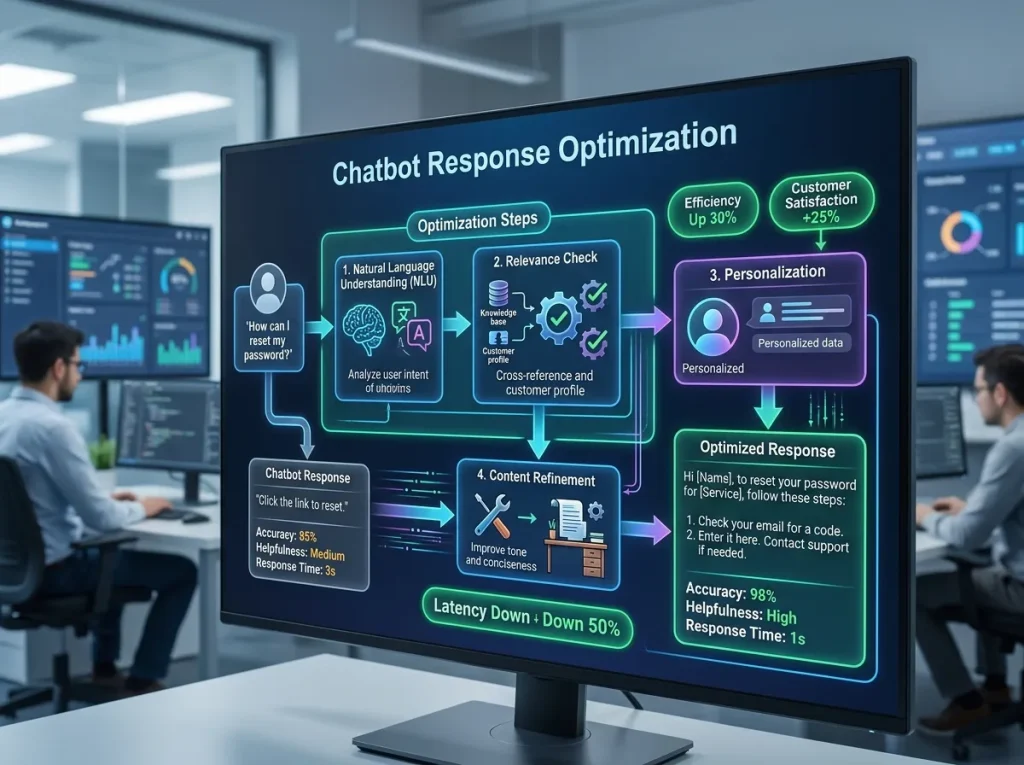
Chatbot Response Optimization involves improving automated responses based on observed performance and user behavior. Analysis provides the information needed to determine which parts of the chatbot experience may require refinement.
Optimization can involve improving response wording, expanding knowledge coverage, adjusting conversational flows, refining intent recognition, updating outdated information, and improving fallback responses.
The process can also involve identifying questions that users frequently ask but the chatbot does not answer successfully. Adding useful information around these topics can improve the overall conversation experience.
Optimization should be ongoing because customer expectations, products, services, and business information change over time. A response that was accurate several months ago may become outdated as products, policies, prices, or services change.
Chatbot Response Analysis for Customer Retention
Chatbots can contribute to customer retention by helping users receive information and support without unnecessary delays. When customers can quickly find answers, resolve simple problems, or access relevant information, the overall relationship with a business can become more convenient.
However, the chatbot itself is not automatically responsible for retention. Its effectiveness depends on the quality of the experience it provides.
Businesses can analyze whether returning customers use the chatbot, which questions they ask, whether their issues are resolved, and whether users continue interacting with the brand after the conversation.
For businesses focused on customer relationships, Marketing Bot Customer Retention provides additional context around using marketing bots to support ongoing customer engagement and retention activities.
Chatbot Analysis in Marketing Campaigns
Chatbots can also become part of broader marketing campaigns. A Chatbot Campaign can encourage users to interact with promotional content, discover products, answer questions, participate in campaigns, or provide information to marketing teams.
Analyzing chatbot campaign performance can reveal which messages attract attention and which interactions lead to meaningful actions.
For example, a campaign may generate a large number of chatbot conversations but relatively few conversions. Another campaign may attract fewer conversations while generating stronger engagement or lead quality.
A Chatbot Campaign can therefore be evaluated through a combination of conversation volume, response performance, engagement, conversion behavior, and user outcomes.
Identifying Conversation Gaps
One of the most valuable outcomes of chatbot response analysis is identifying conversation gaps. These gaps occur when the chatbot does not have sufficient information or conversational capability to address a user’s request effectively.
A high fallback rate can be one indication of such a gap. Repeated human handoffs can provide another signal, especially when users are transferred for questions that should reasonably be handled through automation.
Businesses can also examine unanswered questions and recurring topics to identify areas where chatbot knowledge should be expanded.
These gaps should be evaluated in context. Some requests are naturally complex and may be better handled by human representatives. The objective is not to eliminate every handoff but to ensure that automated systems handle appropriate interactions effectively.
Connecting Chatbot Analysis With Business Outcomes
Chatbot analysis becomes more meaningful when conversational data is connected with broader business outcomes. Instead of measuring chatbot activity independently, businesses can examine how conversations relate to leads, sales, customer support resolution, engagement, and retention.
For marketing teams, this can mean connecting chatbot interactions with form submissions, campaign responses, product inquiries, or conversions. For customer service teams, it may involve comparing chatbot conversations with support resolution and escalation rates.
This connection helps businesses distinguish activity from meaningful results. A chatbot may have high conversation volume but limited business impact, while another may handle fewer conversations but contribute more directly to useful customer actions.
The Importance of Continuous Chatbot Analysis
Chatbot performance can change as websites, products, customer expectations, and marketing campaigns evolve. New questions may appear, existing information may become outdated, and users may interact with the chatbot in ways that were not anticipated during its initial development.
Continuous Chatbot Response Analysis provides a way to identify these changes. Regularly examining conversations can reveal new user behavior, emerging questions, response problems, and opportunities for optimization.
The objective is to maintain a chatbot that remains relevant and useful rather than treating its original configuration as permanent.
Final Thoughts
Chatbot Response Analysis provides businesses with a deeper understanding of how automated conversations perform in real-world interactions. By examining Chatbot Response Performance, Chatbot Response Accuracy, Chatbot Conversation Analysis, Chatbot Response Quality, and Chatbot Engagement Metrics, businesses can identify successful interactions and areas requiring improvement.
AI chatbot analytics can provide additional visibility into user behavior, while automated response analysis can help determine which conversations are suitable for automation and which require human support. When these insights are connected with marketing, customer service, and business outcomes, chatbot data becomes more valuable.
Effective chatbot optimization is an ongoing process. As customer needs and business information change, analyzing real conversations can help organizations maintain more accurate, relevant, and useful automated interactions. Businesses can also explore AI in Event Management to understand how artificial intelligence can support event planning, attendee engagement, and operational efficiency.
Frequently Asked Questions
What is Chatbot Response Analysis?
Chatbot Response Analysis is the process of evaluating chatbot conversations to understand response accuracy, quality, relevance, engagement, performance, and user behavior. It helps businesses identify successful interactions and areas where automated conversations may need improvement.
Why is Chatbot Response Analysis important?
It helps businesses understand whether their chatbot is actually meeting user needs. Analysis can reveal inaccurate responses, conversation drop-offs, frequent questions, engagement patterns, and situations where users require human assistance.
What is Chatbot Response Accuracy?
Chatbot Response Accuracy measures how effectively a chatbot understands a user’s intent and provides an appropriate answer. High accuracy means responses are relevant to the questions and context provided by users.
What are Chatbot Performance Metrics?
Chatbot Performance Metrics are measurements used to evaluate chatbot effectiveness. They can include response time, completion rate, fallback rate, human handoff rate, engagement, conversion rate, and user satisfaction.
What is Chatbot Conversation Analysis?
Chatbot Conversation Analysis examines complete interactions between users and chatbots. It can reveal conversation patterns, recurring questions, drop-off points, topic changes, and areas where users frequently request human assistance.
What is AI Chatbot Analytics?
AI Chatbot Analytics uses analytical technologies to examine chatbot interactions and identify patterns in user behavior, questions, engagement, response quality, and conversation outcomes.
What are Chatbot Engagement Metrics?
Chatbot Engagement Metrics measure how actively users interact with a chatbot. They can include conversation length, message frequency, button clicks, content requests, repeat interactions, and completion of desired actions.
How can businesses improve Chatbot Response Quality?
Businesses can improve response quality by analyzing real conversations, identifying inaccurate or unclear answers, updating chatbot information, improving intent recognition, and refining responses based on user behavior and feedback.
What is Automated Response Analysis?
Automated Response Analysis evaluates responses generated automatically by chatbot systems. It helps businesses determine which automated interactions work effectively and where human assistance may still be appropriate.
What is Chatbot Response Optimization?
Chatbot Response Optimization involves improving automated responses and conversation flows based on performance data and user interactions. It can include refining response wording, expanding knowledge coverage, improving intent recognition, and addressing recurring conversation gaps.