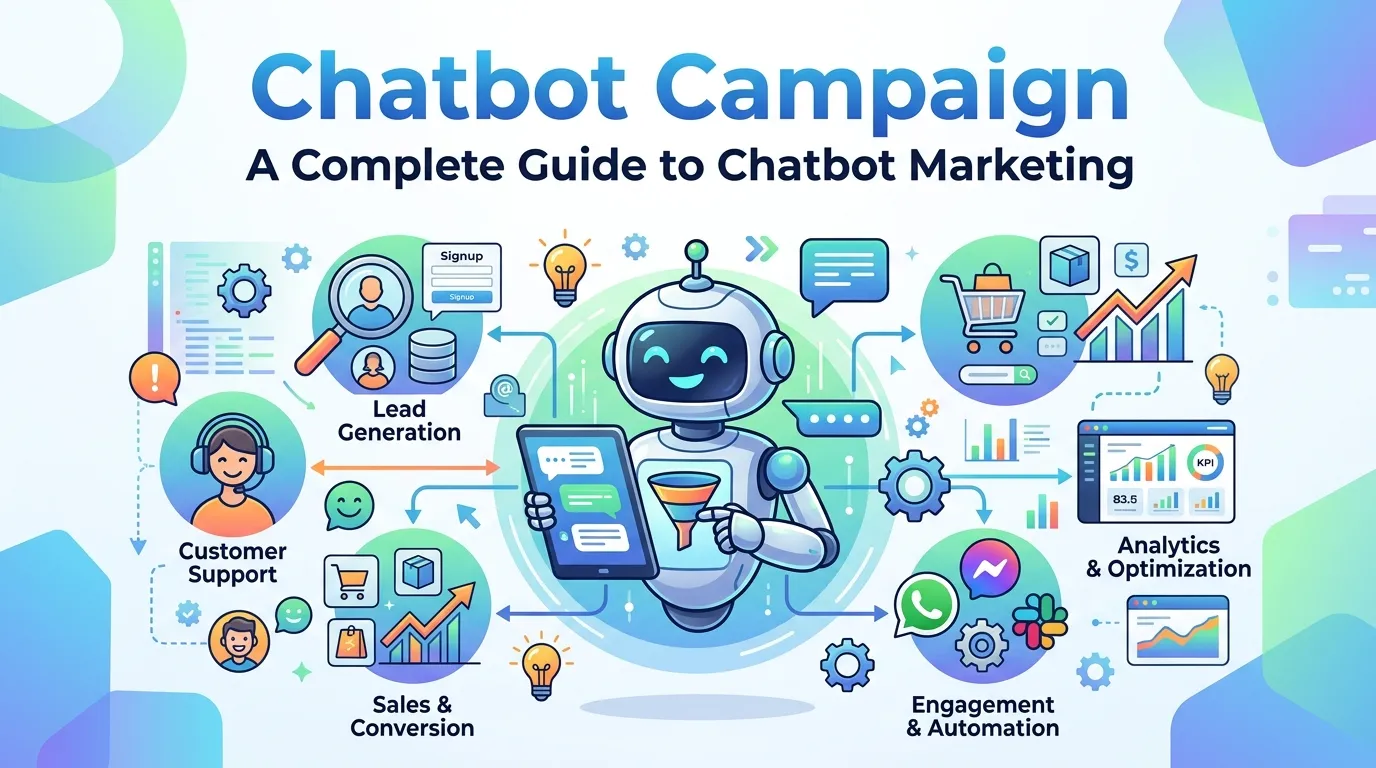
A chatbot campaign helps businesses engage customers, generate leads, provide support, and drive conversions through automated conversations. By combining AI, personalization, marketing automation, and clear campaign goals, businesses can create useful customer experiences while improving marketing efficiency and results.
A chatbot campaign can help businesses communicate with customers, generate leads, answer questions, and guide prospects toward conversions without requiring a marketing or support team to respond manually to every interaction.
Modern chatbots can do much more than provide basic automated replies. When combined with customer data, marketing automation, conversational AI, and well-designed workflows, they can become an important part of a company’s digital marketing strategy.
A successful chatbot campaign starts with a clear objective. Instead of deploying a chatbot simply because AI technology is becoming more popular, businesses should determine what they want the chatbot to accomplish. This could include generating leads, answering product questions, supporting customers, booking appointments, or helping visitors find the right product or service.
What Is a Chatbot Campaign?
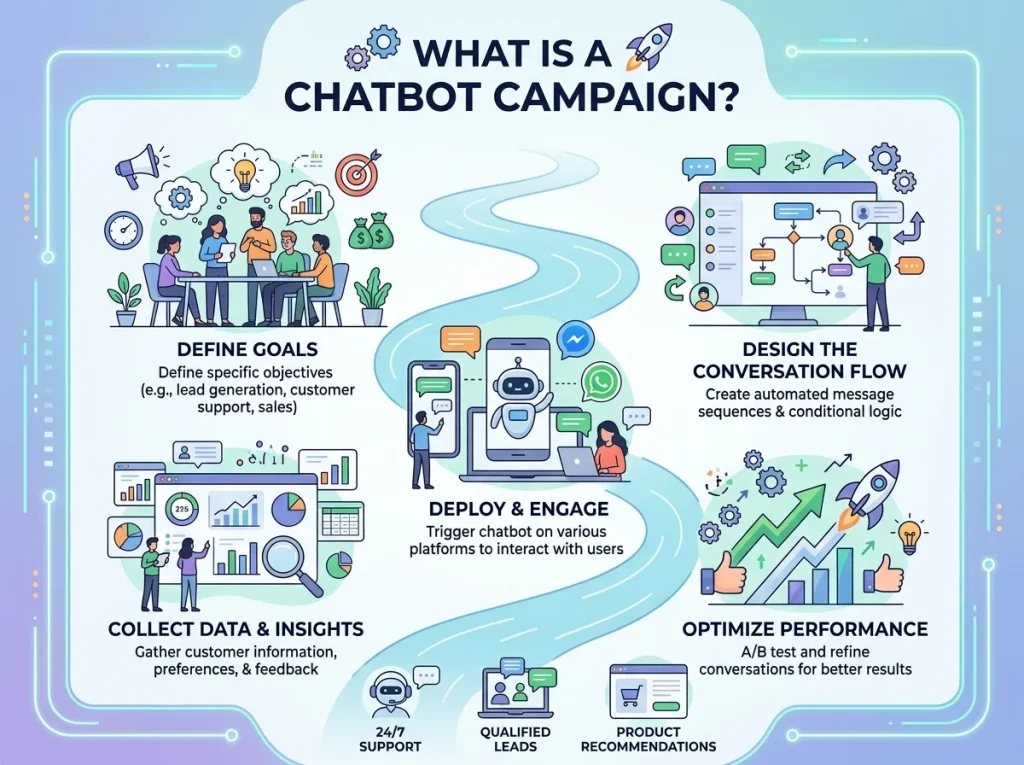
A chatbot campaign is a planned marketing or customer communication campaign that uses a chatbot to interact with users and guide them toward a specific goal.
For example, a business might place a chatbot on its website and use it to welcome visitors, ask about their needs, recommend relevant services, collect contact information, and connect qualified prospects with a sales representative.
A chatbot campaign can also operate through messaging platforms. Businesses can use conversational experiences to communicate with customers where they already spend time rather than requiring every interaction to happen through a website.
The campaign should have a defined audience, message, conversation flow, call to action, and measurement process.
Why Businesses Use Chatbot Campaigns
A well-designed chatbot marketing campaign can create faster and more convenient interactions between businesses and customers. Website visitors do not always want to search through multiple pages to find an answer. A conversational interface can help them find relevant information more directly.
Chatbots can also support marketing teams by handling repetitive conversations. Instead of manually answering the same questions about pricing, services, availability, or product features, a chatbot can provide predefined answers and escalate more complex questions when necessary.
For businesses interested in improving customer interactions, Bots for Customer Engagement provides additional information about using bots to engage audiences.
Define Your Chatbot Campaign Goal
The first step in developing a chatbot campaign strategy is deciding what you want to achieve.
A chatbot designed for lead generation will need a different conversation flow from one designed for customer support. Similarly, a chatbot created to increase product sales should focus on product discovery and conversion rather than simply answering frequently asked questions.
Common campaign objectives include increasing qualified leads, improving customer support response times, scheduling appointments, collecting feedback, increasing product purchases, and guiding website visitors toward relevant resources.
Once the objective is clear, you can determine what the chatbot should ask, what information it should provide, and what action users should take at the end of the conversation.
Create a Conversational Marketing Strategy
A strong conversational marketing strategy focuses on creating useful interactions rather than pushing users toward a sales message immediately.
The conversation should feel relevant to the visitor. For example, a software company could begin by asking what type of solution the visitor is looking for. Based on the response, the chatbot could recommend a product category, explain relevant features, and offer a product demonstration.
The goal is to make each question useful. Asking for too much information too early can cause users to leave the conversation.
A good conversational experience gradually moves the user toward the next appropriate action.
Use AI Chatbot Marketing to Personalize Conversations
AI chatbot marketing can make chatbot conversations more flexible by allowing systems to understand user questions and respond based on context.
Traditional rule-based chatbots generally follow predefined paths. AI-powered systems can provide more natural interactions and handle variations in how customers ask questions.
However, AI should not replace strategic planning. Businesses still need to define the chatbot’s purpose, brand voice, boundaries, escalation rules, and desired outcomes.
The best campaigns combine automation with human support when a conversation becomes too complex or requires personal attention.
Use Chatbot Lead Generation to Capture Prospects

Chatbot lead generation is one of the most common applications of chatbot marketing.
Instead of presenting visitors with a traditional form immediately, a chatbot can begin a conversation and collect information gradually.
For example, it might ask what service the visitor needs, what type of company they represent, and what their primary challenge is. Once the chatbot understands the visitor’s requirements, it can request contact information and offer an appropriate next step.
This approach can make lead capture feel more interactive.
However, businesses should avoid collecting unnecessary information. Every question should have a clear purpose and contribute to qualification, personalization, or conversion.
Build Automated Customer Engagement
Automated customer engagement allows businesses to communicate with visitors and customers even when employees are unavailable.
A chatbot can welcome visitors, answer common questions, recommend content, provide product information, and direct customers to relevant resources.
Automation is particularly useful for businesses that receive similar questions repeatedly. Instead of making customers wait for a response, the chatbot can provide immediate assistance.
For example, an online business could use a chatbot to help customers understand shipping information, product availability, returns, or order-related questions.
The objective is not to automate every interaction. Instead, automation should handle straightforward conversations while giving users an easy path to human assistance when necessary.
Develop a Conversational AI Campaign
A conversational AI campaign should be designed around the customer journey.
Consider what a person might need at different stages. Someone discovering your brand for the first time may need educational information. A returning visitor might want pricing or product details. A customer may need technical support after making a purchase.
Your chatbot can provide different conversation experiences based on these situations.
Context can also make conversations more relevant. If a visitor arrives on a specific product page, for example, the chatbot could provide information related to that product rather than starting with a completely generic message.
Use a Chatbot for Customer Support
Chatbot customer support can help organizations handle common questions and routine requests.
A support chatbot might help users locate documentation, understand basic troubleshooting steps, check policies, or find the appropriate support resource.
However, the chatbot should clearly communicate when it cannot solve a problem. Giving customers an endless automated loop can create frustration.
A strong support experience allows customers to move from automation to a human representative when the issue requires personal assistance.
Create an Automated Marketing Chatbot
An automated marketing chatbot can become part of a larger marketing automation system.
For example, a chatbot interaction could trigger follow-up communication based on what a visitor expressed during the conversation. A person who requests information about a service could receive relevant content, while a qualified prospect could be directed to a sales booking page.
This makes the chatbot part of a broader customer journey instead of an isolated website feature.
The integration between chatbot conversations, CRM systems, email marketing, and analytics can also help marketing teams understand how conversations contribute to business outcomes.
Consider WhatsApp for Chatbot Campaigns
Businesses that communicate with customers through messaging platforms can also consider WhatsApp-based chatbot campaigns.
A WhatsApp chatbot can support customer communication, marketing interactions, product questions, notifications, and other conversational experiences depending on the business’s use case and platform capabilities.
For more information, see WhatsApp Chatbot for Business Marketing.
Build a Strong Chatbot Conversion Strategy
A chatbot conversion strategy should give users a clear next step.
The desired action depends on the campaign. It might be booking a meeting, requesting a quote, registering for an event, downloading a resource, starting a trial, or completing a purchase.
The call to action should naturally follow the conversation.
For example, if the chatbot has already identified that a visitor needs a particular service, asking them to “Book a Consultation” makes more sense than presenting an unrelated offer.
Keep conversion paths simple. Too many choices can create friction and make it harder for users to complete the desired action.
Measure Chatbot Campaign Performance
A chatbot campaign should be measured using metrics connected to its objective.
Important measurements can include conversation starts, completion rates, qualified leads, booked meetings, conversions, customer satisfaction, and handoffs to human agents.
For lead-generation campaigns, focus on the number and quality of leads rather than conversations alone. For customer support, response time and resolution rates may be more important.
You can also analyze where users leave the conversation. If many visitors abandon the chatbot after a particular question, that part of the flow may need to be simplified.
For broader marketing measurement, you can also review Google Ads Quality Score and understand how paid-search performance fits into your overall digital campaign strategy.
For examples of real-world applications, explore Chatbot Marketing.
Best Practices for a Successful Chatbot Campaign
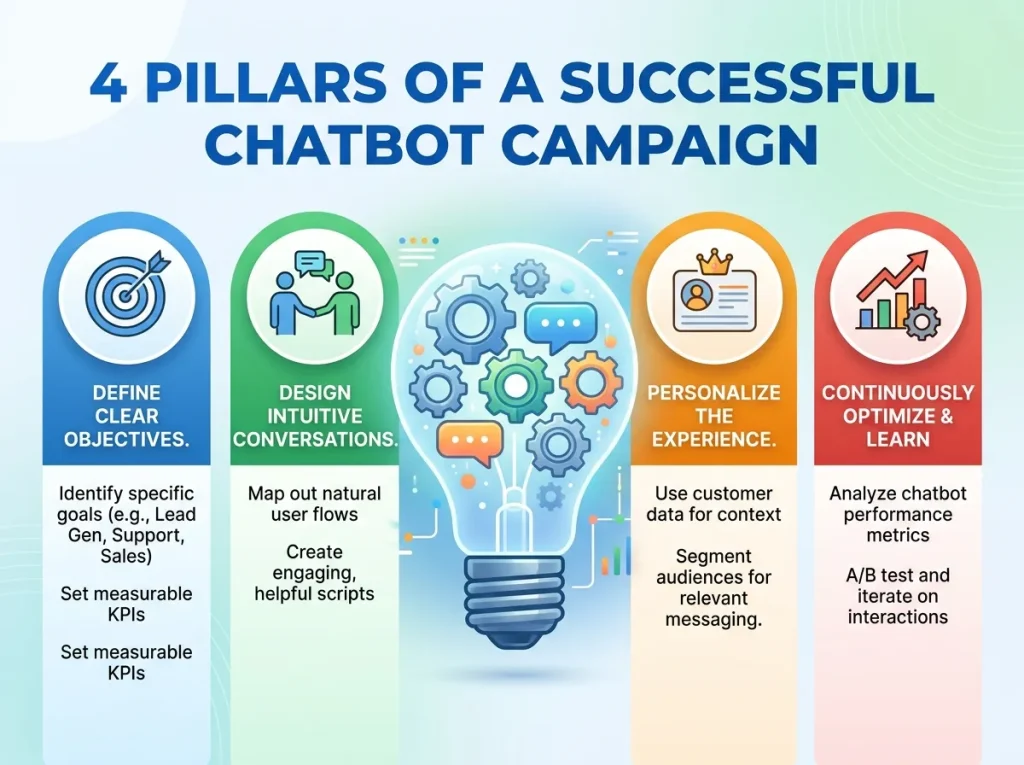
A successful campaign should prioritize usefulness over automation. Start the conversation with a clear purpose and make it obvious what the chatbot can help with.
The chatbot should also use simple language. Long messages and complicated questions can make a conversation feel more like a form than a helpful interaction.
Give users control throughout the experience. They should be able to ask another question, restart the conversation, or request human assistance without difficulty.
Finally, continuously improve the chatbot using real conversation data. Analyze common questions, unsuccessful conversations, drop-off points, and conversion behavior. Updating the chatbot based on actual user behavior can make the experience more useful over time.
Final Thoughts
A chatbot campaign can become a valuable part of a modern digital marketing strategy when it is designed around customer needs and measurable business objectives. From chatbot lead generation and automated engagement to customer support and conversion optimization, chatbots can support multiple stages of the customer journey.
The key is not simply adding AI to a website. Businesses need a clear chatbot campaign strategy, relevant conversations, appropriate automation, strong human handoffs, and reliable measurement. When these elements work together, a chatbot can create more useful customer experiences while helping marketing and sales teams work more efficiently.
Small Summary
A chatbot campaign uses automated conversations to engage customers, generate leads, provide support, and encourage conversions. By combining AI, conversational marketing, automation, and performance measurement, businesses can create personalized interactions that support customers while contributing to broader marketing goals.
10 Frequently Asked Questions
1. What is a chatbot campaign?
A chatbot campaign is a structured marketing or customer communication initiative that uses a chatbot to interact with users and guide them toward a specific objective. The objective could be generating leads, answering questions, promoting a product, scheduling appointments, or supporting customers. Unlike a basic chatbot that simply answers questions, a campaign is designed around a measurable business goal.
2. How does a chatbot marketing campaign generate leads?
A chatbot can generate leads by starting a conversation with website visitors and asking relevant qualification questions. After understanding the visitor’s needs, it can request contact details and recommend an appropriate next step. This can make lead capture more conversational and allow businesses to collect useful information before sending a prospect to sales.
3. What is the difference between a chatbot and an AI chatbot?
A traditional chatbot usually relies heavily on predefined rules, buttons, and conversation paths. An AI chatbot can use artificial intelligence to understand a wider variety of natural-language questions and respond based on context. However, AI chatbots still need clear objectives, training, safeguards, and human escalation processes to provide a reliable experience.
4. How can businesses use chatbots for marketing?
Businesses can use chatbots to welcome website visitors, recommend products, answer pre-sales questions, distribute content, qualify prospects, collect leads, schedule meetings, and support promotional campaigns. A chatbot can also work alongside email marketing, CRM systems, advertising, and other marketing channels to create a more connected customer journey.
5. Can chatbots improve customer engagement?
Yes, chatbots can support customer engagement by providing immediate responses and making information easier to access. They can interact with customers outside normal business hours and provide personalized guidance based on the user’s questions. The experience is most effective when the chatbot provides genuinely useful information instead of repeatedly pushing promotional messages.
6. How can I create an effective chatbot campaign strategy?
Start by identifying one primary campaign objective and the audience you want to reach. Then map the customer journey and determine what questions the chatbot should ask, what information it should provide, and what action users should take. Test the conversation before launch and use performance data to improve it after deployment.
7. Are chatbots effective for customer support?
Chatbots can be effective for routine customer-support questions and straightforward requests. They can provide immediate answers to frequently asked questions and direct customers toward relevant resources. However, complicated or sensitive issues may require human assistance, so a good support chatbot should provide a clear and easy escalation option.
8. How can I measure chatbot campaign success?
The right metrics depend on your campaign objective. Lead-generation campaigns can measure qualified leads, conversion rates, and booked appointments. Marketing campaigns may focus on engagement and conversions, while support campaigns can measure resolution rates, response times, and customer satisfaction. Conversation abandonment can also reveal areas where the chatbot experience needs improvement.
9. Should a chatbot campaign use AI?
AI can be useful when customers ask questions in different ways or when conversations require contextual understanding. However, not every chatbot needs advanced AI. Simple campaigns with predictable questions may work well with structured conversation flows. The technology should match the complexity of the customer experience and the campaign’s objectives.
10. Can chatbots increase conversions?
A chatbot can contribute to higher conversions by helping visitors find information quickly, answering objections, qualifying prospects, and directing users toward relevant actions. However, conversion results depend on factors beyond the chatbot, including the offer, landing page, audience, pricing, trust, and overall customer experience. The chatbot should therefore be treated as one part of a broader chatbot conversion strategy, not a standalone solution.