Bot qualification uses chatbots to assess prospect needs, collect relevant information, and identify potential customers who are a good fit for a business. By combining automated lead qualification, conversational screening, lead scoring, and CRM integration, companies can improve response times and help sales teams prioritize opportunities. Clear criteria, responsible data handling, human support, and regular performance analysis are essential for building an effective qualification workflow.
Bot qualification is becoming an important part of modern lead generation because businesses need efficient ways to identify potential customers and understand their needs. Instead of relying entirely on manual conversations, companies can use chatbots to collect relevant information, evaluate prospect responses, and determine which leads are most likely to become customers. This approach helps sales and marketing teams focus on opportunities that match their products, services, and business objectives.
As customer expectations continue to change, people increasingly expect quick responses and convenient ways to communicate with businesses. Chatbots can support these expectations by asking relevant questions, providing immediate answers, and guiding visitors toward suitable solutions. When designed carefully, bot qualification can improve the customer experience while reducing repetitive work for sales representatives.
Effective qualification requires more than asking visitors to complete a series of questions. Businesses need to establish clear qualification criteria, understand customer intent, and use the collected information responsibly. By combining conversational experiences with structured evaluation methods, organizations can develop a reliable qualification process that supports stronger relationships and more effective sales activities.
What Is Bot Qualification?
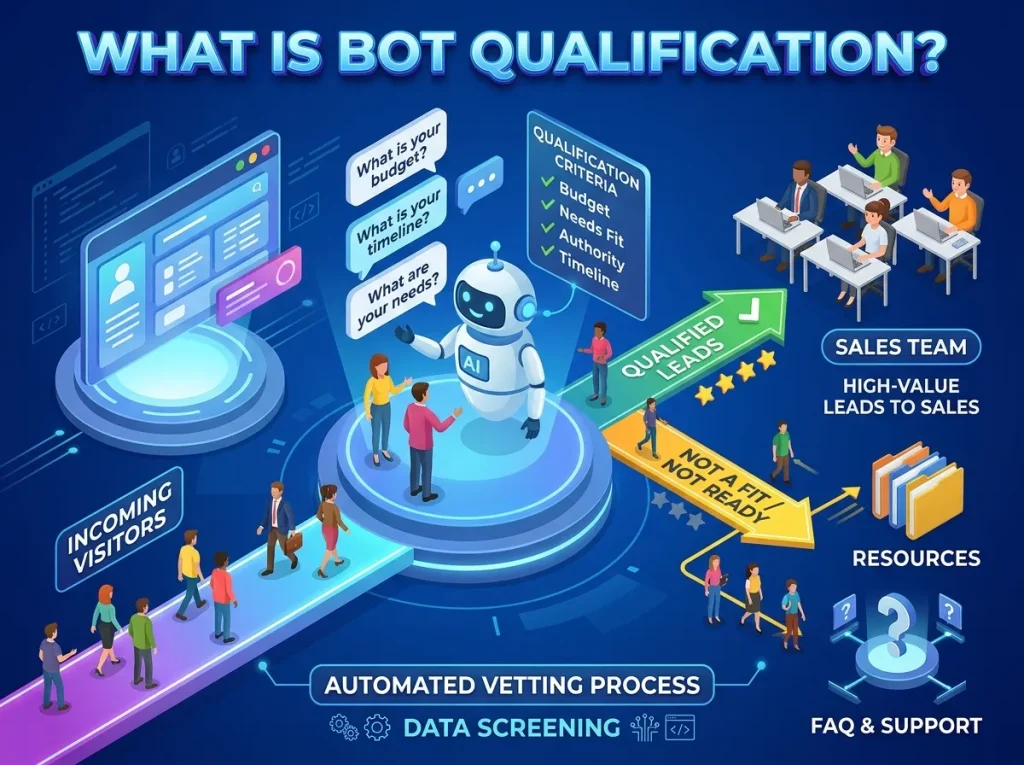
Bot qualification is the process of using automated conversational tools to assess whether a website visitor, inquiry, or potential customer meets specific criteria. A qualification bot interacts with prospects through a website chat interface, messaging platform, or other supported communication channel. During the conversation, it gathers information that helps a business understand the prospect’s requirements, interests, and readiness to purchase.
Unlike a basic chatbot that only answers frequently asked questions, a qualification-focused bot follows a purposeful conversation. It may ask about a visitor’s business needs, preferred service, expected timeline, budget range, or role in a purchasing decision. The answers help the business determine whether the prospect should receive additional information, enter a nurturing process, or connect with a sales representative.
Bot qualification is useful for organizations that receive large numbers of inquiries and need a consistent way to evaluate them. It can support business-to-business sales, online service providers, software companies, and other organizations that want to understand customer needs before arranging a sales conversation.
The objective is not simply to reject unsuitable prospects. A well-designed qualification system helps every visitor reach the most relevant next step, whether that involves speaking with a specialist, exploring educational content, or receiving follow-up information.
How Chatbot Lead Qualification Works
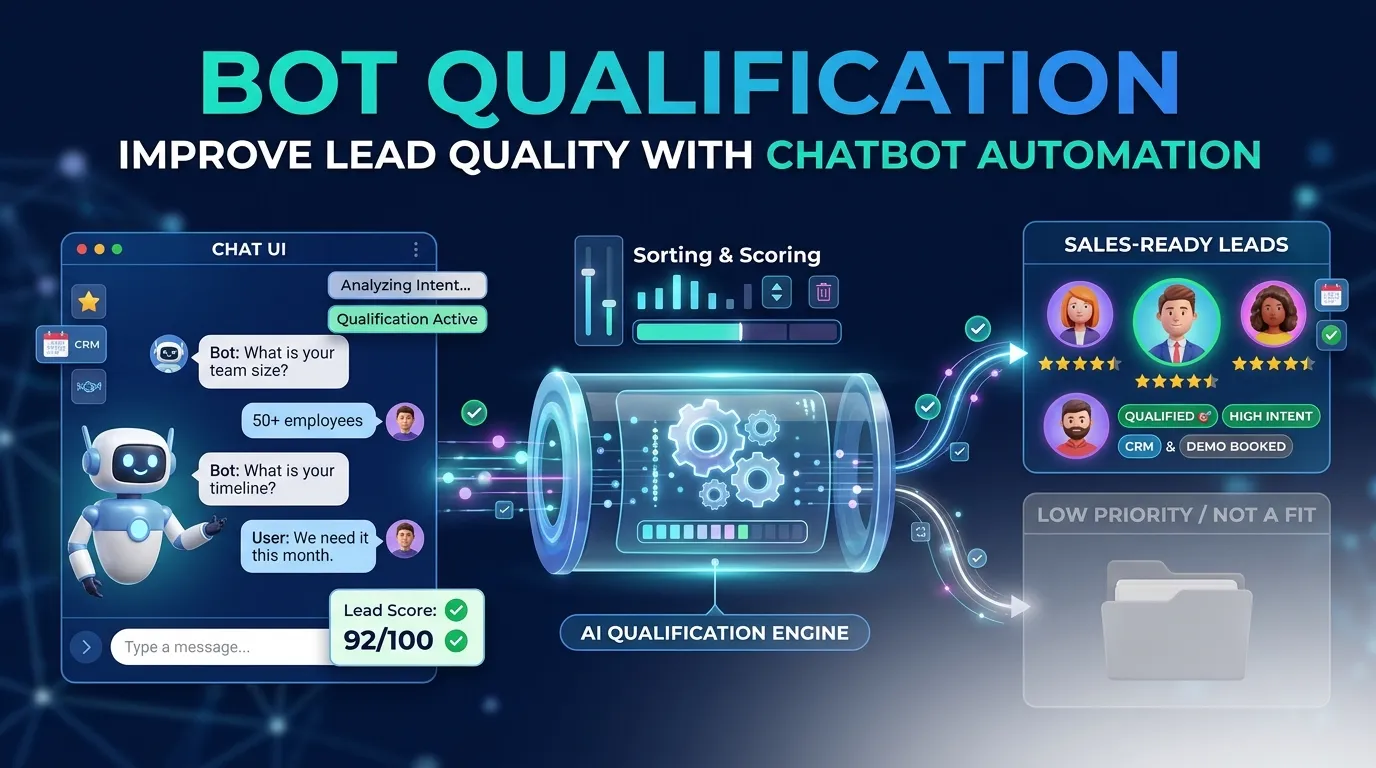
Chatbot lead qualification typically begins when a visitor initiates a conversation or responds to an automated invitation. The chatbot introduces its purpose and asks questions related to the visitor’s needs. The sequence should feel natural, with each question helping the system understand the prospect more clearly.
For example, a business software company might ask visitors which challenge they want to solve, how many employees will use the platform, and when they expect to implement a solution. The chatbot can then compare the answers with established qualification criteria. A prospect with a relevant requirement and a near-term purchasing timeline might be directed toward a sales consultation, while someone conducting early research could receive educational resources.
The collected information may be passed to a customer relationship management system or another lead management platform. Depending on the available integrations, the system can store responses, assign qualification labels, update lead scores, and notify the appropriate team.
Businesses should also provide a clear route to human assistance. Some prospects have complex requirements that automated questions cannot fully capture. Allowing them to request a representative prevents the conversation from becoming frustrating and helps sales teams handle situations that require personal judgment.
Automated Lead Qualification and Its Business Value
Automated lead qualification helps organizations evaluate inquiries without requiring employees to manually review every initial interaction. By applying consistent questions and qualification rules, businesses can identify promising opportunities more quickly and reduce repetitive administrative tasks.
One major benefit is improved response speed. When a prospect visits a website outside normal business hours, a chatbot can still collect basic information and explain the next steps. The sales team can review the inquiry later with a clearer understanding of the visitor’s needs.
Automation also creates consistency. Human representatives may ask different questions depending on their experience, workload, or communication style. A carefully designed bot qualification process can ensure that important information is collected across similar inquiries. This makes lead evaluation more structured and helps businesses identify gaps in their sales process.
Another advantage is better use of team resources. Sales representatives can spend less time gathering routine information and more time discussing specific challenges, evaluating solutions, and building customer relationships. Marketing teams can also use aggregated qualification data to understand which channels attract prospects who closely match the company’s target audience.
However, automation does not automatically improve lead quality. Poorly selected questions, unclear qualification rules, or overly aggressive scoring can cause businesses to overlook valuable prospects. Organizations should regularly evaluate results and adjust the process according to real customer behavior.
Establishing Clear Chatbot Qualification Criteria
Chatbot qualification criteria determine how a bot evaluates the information it receives. Without clear criteria, the system may collect large amounts of data without producing useful decisions. Businesses should first identify the characteristics that distinguish a relevant prospect from a general website visitor.
Depending on the business model, these characteristics may include industry, company size, specific business requirements, available budget, purchasing authority, implementation timeline, or interest in a particular service. Not every business needs to ask about all these factors. The most useful questions are those that directly influence the next step in the sales process.
For business-to-business organizations, company fit and the prospect’s role may be important. For service providers, the type of service required and expected project timeline could be more relevant. A company offering subscription software might focus on the prospect’s intended use, current challenges, and preferred features.
Questions should be easy to understand and proportionate to the value of the conversation. Asking for too much personal or business information at the beginning may discourage visitors from continuing. A progressive approach works better: collect essential details first, then request additional information when it becomes necessary.
Businesses should also define what happens when answers are incomplete or do not match standard criteria. Rather than automatically marking every uncertain lead as unqualified, the chatbot can ask a follow-up question, provide helpful information, or offer a human handoff.
Creating an Effective Bot Qualification Process
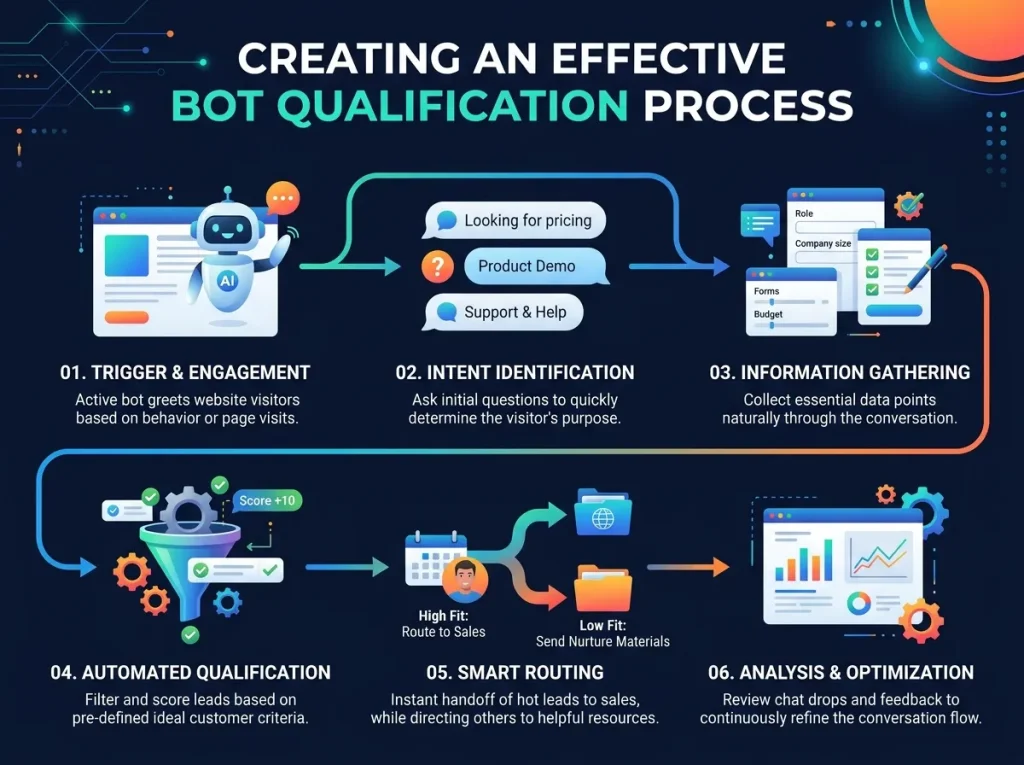
An effective bot qualification process begins with a clear understanding of the sales journey. Businesses should determine what information sales representatives need before contacting a prospect and which questions can reasonably be answered through an automated conversation.
The next step is to create a short conversational sequence. Each question should have a clear purpose, and the order should follow the visitor’s likely needs. Starting with the problem the visitor wants to solve often feels more natural than immediately asking about budget or purchasing authority.
After defining the conversation, businesses should establish qualification outcomes. A prospect may be considered ready for sales contact, suitable for further nurturing, or outside the company’s current service scope. These categories should reflect actual business requirements rather than arbitrary assumptions.
The chatbot should then connect each outcome to a useful action. Qualified prospects might be offered a meeting link or connected with a representative. Prospects who need more information could receive relevant resources, while inquiries requiring specialized assistance might be transferred to a support or consulting team.
Testing is essential before a qualification bot is deployed widely. Businesses should review conversations with different visitor needs, identify confusing questions, and check whether the resulting lead classifications are accurate. Ongoing monitoring helps ensure the bot remains useful as products, services, and customer expectations change.
Conversational Lead Qualification and Customer Experience
Conversational lead qualification uses a dialogue-based approach to understand potential customers. Rather than presenting a long form with multiple fields, the chatbot asks questions gradually and adapts the conversation according to the visitor’s responses.
This approach can make qualification feel more accessible. Visitors can explain their goals, request clarification, and explore relevant options while receiving immediate responses. When the chatbot recognizes a visitor’s stated need, it can guide the conversation toward information that is genuinely useful.
Good conversational design requires a balance between efficiency and flexibility. A rigid sequence that repeats irrelevant questions can make the experience feel mechanical. By contrast, a conversation that adapts to previous answers can reduce unnecessary steps and help visitors reach suitable information more quickly.
Businesses should use simple language, keep questions focused, and clearly explain why certain information is needed. Visitors should be able to correct an answer or request human assistance when necessary. These choices help build trust and reduce the risk of collecting misleading information.
Conversational qualification can also benefit from insights gained through AI chatbots for health apps. Although health applications have different privacy and service requirements, they demonstrate the importance of creating conversational interactions that respond to user needs and guide people toward appropriate next steps. Businesses in every sector should adapt conversational automation to their own audience, responsibilities, and operational requirements.
Chatbot Lead Scoring for Better Prioritization
Chatbot lead scoring assigns values to selected prospect characteristics or actions. These scores help businesses prioritize inquiries according to their potential relevance and readiness. When integrated with bot qualification, lead scoring can transform conversational responses into structured information for sales and marketing teams.
A company might assign higher scores to prospects who express a clear need for its solution, match its target customer profile, or indicate that they intend to make a decision soon. Other signals, such as requesting a product demonstration or asking about implementation, may also contribute to the score when they are relevant to the company’s sales process.
The scoring model should reflect the business’s actual customer journey. A high website activity level does not always indicate purchase intent, and a visitor who asks only a few questions may still be a valuable prospect. Scores should therefore combine relevant characteristics rather than depend on one isolated action.
Businesses should establish thresholds that determine when a lead is ready for sales follow-up. These thresholds need regular review because customer behavior and sales outcomes may change over time. Sales teams can provide useful feedback by identifying which high-scoring prospects convert and which classifications appear inaccurate.
Organizations can also monitor chatbot results through chatbot engagement analytics. Reviewing completion rates, response patterns, handoff frequency, and downstream conversions can reveal whether the qualification conversation is helping visitors progress or causing them to abandon the interaction.
Automated Prospect Screening and Lead Quality
Automated prospect screening allows businesses to evaluate incoming inquiries against predefined requirements before assigning them to the next stage of the sales process. It can help identify prospects who appear to fit the company’s target market while separating inquiries that need further clarification or a different type of assistance.
A screening process may consider the prospect’s stated goals, relevant organizational characteristics, required services, or intended timeframe. The chatbot can use this information to recommend an appropriate next step without requiring a sales representative to conduct the initial assessment manually.
Screening should remain flexible. A prospect who does not meet every standard criterion may still have a valuable opportunity, particularly when the business serves several market segments or offers customizable solutions. Qualification rules should identify likely fit rather than make irreversible decisions based on incomplete information.
Businesses should also avoid collecting sensitive or unnecessary details simply because the chatbot can ask for them. Data collection should be limited to information that supports a legitimate business purpose, with appropriate privacy notices and access controls. Clear retention practices and reliable data handling help maintain trust throughout the qualification process.
When screening rules are reviewed regularly, businesses can improve the quality of sales handoffs, reduce time spent on irrelevant inquiries, and understand which audiences are most likely to benefit from their offerings.
Integrating Bot Qualification with Sales and Marketing
Bot qualification becomes more valuable when its results connect with the systems used by sales and marketing teams. Without integration, employees may need to copy conversation details manually, increasing the likelihood of errors and delaying follow-up.
A connection with a customer relationship management platform can help store prospect information, record qualification outcomes, and assign leads to appropriate team members. Marketing automation systems may use the same information to support relevant follow-up communications, provided the business has an appropriate basis for contacting the prospect.
The integration should define which information is stored, how records are updated, and who is responsible for acting on qualified leads. Sales representatives should be able to review the conversation context instead of asking prospects to repeat details they have already provided.
Businesses can also connect qualification results with their wider conversion strategy. The guidance in How to Improve B2B Conversion Rates with Chatbots can complement qualification efforts by focusing on how chatbot interactions support the journey from initial interest to meaningful business action.
For organizations with multiple sales teams or service categories, routing rules can send prospects to the appropriate department based on their needs. These rules should include a fallback option for inquiries that do not clearly match an existing category.
Bot Qualification Workflow and Continuous Improvement
A bot qualification workflow defines how a prospect moves from the first conversation to a meaningful next step. It includes the questions the chatbot asks, the information it collects, the rules it uses to assess fit, and the actions that follow each outcome.
A typical workflow begins with visitor engagement, followed by needs assessment and relevant qualification questions. The chatbot then evaluates the responses, assigns a qualification category or score, and routes the prospect toward a suitable action. Depending on the result, that action might be a sales meeting, a follow-up sequence, an educational resource, or a conversation with a support specialist.
Businesses should measure the workflow from beginning to end. The number of conversations started is useful, but it does not reveal whether the system is generating meaningful opportunities. More informative measures include conversation completion, qualification accuracy, qualified-lead rate, sales response time, meeting bookings, and conversion into customers.
It is also important to review unsuccessful interactions. Visitors may abandon a conversation because it is too long, asks for information too early, or fails to answer an important question. Reviewing these patterns can help teams simplify the flow and improve the experience.
Qualification workflows should evolve with business priorities. New products, changing customer expectations, and feedback from sales teams may require different questions or updated scoring rules. Regular testing helps ensure that the chatbot continues to support accurate decisions rather than simply maintaining an outdated process.
Common Challenges in Bot Qualification
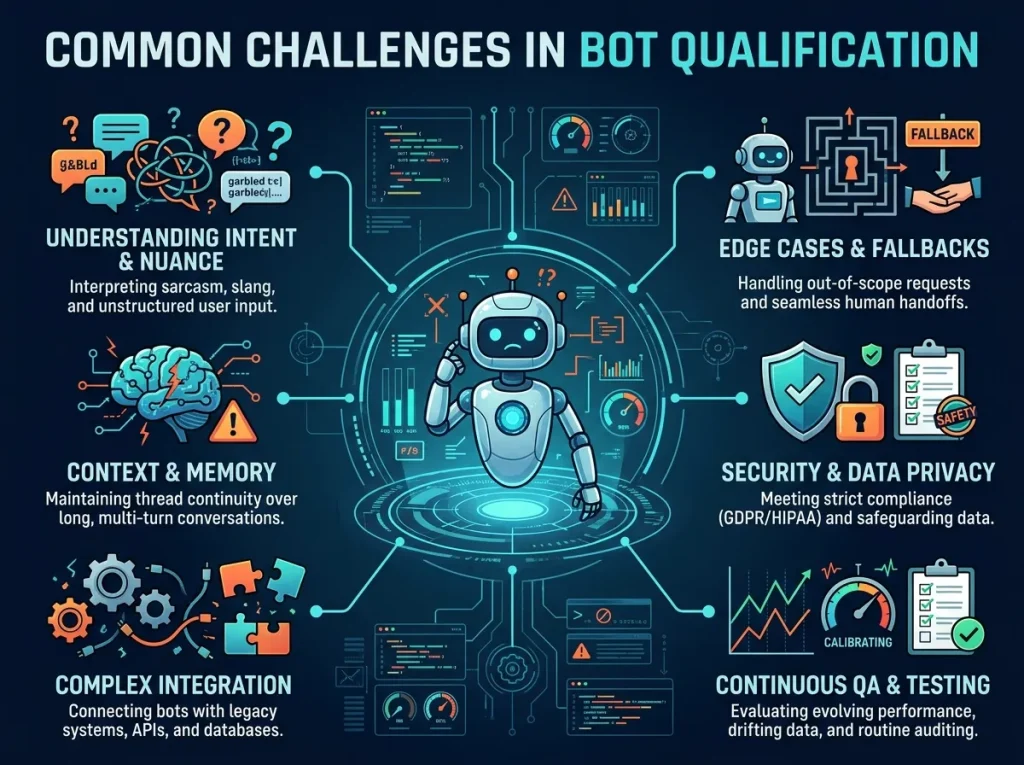
One common challenge is designing a chatbot that feels like an interrogation rather than a helpful conversation. Too many questions can discourage visitors, especially when they have not yet received any useful information. Businesses should prioritize essential questions and make the purpose of the interaction clear.
Another challenge is inaccurate qualification. If the rules are too restrictive, the bot may overlook promising prospects. If they are too broad, sales teams may receive a high volume of inquiries that are unlikely to convert. Reviewing actual sales outcomes helps businesses refine their criteria and scoring thresholds.
Poor integration can also limit effectiveness. When information does not reach the appropriate systems or teams, qualified prospects may wait too long for follow-up. Businesses should test data transfers, assignment rules, and notifications before relying on the workflow.
Finally, companies must balance automation with human judgment. Chatbots are effective for structured information gathering and routine screening, but they may not understand every complex requirement. Providing a clear human handoff ensures that prospects can receive personal assistance when automated responses are insufficient.
The Future of Bot Qualification
The future of bot qualification will be shaped by improvements in conversational technology, automation, and customer data analysis. Chatbots are becoming better at understanding customer needs, adapting questions to different responses, and guiding prospects through more relevant conversations. These developments can help businesses identify promising leads more efficiently while creating a smoother customer experience.
However, advanced technology alone does not guarantee better results. Businesses need to evaluate chatbot performance based on lead quality, qualification accuracy, response efficiency, and sales outcomes. Clear questions and reliable qualification criteria remain essential for ensuring that automation supports genuine business objectives.
Further developments may strengthen CRM integration, improve customer intent analysis, and enable more accurate lead routing. Better reporting can also help marketing and sales teams understand how prospects move through the qualification process. At the same time, organizations must protect customer information, communicate transparently, and review automated decisions to maintain trust.
A balanced approach will remain important as these tools evolve. By combining automation with clear processes and accessible human support, businesses can improve lead management without losing the personal attention customers expect. Integrating chatbot qualification with a broader strategy to improve B2B conversion rates with chatbots can help organizations turn meaningful conversations into stronger sales opportunities.
Conclusion
Bot qualification helps businesses identify suitable prospects, understand customer needs, and streamline lead management. Through chatbot lead qualification, automated prospect screening, and structured lead scoring, companies can collect valuable information before directing inquiries to the appropriate sales or marketing teams.
Effective qualification requires clear criteria, natural conversations, reliable system integration, and ongoing performance monitoring. Businesses should keep questions relevant and avoid rigid rules that could cause promising prospects to be overlooked. A flexible approach helps chatbots deliver a smoother experience while supporting more accurate qualification decisions.
By integrating bot qualification into the broader customer journey, organizations can improve lead routing, strengthen sales handoffs, and use their team’s time more efficiently. These improvements can also support event marketing efforts, where understanding audience needs and maintaining meaningful interactions are essential. Applying similar principles to virtual event sponsorship and online audience engagement can help businesses create more relevant experiences for potential customers and event attendees.
A well-managed qualification workflow combines automation with human support, allowing businesses to improve efficiency while keeping customer needs, trust, and long-term goals at the center of their strategy.
Frequently Asked Questions
1. What is bot qualification?
Bot qualification is the use of chatbots to evaluate prospects through automated conversations. It gathers information about their needs, requirements, and readiness to purchase so businesses can determine suitable next steps.
2. How does chatbot lead qualification work?
A chatbot asks relevant questions, reviews the visitor’s responses against predefined criteria, and assigns an appropriate qualification outcome. It may then direct the prospect to sales, follow-up communications, or helpful resources.
3. What is automated lead qualification?
Automated lead qualification uses software and predefined rules to assess incoming leads without requiring employees to manually review every initial inquiry. It helps businesses organize prospects and prioritize follow-up.
4. Which criteria should a qualification chatbot use?
Criteria may include customer needs, industry, company size, budget, purchasing authority, and implementation timeline. The most appropriate criteria depend on the business model and its sales process.
5. What is chatbot lead scoring?
Chatbot lead scoring assigns values to relevant prospect characteristics or actions. The resulting score helps businesses prioritize leads that appear more likely to become customers.
6. Can bot qualification improve conversion rates?
Yes. It can improve conversions by responding quickly, collecting useful information, and directing prospects toward relevant next steps. Results depend on the quality of the conversation and the accuracy of qualification rules.
7. How does conversational lead qualification benefit customers?
It allows customers to answer questions gradually, receive immediate information, and explore suitable solutions through an interactive conversation. A well-designed chatbot also offers access to human assistance when needed.
8. Should bot qualification connect with a CRM?
CRM integration is often beneficial because it allows businesses to store prospect details, share qualification outcomes, assign leads, and support timely follow-up. The integration should be tested to ensure information is accurate.
9. What are the main challenges of bot qualification?
Common challenges include lengthy conversations, inaccurate scoring, unclear criteria, poor integration, and limited human support. Regular testing and customer feedback help businesses address these issues.
10. How can businesses measure bot qualification performance?
Businesses can monitor conversation completion rates, qualified-lead rates, qualification accuracy, response times, meeting bookings, and customer conversions. These measures help determine whether the chatbot is generating useful opportunities and supporting business goals.