
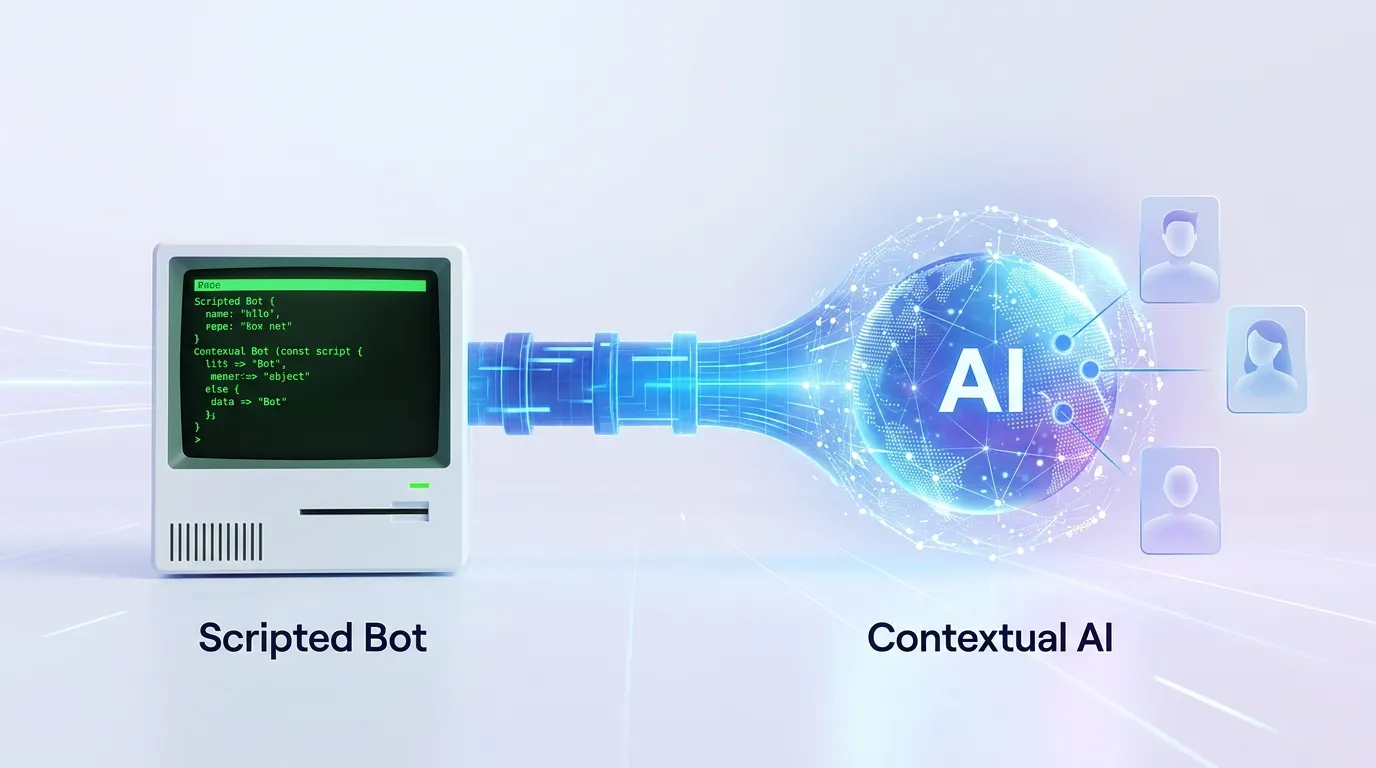
Bots for customer engagement help businesses connect with customers through personalized, real-time conversations. They can answer questions, recommend products, collect feedback, and automate support tasks while improving the overall customer experience.
What Are Bots for Customer Engagement?

Bots for customer engagement are software tools designed to communicate with customers through websites, messaging apps, social media, and other digital channels. They can answer questions, provide information, recommend products, collect customer feedback, and guide users toward specific actions.
Traditional chatbots typically rely on predefined rules and scripted responses. Modern AI-powered systems can understand natural language, recognize customer intent, maintain conversational context, and provide more flexible responses. Conversational AI can also support more complex customer-service workflows by connecting conversations with business systems and data.
For businesses, the goal is not simply to automate conversations. The real objective is to make customer interactions faster, more relevant, and more useful while giving human employees more time to handle situations that require personal attention.
How Do Customer Engagement Chatbots Work?
Customer engagement chatbots use conversational interfaces to communicate with customers and respond to their requests. Depending on the technology, a bot may use predefined rules, natural language processing, machine learning, generative AI, or a combination of these technologies.
For example, a customer visiting an online store might ask, “Which running shoes are best for beginners?” The chatbot can understand the question, recommend relevant products, explain their features, and direct the customer to a product page.
A support chatbot might handle a different interaction. A customer could ask about an order, and the bot could retrieve information from the company’s systems and provide an update.
Modern AI systems are increasingly moving beyond answering questions toward helping customers complete tasks. Recent Gartner research found that 58% of customers who use GenAI have used it to complete a task, showing the growing expectation for AI to do more than simply provide information.
Why Are AI Bots for Customer Engagement Important?
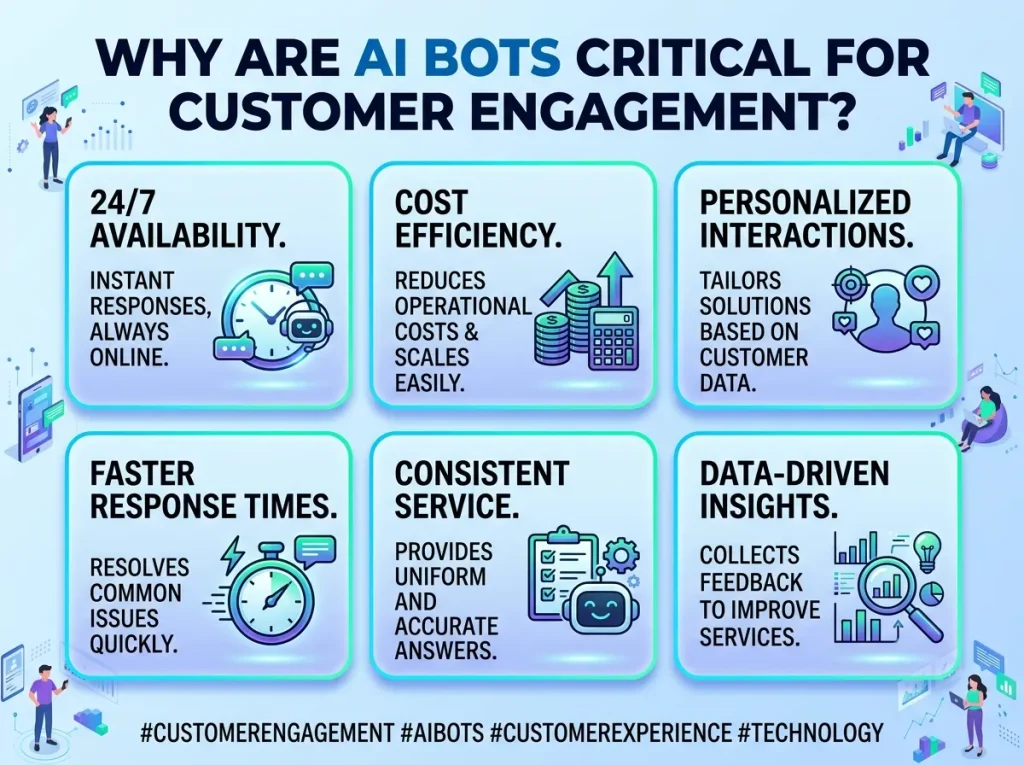
AI bots for customer engagement can help businesses respond to customers more quickly and consistently. Customers increasingly expect convenient digital experiences, and waiting for an email response or human representative can create unnecessary friction.
One of the biggest advantages is availability. A chatbot can respond outside normal business hours, allowing customers to receive assistance whenever they need it. Chatbots can also handle multiple conversations simultaneously, which can be difficult for human teams during periods of high demand.
AI bots can also help businesses personalize interactions. When connected to appropriate customer and product information, they can use conversation context to provide more relevant answers, recommendations, and guidance.
However, businesses should not view automation as a replacement for human support in every situation. Customers still value access to human agents, particularly when a problem is complicated or sensitive. Gartner reported in 2026 that 87% of customers believe companies using GenAI for customer service should provide access to a human agent.
Customer Engagement Automation
Customer engagement automation allows businesses to automate repetitive interactions while keeping customers connected with the brand.
For example, a company can use automation to answer frequently asked questions, send order updates, remind customers about abandoned carts, collect feedback, qualify leads, or provide information about products and services.
Automation can also help marketing teams create more timely interactions. A visitor who spends time viewing a particular product could receive assistance from a chatbot asking whether they need help. Similarly, a returning customer might receive personalized recommendations based on their current conversation.
The most effective approach is to automate tasks where speed and consistency are valuable while giving customers an easy way to reach a human when necessary.
AI Chatbot for Customer Interaction
An AI chatbot for customer interaction can support customers throughout different stages of their relationship with a business.
During the awareness stage, a chatbot can answer basic questions and introduce customers to products or services. During the consideration stage, it can provide comparisons, recommendations, pricing information, and product details. For ecommerce businesses, chatbot interactions can also work alongside paid advertising efforts. Understanding Facebook Ads Metrics Explained can help marketers evaluate how advertising campaigns perform and identify opportunities to improve customer acquisition.
After a purchase, the same chatbot can help with order tracking, delivery questions, returns, troubleshooting, and account-related requests.
This makes the chatbot more than a customer service tool. It can become part of the complete customer journey.
For example, an ecommerce chatbot could ask what type of product a customer is looking for, understand their preferences, recommend several options, answer questions about shipping, and guide them toward checkout. Businesses can also combine chatbot interactions with an Affiliate Marketing for Ecommerce strategy to support product discovery, referrals, and additional sales opportunities.
The quality of these interactions depends heavily on the information available to the AI system. Research published in 2026 found that information quality and problem-solving capability are important factors in chatbot satisfaction, highlighting why accurate knowledge and effective resolution matter more than simply making a bot sound human.
Conversational AI for Customer Engagement
Conversational AI for customer engagement uses technologies such as natural language processing and machine learning to create more flexible customer conversations.
Unlike a basic rule-based chatbot that may only recognize specific commands, conversational AI can interpret different ways of asking the same question. This makes interactions feel more natural and allows customers to communicate using everyday language.
For example, customers might ask:
- “Where’s my order?”
- “Can you tell me when my package arrives?”
- “What’s the status of my delivery?”
A well-designed conversational AI system can understand that these requests have a similar intent.
Conversational AI can also connect with customer service platforms, CRM systems, ecommerce platforms, knowledge bases, and other business applications. This allows the system to provide more useful responses instead of relying only on generic information.
The real value comes when AI is connected to the underlying business processes. A conversational interface that cannot access relevant information or complete useful actions may create a better-looking conversation without actually improving the customer experience.
Chatbots for Customer Communication
Chatbots for customer communication can help businesses maintain consistent communication across multiple digital channels.
Companies can use bots on websites, mobile applications, social media, messaging platforms, and other customer-facing channels. This gives customers more ways to interact with a business without requiring employees to manually respond to every basic question.
For example, a travel company could use chatbots to answer questions about destinations, booking requirements, and cancellation policies. A software company could use a bot to explain features, guide users through setup, and direct technical issues to support specialists.
Businesses can also use chatbots to collect information before transferring a conversation to a human agent. Instead of asking customers to repeat their problem, the agent can receive the conversation history and relevant details.
This creates a smoother transition between automated and human support.
Automated Customer Engagement
Automated customer engagement can help businesses remain responsive even when their teams are unavailable.
A chatbot can welcome website visitors, answer common questions, collect contact information, recommend relevant resources, and route conversations according to customer needs.
Automation is particularly useful for repetitive questions. If hundreds of customers ask about shipping times, return policies, pricing, or business hours, a chatbot can provide immediate answers without requiring an employee to handle every conversation individually.
This can reduce repetitive workloads and allow customer service teams to focus on more complicated cases.
However, automation should be carefully designed. A poorly configured bot that repeatedly gives irrelevant answers can create frustration instead of engagement. Businesses should monitor conversations, identify common failures, update their knowledge base, and provide a clear human escalation option.
AI-Powered Customer Engagement
AI-powered customer engagement goes beyond simple automated replies by using customer information, conversation history, and business data to make interactions more relevant.
For example, an ecommerce business might use AI to recommend products based on what a customer is currently discussing. A subscription business could use customer history to answer account-related questions. A SaaS company might use an AI assistant to guide users through features based on their specific needs.
Businesses can also combine AI chatbots with AI Chatbot for Marketing to automate marketing conversations, support lead generation, answer customer questions, and guide prospects toward relevant products or services.
Personalization can make conversations more useful, but businesses should also consider privacy and transparency. Customers need to understand how their information is being used, particularly when AI systems access personal or account-related data.
Recent research also indicates that perceived privacy risk can negatively affect engagement with AI chatbots. Therefore, successful AI-powered engagement requires a balance between personalization, usefulness, security, and customer trust.
Customer Engagement Chatbot Software: What to Look For
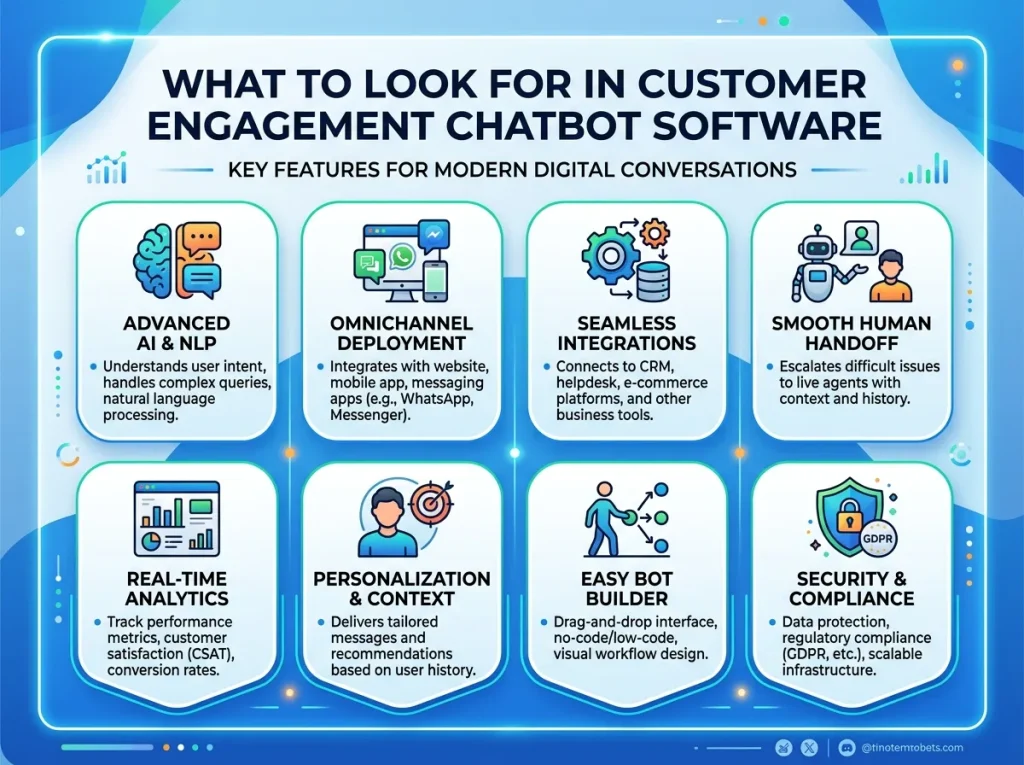
Choosing the right customer engagement chatbot software requires more than comparing the number of features.
Businesses should first identify the problems they want the chatbot to solve. A company primarily interested in answering FAQs may need a simpler system, while a business looking to automate customer journeys may require integrations with CRM, ecommerce, support, and marketing platforms.
Important capabilities can include natural-language understanding, knowledge-base integration, conversation analytics, CRM integration, human handoff, multilingual support, personalization, automation workflows, and reporting.
Businesses can also explore Hyper-Personalization at Scale to understand how AI-driven chatbot strategies can create more relevant conversations and personalized customer experiences across larger audiences.
Integration is particularly important. A chatbot that operates separately from the rest of your business systems may have limited access to the information required to solve customer problems.
Businesses should also evaluate how easily employees can update the bot’s knowledge and review conversations. Regular monitoring is essential because customer questions, products, policies, and business processes change over time.
Chatbots for Improving Customer Experience
Chatbots for improving customer experience should focus on making interactions easier rather than simply reducing human workload.
Speed is one important factor. Customers generally appreciate receiving immediate answers to simple questions instead of waiting in a queue.
Convenience is another. A customer should be able to ask a question naturally without navigating through complicated menus.
Personalization can also improve the experience when it is used appropriately. A chatbot that understands the context of a conversation can provide more useful answers than one that responds with generic information. Businesses looking to improve this area can also explore Chatbot Personalization to understand how personalized chatbot experiences can support customer satisfaction and conversions.
Consistency matters as well. A chatbot can provide standardized information across different interactions, helping reduce situations where customers receive conflicting answers.
But customer experience should remain the priority. A chatbot that prevents customers from reaching a human representative when necessary can damage trust. The best chatbot experiences combine automation with human support so customers can receive personal assistance when automation is not sufficient.
How to Implement Bots for Customer Engagement
Implementing bots for customer engagement should begin with a clear objective. Businesses should first determine which customer interactions they want to improve and what role the chatbot will play in the overall customer experience.
Instead of trying to automate every possible interaction, identify the most common and valuable customer requests. These might include product questions, order tracking, appointment scheduling, lead qualification, technical support, or account assistance.
Next, collect the information the chatbot needs to provide accurate answers. This may include FAQs, product documentation, policies, support articles, pricing information, and customer service data.
The next step is integration. Connect the chatbot to the systems required to retrieve information or perform actions. For example, an ecommerce chatbot may need access to product catalogs, customer accounts, and order systems. It can also support an Affiliate Marketing for Ecommerce strategy by helping customers discover relevant products and guiding them toward suitable purchasing options.
Businesses should then define escalation rules. Some conversations should automatically move to human agents, particularly when the customer is frustrated, the request is complex, or the issue involves sensitive information.
Finally, monitor performance after launch. Review conversation logs, unanswered questions, customer feedback, resolution rates, and escalation rates. Use these insights to continuously improve the chatbot and create more useful customer interactions.
Measuring Customer Engagement Chatbot Performance
The success of a chatbot should be measured using metrics connected to business and customer objectives.
Useful metrics can include conversation volume, response time, engagement rate, resolution rate, customer satisfaction, conversion rate, lead generation, and human-agent escalation rate.
For marketing-focused chatbots, businesses may also track qualified leads, product recommendations, appointments, and sales generated through conversations.
For customer service, resolution rate and customer satisfaction may be more important.
It is also useful to analyze failed conversations. If customers frequently ask questions the chatbot cannot answer, that indicates a knowledge or integration gap.
The objective should not simply be to maximize automation. A chatbot that resolves fewer conversations but creates higher customer satisfaction may be more valuable than one that attempts to automate everything.
Best Practices for Using Bots for Customer Engagement
The most effective chatbot strategies focus on usefulness, clarity, and customer choice.
Start conversations when there is a reasonable opportunity to help, rather than interrupting customers unnecessarily. Keep responses clear and relevant, and avoid overwhelming users with large amounts of information.
Make the chatbot’s identity clear. Customers should understand when they are interacting with AI and how they can request human assistance.
Keep the knowledge base accurate and updated. Outdated information can quickly reduce trust in the system.
Businesses should also monitor customer sentiment and feedback. If users repeatedly express frustration, investigate the cause instead of simply increasing automation.
Finally, connect chatbot performance with broader customer experience goals. The purpose of a chatbot is not merely to produce more automated conversations. It should help customers accomplish what they came to do.
Conclusion
Bots for customer engagement are becoming an important part of modern customer experience strategies. Businesses can use them to provide faster communication, automate repetitive interactions, personalize conversations, generate leads, and support customers around the clock.
However, successful customer engagement requires more than deploying an AI chatbot. Businesses need accurate information, useful integrations, thoughtful conversation design, reliable analytics, privacy protections, and clear human escalation.
The strongest approach combines automation with human support. AI can handle routine interactions and help customers complete simple tasks, while human agents remain available for complex or sensitive situations.
When implemented around customer needs rather than automation alone, customer engagement chatbots can become a valuable part of a broader strategy for improving communication, satisfaction, and long-term customer relationships.
Frequently Asked Questions
What are bots for customer engagement?
Bots for customer engagement are automated tools that communicate with customers through digital channels. They can answer questions, provide recommendations, collect information, and offer support.
How do customer engagement chatbots improve customer service?
They provide quick, 24/7 answers to common questions and can handle multiple conversations at once, reducing repetitive work for support teams.
What is the difference between a chatbot and conversational AI?
Traditional chatbots often follow predefined rules, while conversational AI uses technologies such as natural language processing to understand intent and provide more flexible responses.
Can AI bots for customer engagement replace human agents?
AI bots can handle routine requests, but human agents are still important for complex or sensitive issues. Customers should have an easy option to reach a human when needed.
What businesses can use customer engagement chatbots?
Ecommerce, SaaS, finance, healthcare, travel, education, and professional service businesses can all use chatbots to improve customer communication and support.
What can an AI chatbot for customer interaction do?
It can answer questions, recommend products, collect leads, provide updates, schedule appointments, troubleshoot problems, and connect customers with the right team.
How does conversational AI improve customer engagement?
Conversational AI can understand natural language, maintain context, and provide relevant responses, creating faster and more personalized customer interactions.
What features should customer engagement chatbot software have?
Useful features include AI-powered responses, integrations, analytics, personalization, automation, conversation history, and human handoff.
How can businesses measure automated customer engagement?
Businesses can track response time, conversation volume, resolution rate, customer satisfaction, conversions, leads, and escalation rates.
Are chatbots good for improving customer experience?
Yes. Chatbots for improving customer experience can provide faster answers, self-service options, consistent information, and 24/7 support while allowing human assistance when necessary.








[…] businesses interested in improving customer interactions, Bots for Customer Engagement provides additional information about using bots to engage […]
[…] can also learn more about effective customer engagement by exploring Bots for Customer Engagement, particularly when planning how automated conversations can support broader engagement […]