
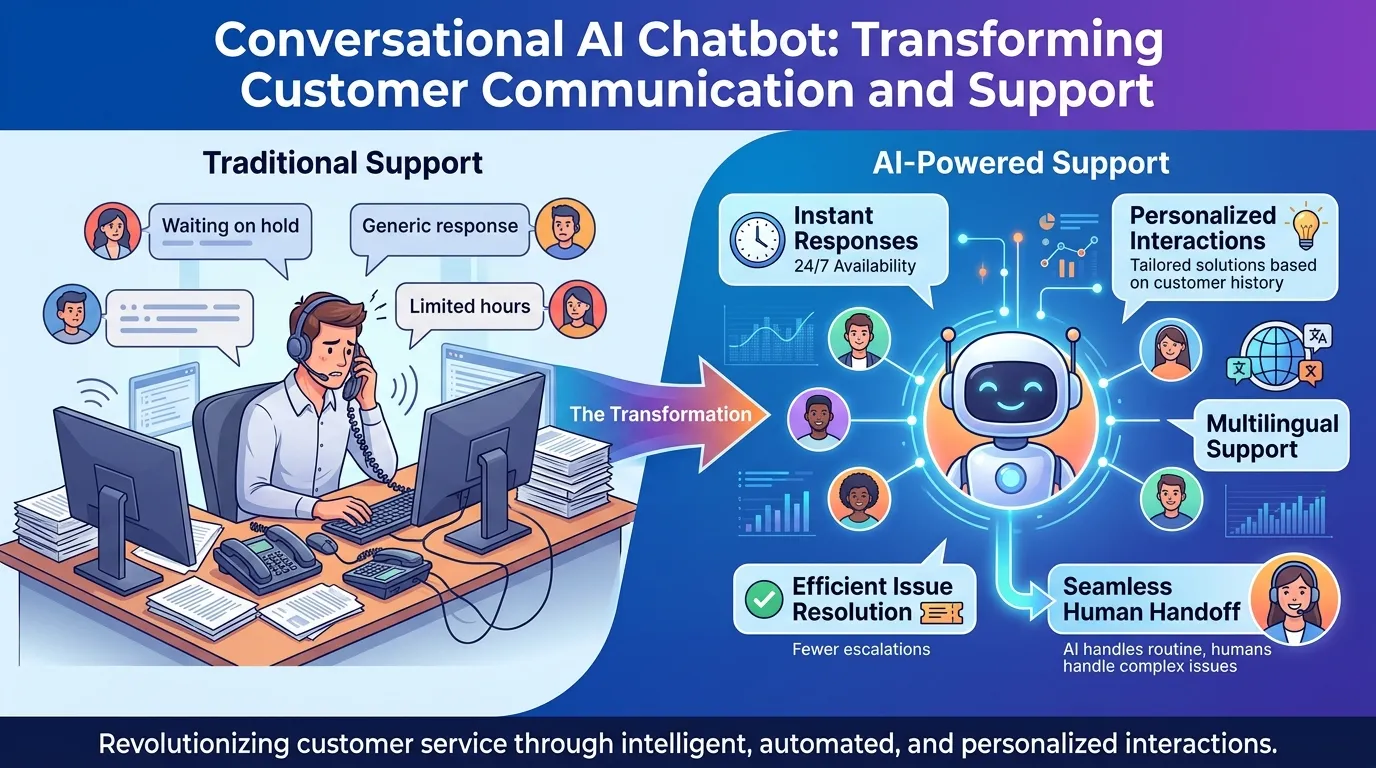
A conversational AI chatbot helps businesses deliver faster and more personalized communication. By combining AI customer service, chatbot automation, virtual assistants, and conversational marketing, businesses can improve support, engagement, lead generation, and efficiency while maintaining accurate information and human support.
A conversational AI chatbot is changing the way businesses communicate with customers across websites, applications, messaging platforms, and digital services. Unlike traditional chatbots that rely primarily on predefined commands and fixed responses, conversational AI can understand natural language, interpret user intent, maintain context, and provide more relevant responses.
As customers increasingly expect fast and convenient communication, businesses are looking for ways to provide assistance without requiring customers to wait for a human representative. Conversational AI can help address this demand by providing immediate responses while allowing human support teams to focus on more complex conversations.
The technology has applications across customer service, sales, marketing, ecommerce, financial services, healthcare administration, education, travel, and many other industries. Its value comes not simply from automating conversations but from creating more useful and personalized interactions.
Understanding Conversational AI Chatbot Technology
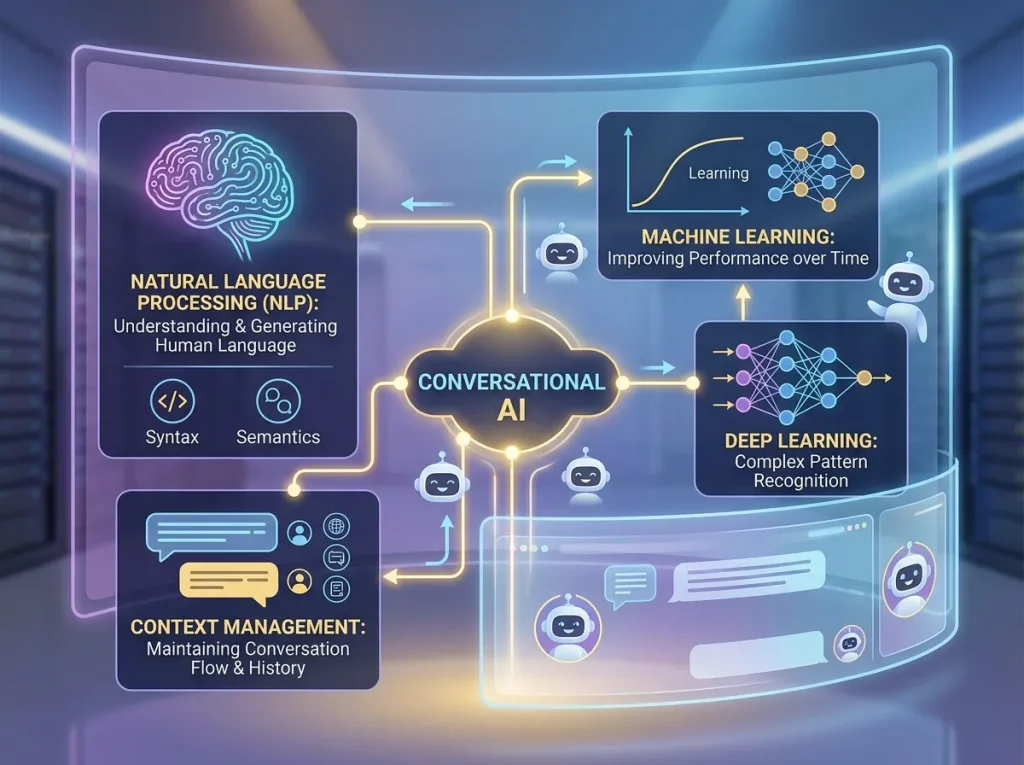
A conversational AI chatbot uses artificial intelligence, natural language processing, machine learning, and related technologies to communicate with users through conversational interfaces.
Traditional automated systems may require customers to select specific options or use particular phrases. Conversational systems are designed to understand more natural requests. A customer might ask a question in several different ways while still receiving an appropriate response.
Context is another important capability. Instead of treating every message as completely independent, modern systems can use information from the conversation to understand what the customer is discussing.
For businesses, this can create a more natural communication experience while reducing the amount of repetitive work handled manually by support teams.
AI Chatbot for Customer Service
An AI chatbot for customer service can provide immediate assistance with common customer questions and routine requests. Customers may use a chatbot to ask about product information, order status, account processes, appointment details, availability, policies, or other frequently requested information.
The chatbot can operate outside traditional business hours, allowing customers to receive assistance when human agents are unavailable.
This does not mean that every customer interaction should be automated. Complex issues, sensitive situations, complaints, and cases requiring human judgment may still need to be transferred to support representatives.
A well-designed customer service chatbot therefore works alongside human agents rather than attempting to replace every aspect of customer support.
The Growth of Conversational AI Solutions
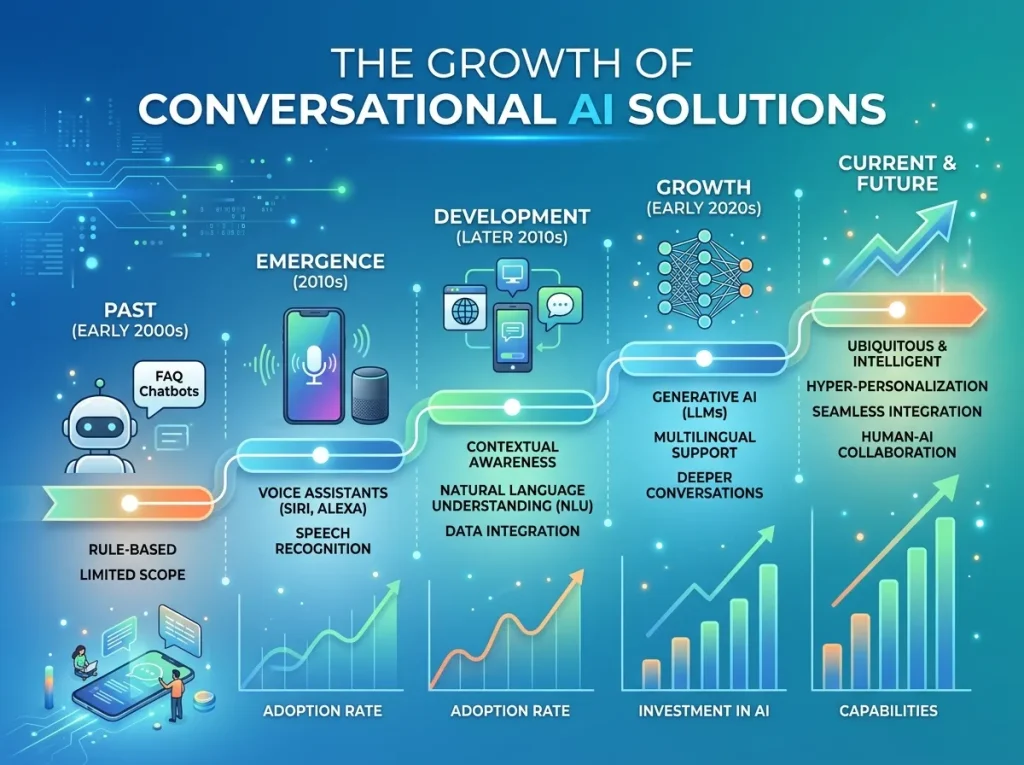
Conversational AI solutions have expanded beyond simple question-and-answer systems. Businesses can now integrate conversational interfaces with customer databases, knowledge bases, CRM platforms, ecommerce systems, scheduling tools, and other business applications.
This integration allows a chatbot to do more than provide generic information.
For example, a conversational system connected to an appropriate business platform may be able to help a customer find information about an order, schedule an appointment, locate a relevant service, or direct a request to the correct department.
The quality of these experiences depends heavily on integration, data accuracy, system design, security, and the quality of the underlying knowledge.
Businesses should therefore evaluate conversational AI as part of their broader digital infrastructure rather than treating it as an isolated chat window.
AI-Powered Chatbot and Personalization
An AI-powered chatbot can create more personalized conversations by considering context, customer preferences, previous interactions, and the information available within authorized business systems.
Personalization can make digital interactions more relevant. Instead of providing the same response to every visitor, the chatbot can adapt its communication to the user’s question and circumstances.
For example, a returning customer may need assistance with an existing product, while a new visitor may need basic information before making a purchase.
However, personalization needs to be handled responsibly. Businesses should be transparent about how customer information is used and should avoid collecting unnecessary personal information.
Trust is essential because customers may be reluctant to interact with systems that appear intrusive or unclear about how their information is handled. This is particularly important when conversational AI is used in specialized environments, such as AI chatbots for health apps, where users may expect additional care around sensitive information and communication.
Intelligent Chatbot Technology
Intelligent chatbot technology is designed to understand intent rather than simply match keywords. Natural language understanding allows a system to interpret variations in language and identify what the user is actually trying to accomplish.
For instance, customers might ask, “Where is my order?”, “Can you tell me when my package will arrive?”, or “I need an update on my delivery.” Although the wording is different, the underlying intent may be similar.
Modern systems can also use conversation context to reduce unnecessary repetition. If a customer has already explained their issue, the system should ideally avoid asking the same question repeatedly.
This creates a smoother experience and can reduce frustration during customer interactions.
Natural Language Chatbot Experiences
A natural language chatbot allows customers to communicate using everyday language rather than rigid commands.
Natural language interaction is particularly useful when customers do not know exactly which category their question belongs to. They can simply describe what they need and allow the system to determine the appropriate response.
The quality of natural language interaction depends on factors such as language understanding, context management, knowledge quality, response generation, and conversation design.
Businesses should also account for spelling mistakes, abbreviations, different writing styles, and ambiguous questions. Multilingual capabilities can further expand the usefulness of conversational systems, particularly when AI-NLP chatbot translation is used to support communication across different languages.
When the system cannot confidently determine the customer’s intent, it should ask a clear clarification question or provide a suitable path to human assistance instead of confidently providing an incorrect answer.
AI Customer Support Chatbot
An AI customer support chatbot can help support teams manage high volumes of routine conversations. This can be particularly valuable for companies that receive similar questions repeatedly.
A chatbot can provide information from an approved knowledge base and help customers find relevant resources without requiring a support agent to manually answer every basic question.
This can improve operational efficiency and allow human agents to dedicate more time to complicated cases.
AI support can also assist agents directly. Instead of communicating with the customer independently, an AI system can summarize conversations, suggest responses, locate relevant information, or help categorize requests.
This creates another important use case for conversational AI: augmenting human support rather than replacing it.
Automated Customer Service
Automated customer service can provide faster access to information while reducing the workload associated with repetitive support requests.
Customers increasingly expect businesses to respond quickly. Long waiting periods can negatively affect satisfaction, particularly when the customer’s question is relatively simple.
Automation can address routine interactions immediately. Customers may receive answers without waiting in a queue, while support teams can focus their attention on cases requiring empathy, investigation, or specialized knowledge.
Automation should nevertheless be designed around customer needs. If a customer is repeatedly forced through an automated system without being able to reach a person, the experience can become frustrating.
Effective automation therefore includes clear escalation paths and an appropriate balance between self-service and human support.
Chatbot Automation Across the Customer Journey
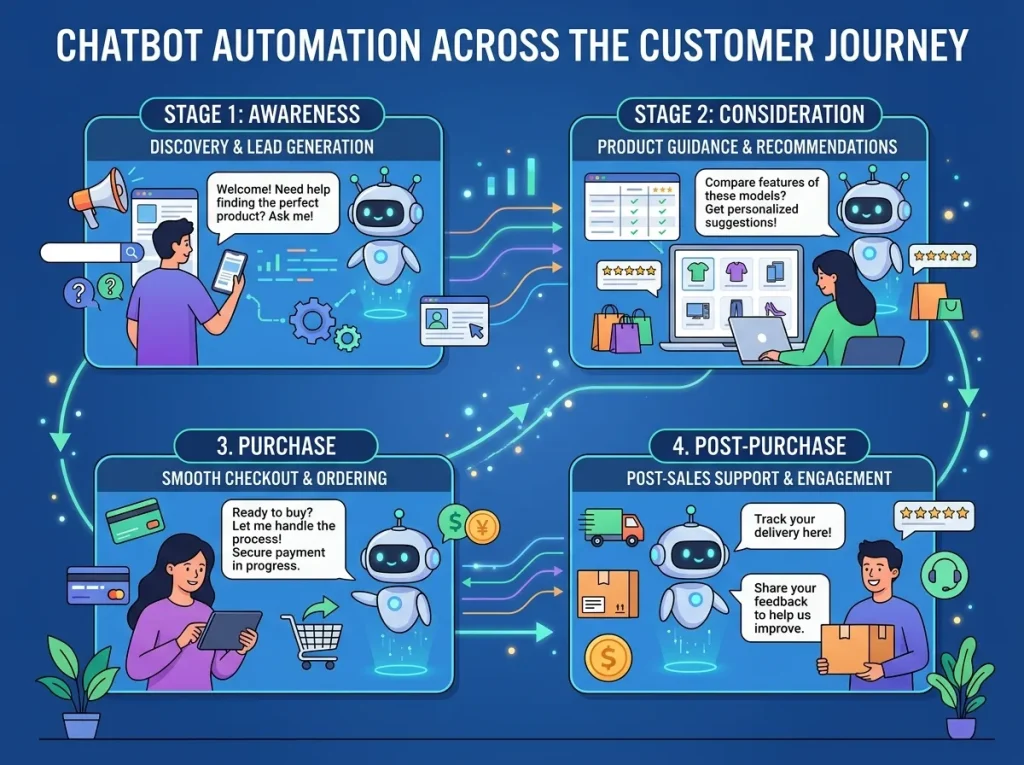
Chatbot automation can support customers at multiple stages of their relationship with a business.
During the awareness stage, a chatbot can answer questions about products or services and direct visitors toward useful resources. During consideration, it can provide comparisons, explain features, or help users identify relevant options.
During the purchasing process, a chatbot may assist with product discovery, common questions, or navigation. After purchase, it can provide support information, help locate resources, or direct customers toward appropriate service channels.
This makes conversational AI more than a customer support technology. It can become part of the broader customer experience.
AI Virtual Assistant and Business Productivity
An AI virtual assistant can support both external customers and internal employees. Customer-facing assistants can handle questions and service requests, while internal assistants can help employees locate company information, understand procedures, or complete routine tasks.
For employees, conversational interfaces can make information easier to access. Instead of searching through multiple documents or systems, an employee can ask a natural-language question and receive a relevant response from approved information sources.
Internal use cases can include HR questions, IT support, policy information, knowledge management, onboarding, and operational assistance.
The effectiveness of these applications depends on the accuracy and accessibility of the organization’s information. Similar conversational applications are also being explored in education, including chatbots in virtual classrooms, where AI can help students access information and interact with digital learning environments.
Conversational Marketing Chatbot
A conversational marketing chatbot can support engagement and lead generation by interacting with website visitors in real time.
Instead of relying exclusively on static forms, businesses can use conversational experiences to ask visitors about their needs and provide relevant information.
For example, a visitor interested in a particular service might interact with a chatbot that explains the service, answers common questions, and directs the visitor toward a consultation or contact opportunity.
Conversational marketing can also help qualify leads by collecting relevant information and identifying whether a visitor may be a suitable prospect.
However, the conversation should provide value rather than feel like an aggressive sales form disguised as a chatbot.
Conversational AI and Lead Generation
Lead generation is another important application of conversational AI. Traditional lead forms often require visitors to complete multiple fields before submitting their information.
A conversational experience can make the interaction more dynamic by asking relevant questions progressively.
The system may determine what information is necessary based on the user’s responses. This can make the process feel more natural and potentially reduce unnecessary friction.
Businesses can also use conversational interactions to identify high-intent prospects. Someone asking detailed questions about pricing, implementation, availability, or product capabilities may demonstrate stronger purchasing intent than someone simply browsing general information.
These signals can support sales teams when used appropriately. Predictive technologies can further strengthen this process by helping marketers identify conversion opportunities, as discussed in predictive AI for conversion rate optimization.
Improving Customer Engagement
Customer engagement depends on relevance, convenience, and the quality of interaction. A conversational AI chatbot can provide another channel through which customers communicate with a business.
Unlike static content, conversational systems allow customers to ask follow-up questions and explore information based on their individual needs.
This interactive nature can make websites and digital services feel more responsive.
Engagement becomes more valuable when the chatbot can connect customers with useful content, products, services, support resources, or human representatives.
The objective should be to make the customer’s journey easier rather than simply increase the number of chatbot conversations.
Human Agents and Conversational AI
The most effective conversational AI strategies usually recognize the importance of human involvement.
AI systems are well suited to repetitive questions, information retrieval, basic qualification, and routine processes. Human agents remain valuable for situations involving complex reasoning, emotional sensitivity, exceptions, negotiations, complaints, and specialized expertise.
A strong handoff process can connect these two capabilities. When escalation occurs, the human agent should ideally receive enough conversation context to understand the customer’s issue without requiring the customer to start over.
This creates a hybrid support environment where AI handles appropriate tasks while humans remain available when their involvement provides greater value.
Data, Accuracy, and Trust
A conversational system is only as useful as the information behind it. Incorrect, outdated, or incomplete knowledge can result in inaccurate responses.
Businesses should maintain reliable knowledge sources and establish processes for updating information. Product details, pricing, policies, availability, service information, and other frequently changing data should be carefully managed.
Trust is particularly important because customers may assume that a confident AI response is accurate.
For this reason, conversational systems should communicate uncertainty appropriately and avoid presenting unsupported information as fact.
Businesses should also consider privacy, security, access controls, and data governance when integrating AI with customer information.
Measuring Conversational AI Performance
Businesses can measure conversational AI performance using both operational and customer-focused metrics.
Response time, conversation volume, resolution rate, escalation rate, customer satisfaction, lead conversion, abandoned conversations, and successful self-service interactions can provide useful insights.
The right metrics depend on the purpose of the chatbot. A customer support system may prioritize resolution and satisfaction, while a marketing chatbot may focus more heavily on qualified leads and conversion.
Conversation analysis can also reveal common customer questions and points of friction. These insights can inform website content, product development, support documentation, and broader marketing decisions.
Performance should therefore be evaluated as part of the overall customer journey rather than simply by counting chatbot interactions.
The Future of Conversational AI Chatbot Technology
The future of the conversational AI chatbot will likely involve increasingly natural interactions, better contextual understanding, multimodal communication, deeper business-system integration, and more personalized experiences.
Customers may increasingly interact with businesses through conversational interfaces that combine text, voice, images, documents, and other forms of information.
AI assistants may also become more capable of completing tasks rather than simply answering questions. This could make conversational interfaces more closely connected to business workflows.
At the same time, responsible AI practices will remain important. Businesses will need to focus on accuracy, transparency, privacy, security, accessibility, and appropriate human oversight.
The goal should not be to automate communication simply because automation is possible. The goal should be to create better experiences while making business operations more efficient.
Conclusion
A conversational AI chatbot can transform customer communication by making digital interactions faster, more accessible, and more personalized. From customer support and automated service to marketing, lead generation, and virtual assistance, conversational AI has applications across many areas of the customer experience.
An AI chatbot for customer service can handle routine questions, while an AI-powered chatbot can create more context-aware interactions. Natural language chatbot technology makes communication more intuitive, and chatbot automation can reduce repetitive workloads.
At the same time, businesses should recognize that successful conversational AI depends on more than advanced technology. Accurate information, thoughtful conversation design, responsible data practices, appropriate automation, and strong human escalation are equally important.
When these elements work together, conversational AI can become a valuable part of a modern customer experience strategy, helping businesses communicate more effectively while giving customers faster and more convenient access to information and support.
Frequently Asked Questions
1. What is a conversational AI chatbot?
A conversational AI chatbot is an artificial intelligence system designed to communicate with users using natural language. It can understand questions, interpret intent, maintain conversation context, and provide relevant responses.
2. How does an AI chatbot for customer service work?
An AI chatbot for customer service uses conversational AI to understand customer questions and provide information or assistance. It can handle routine requests and transfer more complex cases to human support agents.
3. What is the difference between a traditional chatbot and conversational AI?
Traditional chatbots often depend heavily on predefined commands, rules, or menus. Conversational AI can understand more natural language, interpret intent, maintain context, and generate more flexible responses.
4. Can conversational AI replace human customer service agents?
Conversational AI can automate many routine interactions, but it does not need to replace human agents entirely. Human support remains valuable for complex, sensitive, unusual, or emotionally demanding situations.
5. What is an AI-powered chatbot used for?
An AI-powered chatbot can support customer service, lead generation, product discovery, appointment scheduling, frequently asked questions, internal employee assistance, marketing engagement, and other conversational tasks.
6. What is a natural language chatbot?
A natural language chatbot allows users to communicate using everyday language instead of requiring specific commands. It uses language understanding technology to interpret the meaning and intent of user messages.
7. How can chatbot automation improve customer service?
Chatbot automation can provide immediate answers to common questions, reduce repetitive work for support teams, provide assistance outside normal business hours, and help customers access information more quickly.
8. What is a conversational marketing chatbot?
A conversational marketing chatbot engages website visitors through interactive conversations. It can answer questions, recommend relevant information, qualify potential leads, and direct prospects toward appropriate conversion opportunities.
9. How can businesses measure chatbot performance?
Businesses can evaluate chatbot performance using metrics such as resolution rate, customer satisfaction, response time, escalation rate, lead conversion, conversation abandonment, and successful self-service interactions.
10. What makes a conversational AI chatbot successful?
A successful conversational AI chatbot combines accurate information, natural communication, useful integrations, appropriate automation, strong privacy practices, clear escalation to human support, and a customer-focused experience.







[…] useful example of this technology is a Conversational AI Chatbot that can support customer communication while helping businesses handle common inquiries more […]